In healthy tissue, the neighborhood usually has zoning laws - cells mind their business, utilities run on time, and nobody builds a nightclub in a cul-de-sac. Tumors, meanwhile, are the part of town where the streetlights flicker, the permits are fake, and some very suspicious chemistry keeps happening behind boarded-up windows. A new review in Chemical Society Reviews looks at a strange but increasingly interesting way to exploit that chaos: using self-assembling nanomaterials to trigger cuproptosis, a copper-dependent form of cell death, for cancer therapy and imaging.1
Before anybody starts printing "cancer cured by copper" on a T-shirt, let's slow our roll. This is a review article, not a clinical trial, and a lot of the work it discusses sits in the preclinical world - mice, cells, clever materials, and scientists doing the molecular equivalent of building tiny booby traps. Still, the idea is worth your attention because it tackles one of cancer medicine's oldest headaches: how do you hit tumors hard without turning the rest of the body into collateral damage?
Copper: Helpful nutrient, terrible roommate
Copper is not some comic-book villain metal. Your body actually needs it. It helps enzymes do their jobs and keeps basic cellular machinery humming along. But like caffeine, fireworks, or replying-all, dose and context matter.
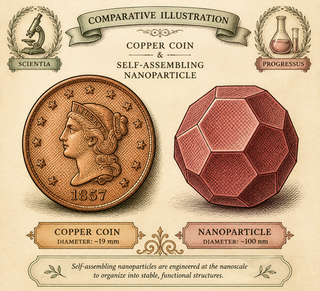
Cuproptosis is a recently described form of programmed cell death in which excess copper disrupts key processes in mitochondria - the cell's energy factories - especially in cells that rely heavily on certain metabolic pathways.2 The short version: too much copper in the wrong place can cause proteins involved in energy metabolism to clump up and stress the cell to death.
Cancer researchers like this because some tumors have altered copper handling and unusual metabolic habits. In theory, that creates an opening. If you can deliver copper, or a copper-activating system, preferentially to tumor tissue, you might shove cancer cells over a biochemical cliff while sparing healthier neighbors.
That "if," of course, is doing the heavy lifting of an Olympic powerlifter.
Tiny delivery crews with trust issues
This is where self-assembly comes in. Self-assembling nanoplatforms are materials designed so their components spontaneously organize into useful structures - nanoparticles, micelles, coordination complexes, and other tiny delivery vehicles. Think IKEA furniture, except it builds itself and ideally doesn't leave you with three mysterious screws and existential dread.
The review by Wang and colleagues focuses on systems that stay relatively stable while circulating, then change shape, fall apart, or switch on when they hit tumor-specific conditions.1 Those conditions can include acidic pH, high glutathione levels, reactive oxygen species, enzymes, light, ultrasound, or other internal and external triggers.
Why all the drama? Because tumors are messy environments. They often differ from normal tissue in acidity, redox balance, oxygen levels, and vascular structure. Researchers are trying to turn that mess into a targeting system. The nanosystem cruises quietly, reaches the tumor's sketchy neighborhood, notices the bad plumbing and weird electrical wiring, and says, "Ah yes, this is my stop."
Why not just dump in copper and hope for the best?
Because "hope for the best" is not a recognized drug-delivery platform, and copper in the wrong tissues can be toxic. The whole field hinges on spatiotemporal control - getting the active therapy to the right place at the right time.
According to the review, these self-assembled systems can do several useful things at once:1
- carry copper ions or copper-binding compounds
- respond to tumor-specific triggers
- combine cuproptosis with other treatments like chemotherapy, phototherapy, or immunotherapy
- include imaging functions so researchers can track where the material goes and whether it's doing anything useful
That last part matters more than it sounds. Cancer treatment would love fewer "we think it's working?" moments. If the same platform helps visualize drug delivery while also treating the tumor, that's a neat two-for-one.
The cool part - and the part where I squint a little
The cool part is that cuproptosis offers a mechanism different from the usual apoptosis-heavy script. Cancer cells are notorious little escape artists. Give them one death pathway and some of them start looking for an emergency exit. Expanding the menu of ways to kill them is a smart move, at least on paper.
Recent reviews have framed cuproptosis as a potentially important addition to cancer biology, especially because it links metal homeostasis, mitochondrial metabolism, and therapy design.23 There is also growing interest in nanomedicine strategies that exploit tumor microenvironment cues for precision drug release.45
Now the squinting. Preclinical nanomedicine is full of beautiful schematics and tragic translation records. A nanoparticle can look like a genius in a mouse and then behave like a confused tourist in humans. Tumor heterogeneity also complicates everything. Not every cancer has the same copper metabolism, the same microenvironment, or the same vulnerability to this pathway. And manufacturing complex self-assembling systems at clinical grade is not exactly a weekend craft project.
So yes, promising. Also yes, plenty of room for reality to throw a folding chair.
Why this still matters
Even with the caveats, this line of work is interesting because it tries to solve multiple problems at once: specificity, controllability, imaging, and resistance. If future studies confirm that cuproptosis-targeting platforms can selectively stress tumors while limiting normal tissue toxicity, they could become part of more tailored treatment strategies.
Best case, this becomes one more way to make cancer treatment less blunt. Not a magic bullet - oncology has enough of those already, usually announced in headlines that should come with a breathalyzer test - but a smarter toolkit.
For now, the field is still building the map. The neighborhood is weird, the tenants are unruly, and copper is a dangerous contractor. But if researchers can learn how to deploy it with precision, this sketchy block of tumor biology might eventually become a place where cancer cells run out of lease options.
References
Disclaimer: The image accompanying this article is for illustrative purposes only and does not depict actual experimental results, data, or biological mechanisms.
-
Wang Q, Du H, Li X, Hu X, Kang N, Kang H, Li F, Ling D. Self-assembly for cuproptosis-based cancer therapy and imaging. Chem Soc Rev. 2025. doi: 10.1039/D5CS01136A ↩↩↩
-
Ge EJ, Bush AI, Casini A, Cobine PA, Cross JR, DeNicola GM, Dou QP, Franz KJ, Gohil VM, Gupta S, et al. Connecting copper and cancer: from transition metal signalling to metalloplasia. Nat Rev Cancer. 2022;22(2):102-113. doi: 10.1038/s41568-021-00417-2 PMCID: PMC8798920 ↩↩
-
Tsvetkov P, Coy S, Petrova B, Dreishpoon M, Verma A, Abdusamad M, Rossen J, Joesch-Cohen L, Humeidi R, Spangler RD, et al. Copper induces cell death by targeting lipoylated TCA cycle proteins. Science. 2022;375(6586):1254-1261. doi: 10.1126/science.abf0529 PMCID: PMC9287636 ↩
-
Zhang RX, Li J, Zhang T, Amini MA, He C, Lu B, Ren H, Li X, Yao M, Chen Y, et al. Engineering nanoparticles for tumor microenvironment modulation and cancer therapy. Adv Mater. 2024;36(3):e2306319. doi: 10.1002/adma.202306319 ↩
-
Zhang Y, Wang F, Ju E, Liu Z, Ren J, Qu X. Metal-organic-framework-based nanomaterials for biomedical applications. Chem Soc Rev. 2024;53(1):271-320. doi: 10.1039/D3CS00849A ↩