At halftime, fibrolamellar liver cancer has been winning partly because the scoreboard had no numbers on it.
Most cancers come with at least a few measurable breadcrumbs. Prostate cancer has PSA. Some liver cancers raise alpha-fetoprotein. Blood tests may not solve the whole mystery, but they can at least tap the detective on the shoulder and say, “Maybe look over there.”
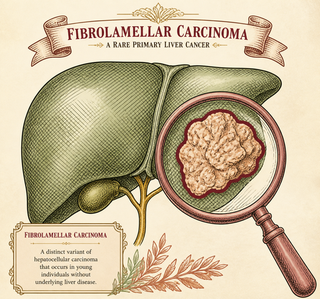
Fibrolamellar carcinoma, or FLC, has been more annoying. It is rare, often strikes young people with otherwise healthy livers, and usually does not come with the standard liver-cancer warning lights blinking. Evolution, being the universe’s least sentimental game designer, handed this tumor a strange genetic engine and then forgot to include a convenient dashboard.
A new study in the Journal of Hepatology suggests that dashboard might finally have a useful gauge: procalcitonin, a blood marker doctors usually associate with bacterial infection, not cancer drama in a healthy-looking liver.
The Weird Little Tumor With A Signature Move
FLC is not your standard hepatocellular carcinoma wearing a different jacket. Most cases carry a characteristic gene fusion called DNAJB1-PRKACA, created when two genes get awkwardly welded together. That fusion appears to drive abnormal protein kinase A signaling, which is a very molecular way of saying the cell’s internal command center starts taking instructions from a suspicious intern with root access.
Researchers have spent the past decade mapping this biology, building models, and even testing immune strategies that target the fusion protein itself. A 2022 roadmap in Nature Reviews Gastroenterology & Hepatology argued that FLC research is now mature enough for smarter trials and better biomarkers, while newer multiomics work has shown that different genetic routes can still converge on the same protein kinase A trouble zone. Cancer evolution loves a theme. It will remix the playlist, but the beat stays ominous.
Procalcitonin Enters Wearing The Wrong Name Tag
Procalcitonin, or PCT, is normally known as a marker that can rise during bacterial infection. It is a precursor of calcitonin, a hormone involved in calcium regulation. In day-to-day medicine, clinicians often think about PCT when they are asking, “Is this infection serious, or is the body just being theatrical again?”
That is why the new FLC finding is so interesting. Nault and colleagues started with an observation in one patient, then tested whether serum PCT might be elevated across a larger FLC group. They measured PCT in 18 patients with FLC, then compared those results with patients who had conventional hepatocellular carcinoma, cholangiocarcinoma, or cirrhosis.
The signal was not subtle. In the European cohort, median serum PCT in FLC was 55.2 μg/L, compared with about 0.11-0.16 μg/L in the comparison groups. Across European and US cohorts, elevated PCT appeared in 83% of FLC cases, versus 3% of HCC and cholangiocarcinoma cases. If biomarkers had facial expressions, this one would be raising both eyebrows.
The Tumor Was Actually Making The Stuff
A blood marker is only useful if you know where it is coming from. Otherwise, you are just chasing smoke and hoping it files paperwork.
The authors dug deeper using RNA sequencing, spatial transcriptomics, and immunohistochemistry. They found that CALCA, the gene encoding procalcitonin-related products, was strongly overexpressed in FLC compared with other liver tumors and non-tumor liver tissue. Spatial transcriptomics localized CALCA expression to the tumor cells themselves. Immunohistochemistry confirmed PCT overexpression in most FLC tumor samples, but not in the other liver cancers tested.
That matters because it argues PCT is not merely a bystander inflammation signal. The tumor cells appear to be flying the flag.
Why This Could Change The Playbook
FLC creates a practical problem: patients may be young, liver tests may look boring, and standard tumor markers may refuse to participate. Imaging and biopsy remain central, but a simple blood test could help clinicians decide when to suspect FLC, track disease over time, and monitor treatment response.
In four patients in this study, PCT changes tracked with radiologic response by RECIST 1.1. That is the kind of finding that makes oncologists lean forward slightly, which is their version of a standing ovation.
If larger prospective studies confirm it, PCT could become a low-friction tool for diagnosis and follow-up. Not a crystal ball. Not a replacement for scans. More like a trail marker in a forest where the trees all look aggressively similar.
There are caveats. The cohort was small because FLC is rare. PCT can rise for reasons that have nothing to do with FLC, especially bacterial infection, severe inflammation, kidney dysfunction, and some cancers. So nobody should see a high PCT and immediately yell “fibrolamellar!” across the emergency department. Medicine already has enough yelling.
But for the right patient - especially a young person with a liver mass, normal usual tumor markers, and no obvious infection - this finding could be genuinely useful. Evolution gave FLC a strange survival trick. Scientists may have found one of its tells.
References
-
Nault JC, Campani C, Hirsch TZ, et al. Serum procalcitonin: A novel tumor biomarker for diagnosis and disease monitoring in fibrolamellar hepatocellular carcinoma. Journal of Hepatology. 2026. doi:10.1016/j.jhep.2026.01.015
-
Dinh TA, Utria AF, Barry KC, et al. A framework for fibrolamellar carcinoma research and clinical trials. Nature Reviews Gastroenterology & Hepatology. 2022;19:328-342. doi:10.1038/s41575-022-00580-3
-
Bauer J, Köhler N, Maringer Y, et al. The oncogenic fusion protein DNAJB1-PRKACA can be specifically targeted by peptide-based immunotherapy in fibrolamellar hepatocellular carcinoma. Nature Communications. 2022;13:6401. doi:10.1038/s41467-022-33746-3
-
Kastenhuber ER, et al. Liver cancer multiomics reveals diverse protein kinase A disruptions convergently produce fibrolamellar hepatocellular carcinoma. Nature Communications. 2024;15:10887. doi:10.1038/s41467-024-55238-2
Disclaimer: The image accompanying this article is for illustrative purposes only and does not depict actual experimental results, data, or biological mechanisms.