When I was a kid, I learned that if you ring the doorbell, hide behind the hedge, and then shout "surprise" five minutes later, the effect is not the same as doing it all at once. Childhood science. Peer reviewed by one annoyed neighbor.
Cancer treatment, apparently, has a similar problem.
A new paper in Signal Transduction and Targeted Therapy looks at triple-negative breast cancer, or TNBC, and asks a very practical question: what if chemotherapy is trying to wake up the immune system and hush it at the same time? Like setting off a fire alarm while handing everyone noise-canceling headphones. Elegant? No. Familiar? Sadly, yes.
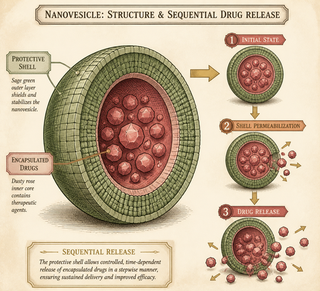
The study by Guo and colleagues built a programmed nanomedicine called R-Gem@Cel-PV to make two drug effects happen in the right place and in the right order: first block an immune-suppressing signal called prostaglandin E2, then trigger tumor cell death that can alert the immune system. Tiny package. Big scheduling energy. [DOI]
Triple-Negative Breast Cancer: The One With Fewer Handles
TNBC gets its name because the cancer cells lack three common treatment targets: estrogen receptor, progesterone receptor, and HER2. In clinic terms, that means fewer obvious buttons to push. No hormonal therapy shortcut. No HER2-targeted shortcut. Just the long hallway with fluorescent lights and several doors marked "maybe."
Immunotherapy has changed the landscape for some patients. Pembrolizumab plus chemotherapy improved outcomes in high-risk early-stage TNBC in KEYNOTE-522, including a 5-year overall survival estimate of 86.6% versus 81.7% with chemotherapy alone. That is not nothing. That is a real number patients and oncologists can sit with. [DOI]
But immunotherapy does not work for everyone. Tumors are not just lumps of misbehaving cells. They are neighborhoods. Some neighborhoods have helpful immune cells hanging around. Others have locked gates, bad lighting, and suspicious myeloid cells smoking outside the loading dock.
Chemo Can Wave a Flag. It Can Also Hide the Flag.
Some chemotherapy can cause immunogenic cell death, or ICD. That means dying cancer cells release distress signals called DAMPs, short for damage-associated molecular patterns. DAMPs are the immune system's version of "something exploded over here, please send competent adults."
Dendritic cells pick up these signals, process tumor material, and help train T cells to recognize cancer. That is the dream. Chemo kills some tumor cells, then the immune system learns the face of the enemy and keeps hunting. Very cinematic. Hans Zimmer optional.
The trouble is that chemotherapy can also increase PGE2, a lipid signal that suppresses immune activity. PGE2 can interfere with dendritic cells, T cells, and natural killer cells, which is rude but biologically on-brand. Reviews over the last few years have described PGE2 as a major immunosuppressive player in cancer and inflammation. [DOI] [DOI]
So the tumor cell dies and sends DAMPs. Good.
It also releases PGE2. Bad.
The immune system receives both messages and responds with the enthusiasm of a pager going off during a power outage.
The New Trick: Block the Brake Before Pressing the Alarm
The authors designed R-Gem@Cel-PV to behave less like a random drug cocktail and more like a timed sequence.
First, the nanovesicle preferentially accumulates in tumor tissue. Then enzymes in the tumor microenvironment help disassemble it. That releases celecoxib, a COX-2 inhibitor, early. Celecoxib reduces PGE2 signaling, meaning the immune brake gets lifted first.
Then comes delayed activation of a gemcitabine prodrug. Gemcitabine kills tumor cells and releases DAMPs later, after the suppressive fog has started to clear.
That sequence matters. Free gemcitabine plus free celecoxib did not recreate the same effect. Which is the part of the paper that makes the tired oncologist in me nod into the wine glass. Biology often cares less about your ingredient list than your choreography.
Using TNBC models, the researchers reported stronger dendritic cell maturation, better CD8-positive T-cell responses, fewer immunosuppressive cell populations, reduced primary tumor growth, and less metastasis with the programmed nanomedicine compared with less controlled approaches. They also used mass spectrometry imaging to show the timing of drug activation inside tumor cells, which is a nice antidote to the usual "trust us, the nanoparticle probably did the thing" energy.
Why This Is Neat, With the Brakes Still On
This is preclinical work. Mouse models and cell systems are not patients. Mice have taught us many useful things, but they have also cured cancer roughly 47,000 times, usually right before disappointing everyone in phase 1.
Still, the concept is sharp.
A lot of cancer therapy focuses on what to give. This paper argues that when and where may be just as important. That fits with a broader push in nanomedicine: use engineered carriers to deliver drugs more precisely, reduce off-target toxicity, and reshape the tumor immune microenvironment rather than just carpet-bombing the body and hoping the cancer files a complaint first. Recent reviews of TNBC nanocarriers and immunogenic cell death make the same larger point: delivery design is becoming part of the therapy, not just packaging. [DOI] [DOI]
If this approach proves reproducible and eventually translates, it could help turn some immune-cold or immune-confused tumors into better targets for T cells. Maybe it could pair with checkpoint inhibitors. Maybe it could make old chemotherapy behave like a better immune partner. Maybe it could spare patients some toxicity by putting more of the action where it belongs.
Many maybes. But useful maybes.
The real message is refreshingly unglamorous: the immune system is not a light switch. It is a committee. A moody committee. If you want it to act, you may need to stop the suppressive memo before sending the emergency alert.
Cancer biology, once again, is a scheduling problem with existential consequences. Very on brand.
References
-
Guo X, Zheng W, Song K, et al. Spatiotemporally programmed nanomedicine engineering to resolve conflicting immunosignals in triple-negative breast cancer. Signal Transduction and Targeted Therapy. 2026;11:215. https://doi.org/10.1038/s41392-026-02685-6
-
Schmid P, Cortes J, Dent R, et al. Overall survival with pembrolizumab in early-stage triple-negative breast cancer. New England Journal of Medicine. 2024. https://doi.org/10.1056/NEJMoa2409932
-
Kalinski P. Prostaglandin E2 in the tumor microenvironment, a convoluted affair mediated by EP receptors 2 and 4. Pharmacological Reviews. 2024. https://doi.org/10.1124/pharmrev.123.000901
-
Patterson C, Hazime KH, Zelenay S, Davis DM. Prostaglandin E2 impacts multiple stages of the natural killer cell antitumor immune response. European Journal of Immunology. 2024;54:e2350635. https://doi.org/10.1002/eji.202350635
-
Saifullah Q, Mondal S, Nandi A, Madhuri Y, Das S, Roy P. Nanotechnology in triple-negative breast cancer: a review of nanocarrier systems for enhanced efficacy and reduced toxicity. Nanoscale Advances. 2026;8:3073-3101. https://doi.org/10.1039/D5NA00907C
-
Galluzzi L, Vitale I, Warren S, et al. Targeting immunogenic cell stress and death for cancer therapy. Nature Reviews Drug Discovery. 2024. https://doi.org/10.1038/s41573-024-00920-9
Disclaimer: The image accompanying this article is for illustrative purposes only and does not depict actual experimental results, data, or biological mechanisms.