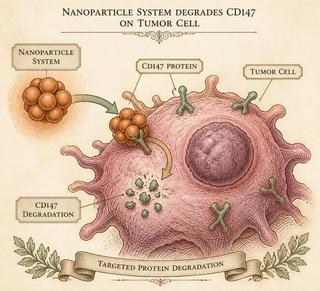
That is basically the bet behind a new Nature Nanotechnology paper on liver cancer - and the data suggest it may be a smart one. Instead of trying to kill tumor cells with one more blunt drug, the researchers built a nanoparticle system that selectively degrades a protein called CD147 inside liver tumors. That move cuts lactate export, cools down the tumor's acidic little bad attitude, and seems to help the immune system do its job again.1
The tumor's sketchy side business
Cancer cells love weird metabolism. Even when oxygen is around, many of them burn through glucose in a way that produces lots of lactate - a phenomenon tied to the Warburg effect.2 That lactate does not just sit there. Tumor cells pump it out through transporters called MCT1 and MCT4, with help from a chaperone protein called CD147.13
Why does that matter?
Because lactate and acidity turn the tumor microenvironment into a hostile dive bar for immune cells. T cells do worse. Natural killer cells do worse. Macrophages can get nudged into more tumor-friendly behavior. In other words, the security team reaches the building and finds the doors glued shut.45
Researchers have tried blocking MCT1 or MCT4 before. The problem is that these transporters matter in normal tissues too, so systemic inhibition can get messy fast.46 Biology remains committed to making every promising idea annoying.
A protein degrader with better aim
This study took a different route. Instead of directly inhibiting MCT1 or MCT4, the team targeted CD147, the helper protein that keeps both transporters functional on the cell surface.1 They designed polymer-based lysosome-targeting chimeras - think of them as molecular eviction notices - to drag CD147 to the lysosome for destruction.
That alone is clever. But they added another layer: acid responsiveness. Since tumors are more acidic than healthy tissues, the nanoparticle system was built to release its payload preferentially inside that acidic tumor environment.1
So the strategy is not "block lactate everywhere and hope for the best." It is closer to "wait until you are in the tumor's nasty little neighborhood, then pull the plug."
What they found
In orthotopic liver cancer models, systemic treatment with these acid-responsive CD147-targeting nanodegraders suppressed tumor growth.1 More importantly, they seemed to reprogram the local metabolic environment by reducing lactate efflux and shifting immune conditions in a more antitumor direction.
The therapy also boosted the effects of other treatments, including multikinase inhibition, immunotherapy, and radiotherapy.1 That matters because liver cancer is notoriously hard to treat, and single-agent miracles are rare enough to belong in mythology.
The safety profile looked favorable in the reported preclinical models.1 That is encouraging, especially given the long-standing concern that messing with lactate transport systemically can hurt normal tissues.
Why this is interesting beyond one paper
This study sits at the intersection of three hot areas in oncology: tumor metabolism, targeted protein degradation, and smarter drug delivery. Each one has had promise. Combining them may be where things get spicy.
First, tumor acidity is not just biochemical clutter. It shapes whether immune cells can function and whether therapies work well.45 If you can change that environment, you may improve several treatments at once.
Second, targeted protein degradation is gaining traction because some proteins are easier to destroy than to inhibit.7 CD147 is a good example. Rather than playing whack-a-mole with two transporters, the researchers removed the backstage manager.
Third, spatial selectivity matters. A lot. Nanomedicine has spent years chasing the dream of delivering potent therapies mainly where they are needed, not everywhere else.8 This paper leans hard into that idea.
The catch - because there is always a catch
This is still preclinical work. Mouse tumors are useful, but they are not tiny opinionated humans with cirrhosis, prior treatments, and immune systems full of history.
Liver cancer is also a brutal clinical setting. Hepatocellular carcinoma often arises in damaged livers, and anything new has to prove not just efficacy but tolerability in patients who may already be medically fragile.9 That bar is high for good reason.
And while nanomedicine can look amazing on paper, translation has a habit of becoming a group project from hell. Manufacturing, distribution in real tumors, off-target uptake, and reproducibility all matter.
The bigger picture
Still, this paper offers a neat idea with real clinical logic. Tumors are not just masses of fast-growing cells. They are ecosystems. Change the chemistry of the neighborhood, and you may make the whole place less hospitable to cancer and less miserable for immune cells trying to fight it.
If these findings hold up and scale, the payoff could be bigger than one liver cancer therapy. It could mean a more general way to target the metabolic tricks tumors use to hide from treatment.
And that is appealing. Not because cancer biology suddenly got simple. It did not. It just occasionally slips and shows us a lever worth pulling.
References
Disclaimer: The image accompanying this article is for illustrative purposes only and does not depict actual experimental results, data, or biological mechanisms.
-
Du J, Han S, Song R, et al. Nano-enabled spatially selective protein degradation modulates lactate metabolism to potentiate antitumor immunity in liver cancer. Nat Nanotechnol. 2026. doi:10.1038/s41565-026-02196-z ↩↩↩↩↩↩↩
-
Warburg O. On respiratory impairment in cancer cells. Science. 1956;124(3215):269-270. doi:10.1126/science.124.3215.269 ↩
-
Payen VL, Mina E, Van Hee VF, Porporato PE, Sonveaux P. Monocarboxylate transporters in cancer. Mol Metab. 2020;33:48-66. doi:10.1016/j.molmet.2019.07.006 PMCID:PMC7093466 ↩
-
de la Cruz-Lopez KG, Castro-Muñoz LJ, Reyes-Hernández DO, García-Carrancá A, Manzo-Merino J. Lactate in the regulation of tumor microenvironment and therapeutic approaches. Front Oncol. 2019;9:1143. doi:10.3389/fonc.2019.01143 PMCID:PMC6824333 ↩↩↩
-
Watson MJ, Vignali PDA, Mullett SJ, et al. Metabolic support of tumour-infiltrating regulatory T cells by lactic acid. Nature. 2021;591(7851):645-651. doi:10.1038/s41586-020-03045-2 PMCID:PMC7610922 ↩↩
-
Beloueche-Babari M, Casals Galobart T, Delgado-Goni T, et al. Monocarboxylate transporter 1 blockade with AZD3965 inhibits lipid biosynthesis and increases tumour immune cell infiltration. Br J Cancer. 2020;122(6):895-903. doi:10.1038/s41416-019-0687-x PMCID:PMC7059186 ↩
-
Békés M, Langley DR, Crews CM. PROTAC targeted protein degraders - the past is prologue. Nat Rev Drug Discov. 2022;21(3):181-200. doi:10.1038/s41573-021-00371-6 PMCID:PMC8969851 ↩
-
Shi J, Kantoff PW, Wooster R, Farokhzad OC. Cancer nanomedicine - progress, challenges and opportunities. Nat Rev Cancer. 2017;17(1):20-37. doi:10.1038/nrc.2016.108 ↩
-
Llovet JM, Kelley RK, Villanueva A, et al. Hepatocellular carcinoma. Nat Rev Dis Primers. 2021;7(1):6. doi:10.1038/s41572-020-00240-3 PMCID:PMC8167641 ↩