That’s right—according to new research, your gut bacteria might be running a secret underground railroad for cancer stem cells, complete with metabolic tunnels and chemical disguises. And you thought your microbiome’s worst crime was giving you gas after tacos.
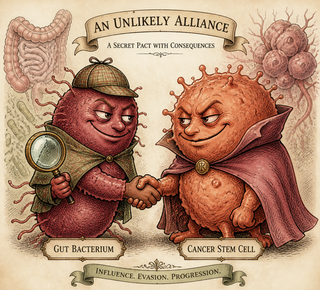
The Plot Twist You Didn’t See Coming: Microbes Team Up With Cancer’s Kingpins
Okay, quick backstory: in the epic drama that is cancer biology, cancer stem cells (CSCs) are like the supervillains. They start the tumor (origin story!), move to new neighborhoods (metastasis!), and basically win gold stars in dodging even the strongest chemotherapy drugs. It’s every Marvel plot, except none of the Avengers have figured out how to stop them (yet).
But here’s where the story gets even stranger. Turns out, our gut microbiota—the trillions of itty-bitty bacteria hanging out in your intestines—might be giving these CSCs helpful tips, cheat codes, and maybe even snack breaks. I mean, who wouldn’t want a supportive friend group, right? Unless they’re, you know, sabotaging your chemo.
Wait, The Microbiome Is Talking To Tumors Now?
Yes! According to Fang, Lau, and Yu’s 2024 review in Gut (DOI: 10.1136/gutjnl-2026-338801), the microbiome’s influence goes way past keeping your digestion on track or making you crave sauerkraut. Those bacteria pump out all sorts of metabolites—tiny chemical signals like short-chain fatty acids (SCFAs) and bile acids. These signals act like coded text messages to cancer stem cells: “Hey, here’s how to change up your metabolism and outsmart the chemo.”
The result? CSCs get even better at dodging drug attacks, remodeling the tumor microenvironment (which is, let’s face it, already the worst neighborhood in town) and generally upping their game at surviving things that are supposed to kill them. You can practically see these bacteria and cancer cells at happy hour, swapping trade secrets.
Microbial Mischief or Metabolic Masterminds? (Yes.)
Now, if you’re picturing this as a bunch of chubby bacteria and smug-looking cancer cells high-fiving in your colon, you’re not far off. Researchers are finding that:
- Good gut bugs (and their chemical gifts) can protect or expose CSCs, depending on the mix
- Some bacteria release metabolites that make CSCs more stubborn (and less killable)
- The real ringleader? The way these bugs tweak the whole tumor “neighborhood”—from how squishy the extracellular matrix is, to whether immune cells can even get in the front door
But here’s where it gets hopeful: if the microbiome can help CSCs, maybe we can flip the script and use it to sabotage them. What if we could make chemo more effective just by tweaking someone’s gut bugs?
Science Gets Personal: How Your Gut Could Rewrite the Script
Dream scenario: You go to the oncologist, and instead of being handed a stack of side effect warnings, you’re offered a tailored probiotic smoothie (“Now with 200% more chemosensitivity!”). Maybe slightly more realistic in five or ten years, but you get the idea.
Researchers are now exploring some wild new therapies, including:
- Designer probiotics that outcompete the bad-news bacteria
- Targeting sketchy bacterial metabolites (or boosting good ones)
- Metabolite “supplements” to sensitize CSCs to chemo
- Even nanomedicine (!), like sending in microscopic robots to tattle on the CSC-microbiome alliance
It sounds like science fiction, but there’s plenty of evidence this is the future (1,2,3). See the references below if you want a deep dive that’s heavier on stats, lighter on sitcom jokes.
Why This Matters (Especially If You Like Winning Against Cancer)
This research answers the age-old question: why does chemo work for some people and not others? Spoiler alert: it’s not always about willpower, destiny, or how many kale smoothies you drink. Sometimes, it’s the party going on in your gut that decides whether your cancer stem cells get evicted or upgraded to a nicer apartment. Tackling the microbiome angle could be the key to finally getting chemo to stick, and keeping those stem-cell troublemakers from coming back for a sequel.
Of course, we’re still figuring out who the hero should be: antibiotics to clear the bad bugs, probiotics to bring in the cavalry, or maybe metabolite cocktails to jam the CSCs’ walkie-talkies. But at least now we know where to look.
Battling The Neighborhood Watch: What’s Next?
Can we really outsmart tumor stem cells by sweet-talking bacteria? Will chemo become a dynamic duo with a yogurt chaser? Scientifically speaking: maybe! But cancer is still the ultimate shapeshifter, and gut bacteria, bless them, have a PhD in adaptation. In the meantime, enjoy your fiber—unless you’re a CSC, in which case: get lost.
References
- Fang F, Lau HCH, Yu J. Microbiota and metabolites modulation of cancer stem cells and chemotherapy sensitivity. Gut. 2024. https://doi.org/10.1136/gutjnl-2026-338801
- Vivarelli S, Salvo A, Zavattari P, et al. Gut microbiota and cancer: From pathogenesis to therapy. Cancers (Basel). 2023;15(4):1259. https://doi.org/10.3390/cancers15041259 (PMCID: PMC9957087)
- Buchta Rosean C, Bostic RR, Ferey JL, et al. Microbiome modulation and cancer therapy: Contributions to cancer immunotherapy. Ann Rev Cancer Biol. 2021;5:151-172. https://doi.org/10.1146/annurev-cancerbio-071920-030255
- Dzutsev A, Badger JH, Perez-Chanona E, et al. Microbes and cancer: Friends or foes? Ann Rev Immunol. 2022;40:387-415. https://doi.org/10.1146/annurev-immunol-120920-124740
- Routy B, Gopalakrishnan V, Daillère R, et al. The gut microbiota influences anticancer immunosurveillance and general health. Nat Rev Clin Oncol. 2024;21(1):47-62. https://doi.org/10.1038/s41571-023-00824-y
Disclaimer: The image accompanying this article is for illustrative purposes only and does not depict actual experimental results, data, or biological mechanisms.