In the late-night reboot of Ocean's Eleven, the casino is your genome, the vault is gene expression, and the crew is made of tiny chemical tags sneaking onto histone proteins to decide which doors stay locked.
That is roughly the plot of Lu and colleagues' new review in Molecular Cancer: cancer is not only a story about broken DNA letters. It is also a story about how cells read the book. Same genome, wildly different behavior, because the packaging has been marked up like a conspiracy board at 2 AM Lu et al., 2026.
The Genome Has Post-It Notes
Your DNA is wrapped around proteins called histones, like thread around spools. That wrapping is not decorative. It controls whether genes are easy to access or stuffed in the basement behind holiday decorations.
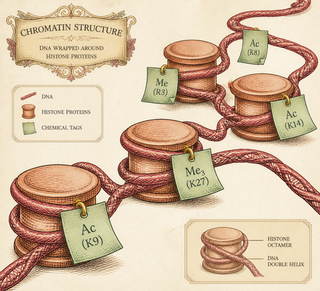
Histone modifications are chemical tags added to those histones. Acetylation often loosens chromatin so genes can be read. Methylation can either activate or silence genes depending on where it lands, because biology saw a simple switch and said, "No thanks, let's make it a haunted control panel."
These tags are handled by three charmingly named groups: writers add marks, erasers remove them, and readers interpret them. In cancer, that whole office can go feral. Writers over-tag the wrong regions. Erasers scrub away useful warnings. Readers recruit the wrong molecular entourage. Suddenly tumor-suppressor genes are muted, growth genes get a standing ovation, and the cell starts acting like it has diplomatic immunity.
Cancer Loves a Flexible Script
The review's big point is that histone changes help cancer stay adaptable. That matters because tumors are not one identical blob of villain cells. They are more like a badly managed group chat: different clones, different moods, everyone ignoring the pinned message.
Histone marks can help cancer cells shift identity, resist therapy, dodge immune attack, and survive stress. Lu and colleagues highlight familiar marks like acetylation and methylation, but also less-famous players such as phosphorylation, ubiquitination, and glycosylation. The quiet ones at the party may be moving the furniture.
Two examples stand out. H3K27me3, a methylation mark often associated with gene repression, can behave differently depending on cancer type and context. H2BK120ub, a ubiquitination mark, also seems to participate in transcriptional control and cancer behavior in ways that are still being sorted out. Translation: the same sticky note can mean "do not enter" in one room and "secret entrance" in another. Extremely rude, scientifically speaking.
The Epigenetic Group Chat
Histone marks do not work alone. They chat with DNA methylation, non-coding RNAs, chromatin remodelers, and metabolism. That last one is especially sneaky. Cancer cells rewire how they use nutrients, and those metabolic changes can feed directly into the molecules used to place histone marks. The cafeteria is influencing the control room.
Recent reviews have pushed this same idea: metabolism and epigenetics are braided together in cancer, not separate departments Sun et al., 2022. The tumor microenvironment also gets pulled into the mess, with epigenetic programs shaping immune escape, inflammation, and therapy response Yang et al., 2023.
This is where things get clinically interesting. If cancer uses epigenetic marks to keep doors locked, maybe treatment can pick those locks.
Drugs That Edit the Stage Directions
Some epigenetic drugs already exist. HDAC inhibitors target erasers involved in acetylation. EZH2 inhibitors target a writer tied to H3K27 methylation. BET inhibitors target readers that recognize acetylated histones. These are not magic whiteboards for the genome, but they can change which genes cancer cells can access.
The review gives special attention to EZH2 and BRD4, two targets with serious oncology interest. EZH2 inhibitors such as tazemetostat have already reached clinical use in selected cancers, and broader cancer epigenetics is moving from "cool mechanism" toward "actual treatment strategy" Davalos and Esteller, 2023.
The next wave sounds even more like science fiction after midnight: PROTACs that drag disease-driving proteins to the cellular trash compactor, dual inhibitors that hit more than one epigenetic target, and combinations with chemotherapy or immunotherapy. A 2024 study, for example, found that pairing DNMT inhibition with selected EZH2 inhibitors could boost viral-mimicry signals in colon cancer cells, basically making tumors wave immune-alert flags like they have made poor life choices Chomiak et al., 2024.
Why This Review Matters
This paper is a review, not a new experiment, so nobody discovered a single cure hiding under the histone couch. What it does well is map the chaos. It pulls together how histone modifications differ across cancers, how they interact with other epigenetic systems, and where therapies might fit.
The hard part is precision. Epigenetic marks are context-dependent, reversible, and entangled with normal cell function. You do not want to "fix" cancer's gene regulation by accidentally turning the whole genome into a karaoke machine.
Still, the appeal is obvious. Mutations can be permanent scars. Epigenetic marks are more like bad instructions written in erasable ink. If researchers can learn which marks matter, in which cancers, and in which patients, oncology gets more ways to make tumors less adaptable, less resistant, and maybe more visible to the immune system.
At 2 AM, that is the kind of plot twist worth staying awake for.
References
-
Lu P, Chan YT, Kwok CF, et al. Histone modifications across cancers: mechanisms, therapy and clinical translation. Molecular Cancer. 2026. DOI: 10.1186/s12943-026-02707-5
-
Davalos V, Esteller M. Cancer epigenetics in clinical practice. CA: A Cancer Journal for Clinicians. 2023;73(4):376-424. DOI: 10.3322/caac.21765
-
Yang J, Xu J, Wang W, Zhang B, Yu X, Shi S. Epigenetic regulation in the tumor microenvironment: molecular mechanisms and therapeutic targets. Signal Transduction and Targeted Therapy. 2023;8:210. DOI: 10.1038/s41392-023-01480-x. PMCID: PMC10203321
-
Sun L, Zhang H, Gao P. Metabolic reprogramming and epigenetic modifications on the path to cancer. Protein & Cell. 2022;13(12):877-919. DOI: 10.1007/s13238-021-00846-7. PMCID: PMC9243210
-
Chomiak AA, Tiedemann RL, Liu Y, et al. Select EZH2 inhibitors enhance viral mimicry effects of DNMT inhibition through a mechanism involving NFAT:AP-1 signaling. Science Advances. 2024;10(13):eadk4423. DOI: 10.1126/sciadv.adk4423. PMCID: PMC10971413
Disclaimer: The image accompanying this article is for illustrative purposes only and does not depict actual experimental results, data, or biological mechanisms.