The weird trick here is that to study leukemia inside the human body, scientists built something outside the human body that behaves more like the human body than many of our usual stand-ins.
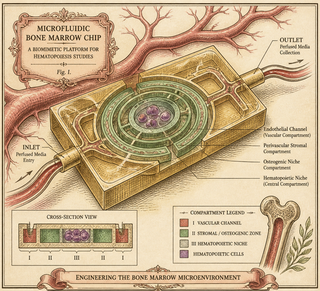
That sounds like biology doing a card trick in a lab coat, but it is the central idea behind Wang, Liu, and Chen's new Nature Protocols paper: a detailed recipe for an immunocompetent bone marrow-on-a-chip model for studying blood cancers and testing therapies like CAR T cells and chemotherapy. In plain English, they are teaching researchers how to build a tiny, living, organized version of human bone marrow on a microfluidic device, then watch cancer and immune cells interact in real time. Tiny stage. Very intense band.
The Marrow Is Not Just Soup
Bone marrow has a humble reputation because most of us only hear about it when someone mentions biopsies, transplants, or restaurant menus that involve toast points. But biologically, marrow is a 24/7 blood-cell factory, immune training room, vascular neighborhood, and cellular jazz club where everyone is improvising on the same changes.
It makes red blood cells, white blood cells, and platelets. It houses stromal cells, blood vessels, immune cells, stem cells, and all kinds of local signals. In leukemia and other hematological malignancies, cancer cells do not just float around twirling mustaches. They move into this neighborhood and start changing the zoning laws. They can use nearby stromal cells, blood vessels, and immune signals to survive treatment, hide from attack, or come back for an encore nobody requested.
That is why flat lab dishes can be so underwhelming. A leukemia cell in a plastic dish is like a saxophonist playing alone in an elevator. You may learn something, but you are missing the rhythm section.
Enter the Chip, Looking Innocent
This protocol lays out how to build a 3D microfluidic human bone marrow model with three concentric compartments, designed to mimic the spatial organization of native marrow. The researchers co-culture stromal and hematopoietic cells in a vascularized niche, then add patient-derived samples when the question calls for personalization.
The whole setup takes about 7 days to establish: one day for device fabrication, one day for cell seeding, and five days for the model to develop. After that, therapeutic testing can run for a few days to two weeks, depending on the experiment. The chip supports live imaging, immunofluorescence, cytokine profiling, flow cytometry, and single-cell sequencing. Translation: you can watch the cellular jam session, measure the secreted noise, sort the players, and read their molecular sheet music.
The immune competence matters. CAR T cells are engineered immune cells, often described as living drugs, which is accurate and also mildly terrifying in the way all great biomedical concepts are. They need to travel, recognize targets, activate, kill, and survive in a complex microenvironment. A model that leaves out the immune neighborhood is asking the trumpet solo to explain the whole concert.
Why This Could Change the Tune
The immediate value is preclinical testing. Animal models can help, but they often differ from human immunity, and many leukemia models either lack a full immune context or take too long to watch dynamic treatment responses. Standard 2D systems are fast, but biology keeps handing them a fake ID.
A patient-derived bone marrow chip could help researchers compare CAR designs, chemotherapy combinations, or sequencing strategies before moving into bigger, slower, riskier studies. If expanded and validated, this kind of platform could also support more personalized decisions: does this patient sample respond better when chemotherapy comes before CAR T therapy? Do the T cells reach the leukemia cells, or do they get stuck at the door like bouncers at the wrong club? Does relapse look like antigen escape, immune exhaustion, stromal protection, or some miserable little chord progression of all three?
Related work makes this feel less like a one-off solo and more like a growing ensemble. A 2025 Nature Biomedical Engineering study used an immunocompetent leukemia chip to track CAR T cell movement, activation, killing, and resistance scenarios in real time. A 2025 Communications Biology study showed that bone marrow microphysiological systems can help evaluate biologic drug safety and hematopoietic toxicity. Meanwhile, bone marrow organoids and vascular niche-on-chip systems are getting better at recreating marrow architecture and immune behavior.
The Catch, Because Biology Charges Cover
This is still a model. It cannot capture the entire body, the full nervous and endocrine context, long-term clonal evolution, or every immune cell subtype that matters. Patient samples vary. Manufacturing chips consistently is not trivial. And any clinical use would need serious validation against real patient outcomes, not just pretty microscopy and vibes.
But as protocols go, this one is valuable because it turns a sophisticated platform into something other laboratories can attempt, compare, and improve. That is how a research tool becomes a standard: not by being magical, but by being reproducible enough that other scientists can argue with it productively.
The big idea is simple: blood cancers do not perform solo, so our models should not make them. This chip gives leukemia, stromal cells, vessels, immune cells, and therapies a small but human-like stage. And if the science holds up, that stage could help researchers hear which treatments are actually in tune before patients have to face the full concert.
References
-
Wang H, Liu L, Chen W. An immunocompetent bone marrow-on-a-chip model for studying human hematological malignancies and preclinical therapeutic screening. Nature Protocols. 2026. https://doi.org/10.1038/s41596-026-01387-1
-
Ma C, et al. Bioengineered immunocompetent preclinical trial-on-chip tool enables screening of CAR T cell therapy for leukaemia. Nature Biomedical Engineering. 2025;9:2098-2114. https://doi.org/10.1038/s41551-025-01428-2
-
Koenig L, et al. A microfluidic bone marrow chip for the safety profiling of biologics in pre-clinical drug development. Communications Biology. 2025;8:754. https://doi.org/10.1038/s42003-025-08137-1
-
Georgescu A, et al. Self-organization of the hematopoietic vascular niche and emergent innate immunity on a chip. Cell Stem Cell. 2024;31:1847-1864.e6. https://doi.org/10.1016/j.stem.2024.11.003
-
Frenz-Wiessner S, et al. Generation of complex bone marrow organoids from human induced pluripotent stem cells. Nature Methods. 2024;21:868-881. https://doi.org/10.1038/s41592-024-02172-2
Disclaimer: The image accompanying this article is for illustrative purposes only and does not depict actual experimental results, data, or biological mechanisms.