Th17 cells are not all villains. Some help defend the gut and other barrier tissues. Others go feral and drive autoimmune disease. Immunology loves this kind of split personality because apparently one level of complexity was not enough [2,4].
The new study says CYP1B1 is switched up during colitis in both mice and humans, and that it helps generate the pathogenic Th17 subset specifically. Not all Th17 cells. Just the nasty ones. That matters. If you can selectively kneecap the inflammatory squad without flattening the useful mucosal defenders, that is a much better therapeutic idea than carpet-bombing the whole pathway and hoping for the best [1].
In mouse models, deleting CYP1B1 reduced colitis and also reduced colitis-associated colorectal cancer. The authors argue this effect was microbiota-independent, which is a neat detail because gut papers often end up sounding like, "Maybe the microbes did it, maybe the moon did it, who knows." Here, the mechanism stayed inside the T cell [1].
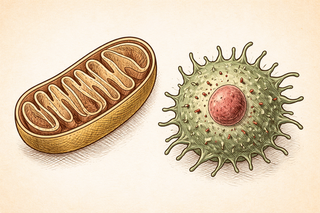
The Mitochondria Are Not Fine
Here is the sharp part.
CYP1B1 seems to help pathogenic Th17 cells maintain redox balance. In plain English, it helps them avoid drowning in their own oxidative mess. Without CYP1B1, these cells had less glutathione synthetase, more reactive oxygen species, and crankier mitochondria. When the mitochondria lost integrity, the pathogenic Th17 cells struggled to survive and develop [1].
That fits with a bigger theme in immunology: mitochondria are not just tiny batteries sitting in the corner. They are more like backstage managers with anger issues. When mitochondrial structure and metabolism go sideways, T cell behavior changes with them. Prior work showed that mitochondrial programs are unusually important for Th17 identity and effector function, including inflammatory output and tissue damage [2,3].
The clever rescue experiment is what makes this paper more than a fishing expedition. The team used N-acetylcysteine to mop up ROS, and they also restored glutathione synthetase expression. Both moves improved mitochondrial fitness and revived pathogenic Th17 generation. That is a much cleaner story than "we deleted a gene and vibes changed" [1].
Why You Should Care Even If You Do Not Spend Friday Nights Reading PNAS
Autoimmune disease treatment still runs into the same brick wall: how do you calm the immune system without turning it into a wet paper towel?
This paper suggests one answer. Instead of blocking every Th17-related signal in sight, maybe you target the metabolic wiring that makes the dangerous Th17 state possible. That is attractive because clinicians already care deeply about the IL-23-Th17 axis in diseases like ulcerative colitis. In fact, IL-23-targeting therapies are already showing clinical benefit in UC trials [5]. What this study adds is a more granular weak spot further downstream: CYP1B1-glutathione-ROS-mitochondria.
If this holds up, the real prize is selectivity. You would want to shut down the inflammatory Th17 cells that behave like drunk guys starting fights outside the bar, while leaving the useful barrier-protective cells alone. Easier said than done, obviously. Biology is rude like that.
Now for the sober bit. This is not a ready-made therapy. It is mostly mechanistic work in mice and cellular systems. Mouse colitis is useful, but it is not the same as treating a human sitting in clinic with bleeding, urgency, weight loss, and a colon that has had enough. Also, CYP1B1 does not exist in a vacuum. It has roles in other tissues, so any future drug strategy would need serious precision to avoid trading one problem for three new ones [1].
Still, this is the kind of paper worth paying attention to. It identifies a surprisingly specific lever inside pathogenic Th17 cells, connects it to redox control and mitochondrial health, and shows the immune system once again behaving like a machine built by brilliant engineers who hated future maintenance crews.
References
-
Hu W, Sun Y, Sun J, Liang Y, Jin S, Liu J, Wu B. Cytochrome P450 1B1 directs pathogenic Th17 cell generation and autoimmune disease by fine-tuning redox homeostasis and mitochondrial integrity. Proc Natl Acad Sci U S A. 2026;123(18):e2527753123. DOI: https://doi.org/10.1073/pnas.2527753123. PubMed: https://pubmed.ncbi.nlm.nih.gov/42054359/
-
Bonetti L, Horkova V, Grusdat M, et al. A Th17 cell-intrinsic glutathione/mitochondrial-IL-22 axis protects against intestinal inflammation. Cell Metab. 2024;36(8):1726-1744.e10. DOI: https://doi.org/10.1016/j.cmet.2024.06.010. PubMed: https://pubmed.ncbi.nlm.nih.gov/38986617/
-
Baixauli F, Acin-Perez R, Villarroya-Beltri C, et al. An LKB1-mitochondria axis controls TH17 effector function. Nature. 2022;610(7932):555-561. DOI: https://doi.org/10.1038/s41586-022-05264-1. PubMed: https://pubmed.ncbi.nlm.nih.gov/36171294/
-
Kono M. New insights into the metabolism of Th17 cells. Immunol Med. 2023;46(1):15-24. DOI: https://doi.org/10.1080/25785826.2022.2140503. PubMed: https://pubmed.ncbi.nlm.nih.gov/36326754/
-
Louis E, Peyrin-Biroulet L, Danese S, et al. Risankizumab for Ulcerative Colitis: Two Randomized Clinical Trials. JAMA. 2024;332(11):881-897. DOI: https://doi.org/10.1001/jama.2024.12414. PMCID: https://pmc.ncbi.nlm.nih.gov/articles/PMC11264075/
Disclaimer: The image accompanying this article is for illustrative purposes only and does not depict actual experimental results, data, or biological mechanisms.