A 43-year-old woman with newly diagnosed triple-negative breast cancer sits in clinic, hears the words “aggressive” and “limited targets,” and immediately becomes fluent in the language of bad Tuesdays.
That is the emergency. Not panic. Priority.
Triple-negative breast cancer, or TNBC, lacks the three usual treatment handles: estrogen receptor, progesterone receptor, and HER2. No handles means fewer easy grabs. Chemo still matters. Immunotherapy can help some patients. But tumors are not passive blobs waiting politely for science to arrive with a clipboard. They adapt. They hide. They hire security.
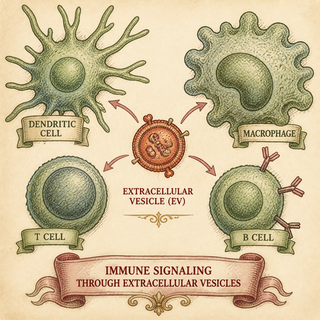
A new Cancer Cell study by Fan and colleagues points to one possible culprit behind that hiding act: cancer stem cells sending out tiny message bubbles that teach the immune system to stand down [1]. Tiny bubbles. Huge attitude.
The Tumor Has a Middle Manager
Cancer stem cells are a small, stubborn subset of tumor cells that can self-renew and help rebuild a tumor after treatment. Think of them as the franchise owners of chaos. Most cancer cells may be causing trouble on the floor, but cancer stem cells may be in the back office deciding where the next location opens.
Fan’s team studied treatment-naive TNBC samples using multiplexed single-cell proteomics, measuring 50 tumor microenvironment proteins. Translation: they looked at many cells, one by one, and asked who was talking to whom before therapy had rearranged the furniture.
They found that cancer stem cells were not just surviving in the tumor neighborhood. They were shaping it. Specifically, they appeared to push immune cells toward becoming regulatory T cells, or Tregs [1].
Tregs are not villains by default. Your body needs them. They keep the immune system from attacking your own tissues, which is generally preferred unless you enjoy autoimmune roulette. But inside tumors, Tregs can become the bouncers at the wrong club. They calm down the very immune cells that should be throwing cancer cells into the parking lot.
The Message Came in a Bubble
The delivery system here is the extracellular vesicle. EVs are tiny membrane-wrapped packets that cells release into their surroundings. They can carry proteins, RNA, lipids, and other molecular gossip. Most cells use them. Cancer cells abuse them. Shocking behavior from the cellular crime syndicate.
In this study, cancer stem cell-derived EVs carried a membrane protein called TSPAN8. That TSPAN8 interacted with CD103 on T cells [1]. The important twist: the vesicles did not need to be swallowed by the T cells to work. They seemed to signal from the outside, like a suspicious package that somehow still gets a meeting with management.
That outside-in signal triggered formation of the LKB1-STRAD-MO25 complex, then phosphorylation of LKB1 and AMPKα. The pathway boosted FOXP3, the master identity switch for Tregs. FOXP3 then increased CD103, creating a feedback loop.
More CD103. More Treg identity. More immune suppression. The tumor gets a quieter neighborhood. Very efficient. Deeply rude.
Why This Is a Big Deal
Checkpoint inhibitors such as anti-PD-1 therapies work by taking brakes off anti-tumor immune cells. But what if the tumor is also building more brakes? What if the security team gets unlocked, walks into the building, and finds the elevators disabled and the stairwell guarded by Tregs with clipboards?
That is why this paper matters.
Fan and colleagues tested a monoclonal antibody strategy to neutralize TSPAN8-positive EVs in preclinical TNBC models. Combined with anti-PD-1 therapy, it reduced tumor growth and improved survival in those models [1]. That does not mean patients should expect this in clinic tomorrow. Preclinical cancer wins have a long history of looking great in mice and then face-planting in humans. The lab-to-clinic pipeline is less “express lane” and more “airport security during a thunderstorm.”
But the concept is sharp: do not only wake up anti-tumor immunity. Also block the tumor’s local propaganda network.
The Larger Pattern
This study fits a broader picture. Recent reviews describe EVs as major players in tumor immune evasion, including their ability to reshape T cells, natural killer cells, macrophages, dendritic cells, and immune checkpoint signaling [2,3]. Other work highlights Tregs as serious obstacles to cancer immunotherapy, especially when they accumulate inside tumors [4]. TNBC adds another layer because its tumor microenvironment can strongly affect whether immunotherapy works or fizzles [5].
So the story is not “TSPAN8 solves TNBC.” Biology almost never gives us a clean villain. It gives us twelve villains, three understudies, and a signaling pathway named like a Wi-Fi password.
The better takeaway is this: some TNBC tumors may contain cancer stem cells that actively train immune suppression through TSPAN8-positive EVs. If future studies confirm this in larger patient groups, TSPAN8-positive cancer stem cells or their vesicles might help identify patients who need combination strategies. Not just “release the immune brakes,” but “stop the tumor from installing new ones during the rescue.”
Bottom Line, No Waiting Room Music
This paper makes cancer stem cells look less like quiet survivors and more like dispatchers. They send vesicles. Vesicles carry TSPAN8. TSPAN8 talks to CD103. T cells become more Treg-like. The immune response gets muffled.
For TNBC, where treatment options can narrow fast, that is worth chasing. Carefully. Reproducibly. With the usual scientific suspicion turned all the way up.
Cancer is not one disease. It is a messy group chat with terrible boundaries. This study may have identified one of the loudest messages in the thread.
References
-
Fan G, Jin J, Wang J, et al. Cancer stem cells orchestrate immune evasion through extracellular vesicle-mediated non-canonical signaling pathways. Cancer Cell. 2026. DOI: 10.1016/j.ccell.2026.04.004
-
Li X, Zhang C, Yue W, Jiang Y. Modulatory effects of cancer stem cell-derived extracellular vesicles on the tumor immune microenvironment. Front Immunol. 2024;15:1362120. DOI: 10.3389/fimmu.2024.1362120. PMCID: PMC11219812
-
Zhang Y, et al. Extracellular vesicles in tumor immunity: mechanisms and novel therapeutic strategies. Molecular Cancer. 2025. DOI: 10.1186/s12943-025-02233-w
-
Tay C, Tanaka A, Sakaguchi S. Tumor-infiltrating regulatory T cells as targets of cancer immunotherapy. Cancer Cell. 2023;41(3):450-465. DOI: 10.1016/j.ccell.2023.02.014
-
Guo Z, Zhu Z, Lin X, et al. Tumor microenvironment and immunotherapy for triple-negative breast cancer. Biomarker Research. 2024;12:166. DOI: 10.1186/s40364-024-00714-6. PMCID: PMC11689763
Disclaimer: The image accompanying this article is for illustrative purposes only and does not depict actual experimental results, data, or biological mechanisms.