2012: scientists name ferroptosis, a strange iron-fueled way for cells to die. 2017: CAR-T therapy becomes the oncology equivalent of handing T cells a badge, a GPS, and permission to kick doors in. 2026: Kong and colleagues report the awkward plot twist: after CAR-T cells surge into battle, excess iron may help run them into the ground.
That is the headline from a new Nature Cancer paper on multiple myeloma and acute lymphoblastic leukemia: CAR-T cells can expand fast after infusion, then enter a “diminution” phase marked by ferroptosis signals and higher serum iron levels. Translation: the tiny bodyguards show up, throw punches, and then some of them appear to rust out on the job. Biology remains deeply weird. It also keeps receipts.
The Rescue Team Has a Battery Problem
CAR-T therapy starts with a smart idea. Take a patient’s T cells. Engineer them with a chimeric antigen receptor, or CAR, so they recognize a cancer target. Grow them. Infuse them back. Now the immune system has a custom search-and-destroy squad.
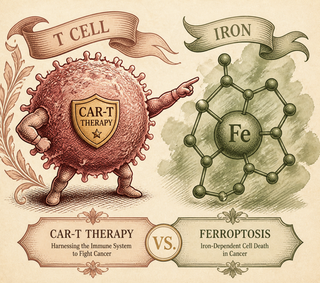
This has changed treatment for several blood cancers. But it is not magic. CAR-T cells need to persist. A one-night-only immune concert is not enough when cancer is hiding backstage with a fake mustache.
In multiple myeloma, especially, researchers already worry about relapse, antigen escape, T-cell exhaustion, and the bone marrow tumor neighborhood, which has the vibe of a parking garage where the lights flicker and nobody should be alone after midnight. Reviews of myeloma CAR-T therapy keep circling the same practical problem: responses can be strong, but durability varies, and CAR-T cells do not always stay fit for the long haul.[1,2]
Kong’s team adds a new suspect to the chart: iron-driven ferroptosis.
Ferroptosis: Rust, But Make It Cellular
Ferroptosis is a regulated form of cell death driven by iron and lipid peroxidation. Less polite version: iron helps reactive oxygen species damage fatty molecules in cell membranes until the cell’s chemistry goes sideways.
Your cells have antioxidant systems that usually keep this mess contained. GPX4 is one of the famous cleanup crews. ACSL4, meanwhile, helps shape lipid composition in ways that can make membranes more vulnerable to ferroptosis. If GPX4 is the janitor with a mop, ACSL4 may be stocking the hallway with very flammable rugs.
In this study, the authors analyzed clinical samples from patients treated with CAR-T cells, then tested the biology in mouse cancer models and ex vivo CAR-T culture systems. Excess intracellular iron impaired CAR-T function. Mechanistically, iron increased mitochondrial reactive oxygen species and lipid peroxidation, partly through ACSL4-associated lipid remodeling.[3]
That matters because ferroptosis is usually discussed as a way to kill tumor cells. Great idea. Throw cancer into the biochemical shredder. But immune cells can get shredded too. Recent work in Nature Communications found that iron-rich tumor microenvironments can induce CD8+ T-cell ferroptosis and dysfunction.[4] Another 2025 study showed GPX4 helps protect T cells and CAR-T cells from ferroptosis, and when that protection drops, antitumor activity suffers.[5]
So yes, ferroptosis can be a weapon. It can also be friendly fire. Oncology: where the knife has a knife.
The ACSL4 Clue
The most striking part of the paper is not just “iron bad.” That would be too simple, and cancer biology has a strict policy against letting anyone have a clean afternoon.
The team found that targeting ferroptosis improved CAR-T performance. In particular, genetically removing ACSL4 from CAR-T cells substantially enhanced antitumor efficacy in preclinical models.[3] That points toward a possible engineering strategy: make CAR-T cells less likely to undergo ferroptosis while preserving their ability to attack cancer.
This is not the same as saying patients should start manipulating iron levels on their own. Please do not freestyle hematology. Iron metabolism is complicated, and cancer patients can have anemia, inflammation, transfusions, marrow disease, and treatment effects all tangled together like hospital charger cables.
The real clinical idea is more precise: if ferroptosis helps explain why CAR-T cells fade, future CAR-T products might be built or conditioned to resist that specific failure mode.
Why This Could Matter
Durable CAR-T responses depend on persistence. Recent single-cell work tracking CAR-T cells in long-term leukemia remission shows that long-lived CAR-T biology can look highly specialized, with particular functional states tied to years of control.[6] The field is learning that “CAR-T cell” is not one thing. It is a living drug with moods, metabolism, memory, stress responses, and, apparently, a vulnerability to biochemical rust.
If these findings hold up in larger clinical studies, they could influence several parts of treatment:
CAR-T manufacturing could screen for ferroptosis sensitivity.
Engineers could design CAR-T cells with better lipid and iron handling.
Clinicians might track iron-related biomarkers after infusion.
Combination therapies might protect immune cells while still pushing cancer cells toward ferroptosis.
That last part is the tightrope. You may want tumor cells to die by ferroptosis. You do not want your CAR-T cells joining them like they misunderstood the assignment.
The Takeaway
This paper gives CAR-T failure a sharper biochemical outline. Not just “the cells got tired.” Not just “the tumor escaped.” Maybe, in some patients, the treatment’s own immune soldiers hit an iron-loaded stress state that damages their membranes and drains their function.
That is useful. Vague exhaustion is hard to fix. A pathway with iron, lipid peroxidation, mitochondria, GPX4, and ACSL4 gives researchers handles to pull.
The emergency note reads like this: CAR-T cells can save lives, but persistence is the pulse to watch. Iron-mediated ferroptosis may be one reason that pulse weakens. Find it early. Block it carefully. Keep the bodyguards on shift.
References
-
Rasche L, Hudecek M, Einsele H. CAR T-cell therapy in multiple myeloma: mission accomplished? Blood. 2024;143(4):305-310. https://doi.org/10.1182/blood.2023021221
-
Zhang X, Zhang H, Lan H, Wu J, Xiao Y. CAR-T cell therapy in multiple myeloma: Current limitations and potential strategies. Front Immunol. 2023;14:1101495. https://doi.org/10.3389/fimmu.2023.1101495
-
Kong D, Yang T, Zhao M, et al. Iron-mediated ferroptosis impairs CAR-T cell function and antitumor efficacy. Nat Cancer. 2026. https://doi.org/10.1038/s43018-026-01187-2
-
Lin Z, Chen H, Ke Y, et al. Iron overload in the tumor microenvironment induces CD8+ T cell ferroptosis and dysfunction. Nat Commun. 2026. https://doi.org/10.1038/s41467-026-73379-4
-
Kłopotowska M, Baranowska I, Hajduk S, et al. GPX4 is a key ferroptosis regulator orchestrating T cells and CAR-T-cells sensitivity to ferroptosis. Cancer Immunol Immunother. 2025;74:280. https://doi.org/10.1007/s00262-025-04133-w
-
Bai Z, Feng B, McClory SE, et al. Single-cell CAR T atlas reveals type 2 function in 8-year leukaemia remission. Nature. 2024;634:702-711. https://doi.org/10.1038/s41586-024-07762-w
Disclaimer: The image accompanying this article is for illustrative purposes only and does not depict actual experimental results, data, or biological mechanisms.