AML cell: u up?
T cell: unfortunately yes.
AML cell: cool, I’m wearing this LILRB4 “do not disturb” hoodie.
T cell: rude.
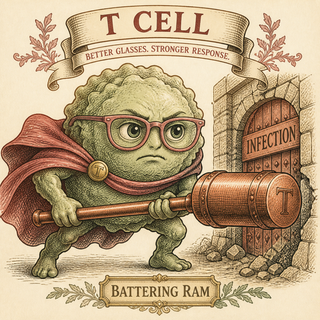
Scientists: what if we gave the T cell better glasses and a battering ram?
That, minus the texting and with substantially more pipettes, is the idea behind a new first-in-human study of dual epitope anti-LILRB4 STAR-T cells for relapsed or refractory acute myeloid leukemia, or AML Lv et al., 2026.
The Problem: AML Is Not Wearing a Name Tag
CAR-T therapy has been a superhero in some blood cancers, especially certain B-cell cancers. The trick is simple in theory: engineer a patient’s T cells to recognize a marker on cancer cells, then send them back in like tiny bodyguards with upgraded badges.
AML makes that trick annoying.
Why? AML cells often share surface markers with healthy blood-forming cells. Target the wrong marker and you risk mowing down the bone marrow’s normal blood factory. That is not precision medicine. That is using a leaf blower in a watch repair shop.
Reviews of AML immunotherapy keep circling the same headache: finding a target that is common enough on leukemia cells, absent enough from healthy stem cells, and stable enough that the cancer cannot just change shirts and sneak out the back Daver et al., 2021; Haubner et al., 2025.
Meet LILRB4, the Immune System’s “Manager Is In a Meeting” Sign
LILRB4 is an inhibitory immune receptor found on some monocytic AML cells. In normal biology, inhibitory receptors help keep immune responses from turning every Tuesday into a five-alarm inflammatory disaster. Useful! Necessary! Also, cancer loves borrowing useful things and making them sketchy.
Earlier work showed that LILRB4 signaling can help leukemia cells suppress T cells and infiltrate tissues Deng et al., 2018. In plain English: some AML cells may use LILRB4 like a fake security badge that says, “Nothing to see here, please continue not murdering me.”
That makes LILRB4 tempting. It appears on monocytic AML blasts but not hematopoietic stem cells in this study’s framing, which means it may offer a cleaner target than the usual myeloid-marker minefield.
STAR-T: CAR-T’s Overcaffeinated Cousin
This study did not use a standard CAR-T design. It used STAR-T cells, short for synthetic T-cell receptor and antigen receptor T cells. STAR receptors try to combine the external target-hunting ability of CARs with signaling machinery closer to a natural T-cell receptor.
If CAR-T is a custom doorbell wired to a flamethrower, STAR-T is closer to rewiring the house’s actual security system. Still intense. Slightly more elegant. Definitely not available at Home Depot.
The researchers screened nanobodies, which are tiny antibody-like binders, to find two that latch onto different parts, or epitopes, of LILRB4. Then they built a dual epitope STAR-T cell. Two grips on the same target. Like grabbing a slippery villain by both lapels, because apparently leukemia did not come dressed for cooperation.
In lab and mouse experiments, the dual epitope STAR-T cells outperformed single epitope STAR-T cells and dual epitope CAR-T cells, including against cells with lower LILRB4 expression Lv et al., 2026.
The Human Trial: Small, Serious, and Worth Reading Carefully
The clinical trial enrolled patients with LILRB4-positive relapsed or refractory AML. Nine received STAR-T infusion. Six completed the safety and efficacy evaluation, with a median follow-up of 10.7 months.
The headline result: the best overall response rate was 50% in the six evaluable patients, or 33.3% across the full analysis set. One patient achieved complete remission with measurable residual disease still detected, one reached a morphologic leukemia-free state, and one had a partial remission.
That is not a victory parade. It is a signal.
The safety story also needs adult supervision. The study reported no grade 3 or higher cytokine release syndrome and no ICANS among the six evaluable patients. That matters because immune cell therapies can sometimes behave like the immune system found a fog machine and a group chat. But three infused patients died from laboratory-confirmed infections in the setting of severe pancytopenia. The investigators did not classify those deaths as dose-limiting toxicities, but clinically, they are still the part of the room where everyone stops joking.
The Plot Twist: The Neighborhood Fights Back
The most useful clue may come from single-cell RNA sequencing. In nonresponders, the researchers found signs that monocyte-mediated suppression of autologous T-cell function may have helped therapy fail.
Translation: even if you give T cells a better weapon, the bone marrow neighborhood may still be full of bouncers whispering, “Maybe take a nap instead.” This fits a broader theme in AML cell therapy: the target matters, but so does the hostile immune environment around it Bhagwat et al., 2024.
Why This Is Intriguing
If larger trials reproduce these results, LILRB4-directed STAR-T therapy could become part of a smarter AML playbook: target leukemia more selectively, spare healthy stem cells more carefully, and maybe use the treatment as a bridge to transplant or combination therapy.
But the next steps are obvious and unforgiving: more patients, longer follow-up, clearer dosing, infection-risk management, and strategies to stop suppressive monocytes from putting the T cells on airplane mode.
Cancer biology remains weird. The night shift is still suspicious. But this study gives researchers a sharper flashlight.
References
-
Lv M, Zheng H, Pei X, et al. Dual epitope anti-LILRB4 synthetic T-cell receptor and antigen receptor (STAR)-T-cell therapy for relapsed/refractory acute myeloid leukemia. Signal Transduction and Targeted Therapy. 2026;11:203. https://doi.org/10.1038/s41392-026-02765-7
-
Daver N, Alotaibi AS, Bücklein V, Subklewe M. T-cell-based immunotherapy of acute myeloid leukemia: current concepts and future developments. Leukemia. 2021;35:1843-1863. https://doi.org/10.1038/s41375-021-01253-x
-
Deng M, Gui X, Kim J, et al. LILRB4 signalling in leukaemia cells mediates T cell suppression and tumour infiltration. Nature. 2018;562:605-609. https://doi.org/10.1038/s41586-018-0615-z
-
Haubner S, Rejeski K, Subklewe M, Sadelain M. Honing CAR T cells to tackle acute myeloid leukemia. Blood. 2025;145:1113-1125. https://doi.org/10.1182/blood.2024024063
-
Bhagwat AS, et al. Cytokine-mediated CAR T therapy resistance in AML. Nature Medicine. 2024;30:3697-3708. https://doi.org/10.1038/s41591-024-03271-5
Disclaimer: The image accompanying this article is for illustrative purposes only and does not depict actual experimental results, data, or biological mechanisms.