One minute you're reheating coffee for the third time, and the next you're reading about a rare head and neck cancer getting treated with drug-filled microscopic fat bubbles. Life comes at you fast. And honestly, cancer biology comes at you faster - usually wearing a fake mustache and trying to sneak past your immune system.
This study looked at adenoid cystic carcinoma of the head and neck, or ACC - a rare cancer that often starts in the salivary glands and has a frustrating habit of growing slowly, spreading along nerves, and then acting way more dangerous than its calm exterior suggests. It's the kind of tumor that seems quiet at first and then pulls a full "actually, I'm the problem" twist several seasons later.
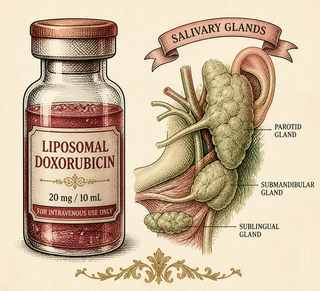
A phase II study tested a combo of liposomal doxorubicin and nab-paclitaxel, with some patients also getting chemoradiotherapy, in people with unresectable locally advanced or recurrent/metastatic ACC. Translation: these were patients whose cancers were either too hard to remove surgically, had come back, or had spread - which is exactly where doctors badly need better options.
Rare cancer, real problem
ACC is rare, but "rare" does not mean "small deal." These tumors can invade nearby tissue, track along nerves, and recur years after treatment. Standard chemotherapy has generally been underwhelming here. Not zero effect, but not exactly the medical equivalent of kicking down the door either.
That matters because once ACC becomes unresectable or metastatic, clinicians often face a menu of imperfect choices: radiation, symptom control, clinical trials, and systemic therapies that may help some patients but rarely produce dramatic, durable responses. It's a bit like trying to stop a very determined raccoon with a garden hose - technically you're doing something, but nobody feels great about the strategy.
Tiny drug packages, bigger hopes
The treatment approach in this paper leans on nanomedicine, which sounds like sci-fi marketing but is actually pretty practical. Liposomal doxorubicin packages doxorubicin inside lipid spheres - basically little delivery vehicles that can change how the drug travels and where toxicity shows up. Nab-paclitaxel is paclitaxel bound to albumin, a blood protein, which helps with drug delivery and avoids some solvent-related issues seen with standard paclitaxel.
In plain English: instead of just hurling chemo into the bloodstream and hoping for the best, these formulations try to deliver it more strategically. Not with GPS-level perfection, sadly. Cancer still loves chaos. But the idea is to improve activity while keeping side effects more manageable.
What the study was trying to do
This was a single-arm, open-label, multicenter phase II trial. That means everyone in the trial received the study treatment, there was no randomized comparison arm, and both patients and clinicians knew what was being given.
Single-arm studies can't tell us everything. They are not the final boss of evidence. But in rare cancers, they can still be extremely useful. When patient numbers are small and no standard therapy really owns the room, a well-run phase II study can tell us whether a regimen looks promising enough to pursue further.
The headline question was simple: can this chemo-nanomedicine combination - with or without added chemoradiotherapy - produce meaningful tumor control in ACC of the head and neck?
Based on the abstract, the answer appears to be: possibly yes, and that gets attention, especially because this is a disease with limited established systemic options.
Why this is interesting beyond the acronym soup
Adenoid cystic carcinoma has a reputation for being biologically stubborn. It often carries MYB or MYBL1 pathway alterations, and researchers have spent years trying to find treatments that actually move the needle in advanced disease. Targeted drugs and multitarget tyrosine kinase inhibitors have shown some activity, but nothing has completely changed the game yet [1-4].
So a regimen that suggests useful antitumor activity matters for three reasons.
First, it could give doctors another option in a setting where the cupboard is not exactly overflowing.
Second, it hints that drug formulation matters. Same broad category - chemotherapy - but delivered in a smarter package.
Third, if chemoradiotherapy adds local control for selected patients, that could be especially relevant in head and neck disease, where tumors can affect speech, swallowing, pain, and basic day-to-day dignity. This isn't just about scans looking prettier. It's about whether someone can eat dinner without feeling like their throat declared war.
The usual catch - because of course there's a catch
Before anyone starts tossing confetti in the infusion suite, some caution is warranted.
This was not a randomized trial, so we can't say this regimen beats another approach head-to-head. The abstract provided here is also truncated, which limits how much we can say about exact response rates, survival outcomes, and toxicity patterns from this post alone. And with rare cancers, promising early results have a habit of walking into larger studies and suddenly forgetting all their lines.
Still, this kind of work is how progress often starts in orphan diseases - small cohorts, careful observation, a signal worth chasing.
Where this could go next
If these findings hold up, the next steps are pretty obvious: validate the results in larger cohorts, define which patients benefit most, clarify the role of added radiation, and compare this strategy with other active systemic options. Biomarkers would help too, because oncology would love - just once - to stop treating every tumor like it read the same instruction manual.
For patients with advanced ACC, even incremental progress matters. In rare cancers, "better than what we had" is not a glamorous slogan, but it can be life-changing.
References
-
Coca-Pelaz A, Rodrigo JP, Bradley PJ, et al. Adenoid cystic carcinoma of the head and neck - An update. Oral Oncol. 2015;51(7):652-661. doi:10.1016/j.oraloncology.2015.04.005
-
van Weert S, Bloemena E, van der Waal I, et al. Adenoid cystic carcinoma of the head and neck: a single-center analysis of 105 consecutive cases over a 30-year period. Oral Oncol. 2013;49(8):824-829. doi:10.1016/j.oraloncology.2013.05.004
-
Dillon PM, Petroni GR, Horton BJ, et al. A phase II study of lenvatinib in patients with progressive, recurrent or metastatic adenoid cystic carcinoma. J Clin Oncol. 2020;38(15_suppl):6506. doi:10.1200/JCO.2020.38.15_suppl.6506
-
Laurie SA, Ho AL, Fury MG, et al. Systemic therapy in the management of metastatic or locally recurrent adenoid cystic carcinoma of the salivary glands: a systematic review. Lancet Oncol. 2011;12(8):815-824. doi:10.1016/S1470-2045(10)70245-X
-
Zhang X, Wei J, Chen N, et al. Liposomal doxorubicin plus nab-paclitaxel with/without chemoradiotherapy in head and neck adenoid cystic carcinoma: single-arm phase II study. Signal Transduct Target Ther. 2026. doi:10.1038/s41392-026-02725-1
Disclaimer: The image accompanying this article is for illustrative purposes only and does not depict actual experimental results, data, or biological mechanisms.