Dispatch from the liver, where the firefight has gone quiet in all the wrong ways: somewhere in a hepatocellular carcinoma, a battalion of CD8 T-cells is pinned down, weapons drawn, staring at a tumor cell that has simply stopped answering its calls. The shells are landing. Nothing detonates. The enemy has found a way to unplug its own alarm system, and for years nobody could figure out who cut the wire. Turns out it was a kinase nobody was watching, running what amounts to an insider-trading scheme on your immune signaling.
Meet STK40, the Tumor's Compliance-Avoidance Department
Liver cancer is the asset class immunotherapy keeps underdelivering on. Checkpoint inhibitors like anti-PD-1 turned melanoma into a comeback story, but in HCC the response rates stay stubbornly mediocre, which is a polite way of saying most patients pay full price for a partial result. The standard of care, atezolizumab plus bevacizumab, was a genuine step up from sorafenib in the IMbrave150 trial, and yet the majority of tumors still shrug it off. The market wants better. The biology wasn't cooperating.
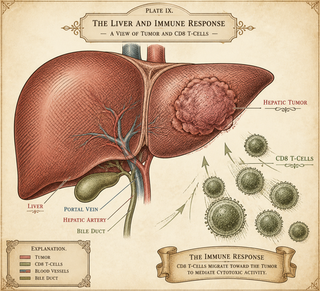
So this team ran an in vivo CRISPR-Cas9 screen, which is the scientific equivalent of disabling every component in the engine one at a time to see which part makes the alarm finally go off. The standout hit was STK40, a serine/threonine kinase that had basically zero reputation in immune evasion circles. Knock it out, and tumors that had been ignoring T-cells suddenly became extremely answerable to them.
The Receptor It Was Quietly Liquidating
Here's the mechanism, and it's almost elegant in its cynicism. Your immune system's main pressure tactic is interferon gamma (IFN-γ), a cytokine T-cells spray at tumor cells to say we know you're in there. For the message to land, the tumor needs IFNGR1, the receptor that catches the signal.
STK40 was scaffolding a ubiquitin ligase called COP1 and using it to tag IFNGR1 for destruction - shredding incoming mail before anyone could read it. Delete STK40, IFNGR1 stabilizes, the receptor stays on the cell surface, and the tumor abruptly becomes sensitive to T-cell cytotoxicity again. It's the difference between a company that's been routing all complaints to a disconnected phone line and one that suddenly has to answer the regulators.
And there's a second payout. Losing STK40 also makes tumor cells start secreting GM-CSF on their own, which recruits conventional type 1 dendritic cells (cDC1) - the immune system's best account managers for antigen cross-presentation. More cDC1s means better-briefed CD8 T-cells, which means a coordinated attack instead of a bunch of confused soldiers firing into a void.
Why the Combo Is the Whole Pitch
The headline number: Stk40 ablation synergizes with PD-1 blockade to drive tumor regression. Synergy is the word every healthcare economist wants to hear, because it means you might extract a real response out of a drug class that already exists and is already (expensively) on the formulary. Even better, hepatocyte-specific Stk40 deletion abolished tumor formation entirely in their plasmid-driven HCC models - the cells couldn't get the venture off the ground.
Now for the part where I play the spoilsport. This is mouse data and genetic deletion, not a pill you can prescribe on Tuesday. Kinases are druggable in principle, but STK40's day job is scaffolding, not classic enzymatic activity, and "make a degrader for a scaffolding kinase" is a multi-year, multi-hundred-million-dollar R&D line item before anyone calculates a QALY. The promise is real; the invoice hasn't even been drafted.
Still, the strategic logic is sound. Instead of inventing a brand-new checkpoint drug from scratch, you find the internal saboteur letting tumors dodge the immunotherapy we already paid to develop - and you make the existing treatment finally earn its price tag. In a field where every incremental month of survival can cost more than a house, repurposing leverage like that isn't just good science. It's the rare cancer story where the economics might actually pencil out.
The night shift, it seems, can be put back to work. We just have to find the off-switch for the off-switch.
Disclaimer: The image accompanying this article is for illustrative purposes only and does not depict actual experimental results, data, or biological mechanisms.
References
-
Zhu L, Zhang S, Li B, et al. Targeting tumor-intrinsic STK40 induces immune vulnerability and drives T cell reinvigoration. Cancer Cell. 2026. DOI: 10.1016/j.ccell.2026.05.001 (PMID: 42208540)
-
Finn RS, Qin S, Ikeda M, et al. Atezolizumab plus Bevacizumab in Unresectable Hepatocellular Carcinoma (IMbrave150). N Engl J Med. 2020;382(20):1894-1905. DOI: 10.1056/NEJMoa1915745
-
Benci JL, Johnson LR, Choa R, et al. Opposing functions of interferon coordinate adaptive and innate immune responses to cancer immune checkpoint blockade. Cell. 2019;178(4):933-948. DOI: 10.1016/j.cell.2019.07.019
-
Böttcher JP, Reis e Sousa C. The Role of Type 1 Conventional Dendritic Cells in Cancer Immunity. Trends Cancer. 2018;4(11):784-792. DOI: 10.1016/j.trecan.2018.09.001
-
Sangro B, Sarobe P, Hervás-Stubbs S, Melero I. Advances in immunotherapy for hepatocellular carcinoma. Nat Rev Gastroenterol Hepatol. 2021;18(8):525-543. DOI: 10.1038/s41575-021-00438-0