Some molecular tweaks are basically a cellular outfit change - and in glioblastoma, ERO1alpha seems to be the stylist from hell, helping cancer cells swap sensible daywear for full black-turtleneck mastermind mode.
Glioblastoma is the kind of brain cancer that makes oncologists grind their teeth. It grows fast, dodges treatment, and keeps finding new ways to survive like the world's worst improv actor who never accepts the scene ending. A new study in Nature Cell Biology points to one reason why: a protein called ERO1alpha helps glioblastoma cells stay aggressive by reorganizing how two major cell structures - the endoplasmic reticulum and mitochondria - talk to each other through contact points called mitochondria-associated membranes, or MAMs Bassot et al., 2026.
That sounds niche. It is niche. But it is also the kind of niche that can quietly run the whole show.
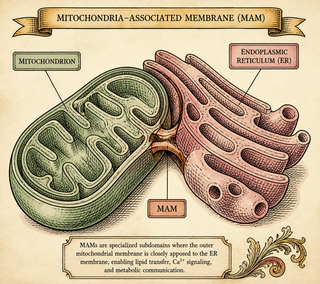
The sketchy little hallway between cell compartments
Cells are not bags of soup, no matter how often biology tries to humble us. They are more like cramped apartments with fussy neighbors. The endoplasmic reticulum, or ER, handles protein folding and calcium storage. Mitochondria make energy. MAMs are the tiny contact zones where these two structures lean across the fence and exchange messages, calcium, and metabolic cues.
And apparently, in glioblastoma, that fence-line gossip matters a lot.
The researchers found that ERO1alpha is a key regulator of these ER-mitochondria connections. When ERO1alpha levels are high, glioblastoma cells become better at maintaining MAM structure and calcium signaling. That, in turn, helps mitochondria keep oxidative phosphorylation humming - basically the high-efficiency power plant setting. For a tumor, that is less "nice to have" and more "keeps the whole criminal enterprise solvent."
Even more ominous, higher ERO1alpha expression was associated with worse survival in patients with GBM Bassot et al., 2026.
Why should anyone care about calcium drama?
Because calcium in cells is not decorative. It is a signaling currency. If genes are the sheet music, calcium is one of the conductors waving everyone in at the right moment.
ER-to-mitochondria calcium transfer helps cells decide how to make energy, how to handle stress, and sometimes whether to live or die. Cancer cells love messing with this system. If they can tune those signals just right, they gain metabolic flexibility - the ability to switch fuel strategies when conditions get ugly. And tumor conditions are often very ugly: low oxygen, nutrient shortages, therapy pressure, all the charming amenities of a hostile microenvironment.
This study suggests ERO1alpha helps glioblastoma cells stay musically agile under that pressure. Instead of missing a beat, they change key.
A tumor that can jam in multiple styles is hard to kill
One of the nastiest features of glioblastoma is plasticity. These cells do not just grow - they adapt. Shut one pathway down, and they start freelancing somewhere else. It is like trying to throw a rowdy guest out of a bar only to find they have already become the bartender.
Bassot and colleagues show that ERO1alpha supports both aggressiveness and metabolic flexibility by controlling MAM dynamics and mitochondrial function Bassot et al., 2026. When they interfered with ERO1alpha, they saw anti-tumor effects, linking this protein to a potentially druggable vulnerability.
That matters because glioblastoma has not exactly been spoiled for successful targeted therapies. Many promising ideas have faceplanted once they hit the realities of the brain - blood-brain barrier issues, tumor heterogeneity, resistance, and the general rudeness of cancer biology.
So a weakness tied to how tumor cells manage energy and organelle communication? That gets attention.
This fits a bigger trend in cancer research
Cancer metabolism has made a serious comeback in the past decade, and MAMs have become a hot neighborhood on that map. Reviews have highlighted how ER-mitochondria contacts shape metabolism, redox balance, calcium signaling, and cell death across many cancers Simoes et al., 2022; Missiroli et al., 2020. In glioblastoma specifically, metabolic rewiring is now viewed as a central reason these tumors resist treatment and survive in punishing conditions Venneti and Thompson, 2017; Ruiz-Rodado et al., 2020.
There is also growing interest in ERO1alpha itself as a cancer-associated protein involved in oxidative stress responses, hypoxia adaptation, and tumor progression in several settings Tanaka et al., 2023. So this glioblastoma paper is not coming out of nowhere. It drops into an ongoing jazz set and takes a very sharp solo.
The exciting part - and the buzzkill part
The exciting part is obvious: if ERO1alpha helps glioblastoma cells stay dangerous, then blocking it might make them more vulnerable. Maybe not as a solo act, but as part of a combo - paired with radiation, chemotherapy, or other metabolic strategies. That is where this could get interesting in the clinic.
The buzzkill part is also obvious: a mechanism-heavy paper is not the same thing as a treatment. A lot still has to happen. Researchers need to confirm these findings across diverse patient tumors, understand which glioblastomas depend on ERO1alpha most, and figure out whether a safe inhibitor can actually work in the brain. The brain is not exactly known for easy drug delivery. It is more like an exclusive club with a bouncer who hates pharmacology.
Still, this study gives us something precious in glioblastoma research - not hype, but a specific, testable weak point. And in a disease this adaptable, even finding where the wiring runs behind the walls is a big deal.
References
-
Bassot A, Violy L, Gorka L, et al. ERO1a fosters glioblastoma aggressiveness and metabolic flexibility by regulating mitochondria-associated membrane dynamics. Nat Cell Biol. 2026. doi:10.1038/s41556-026-01980-2
-
Simões IC, Morciano G, Lebiedzinska-Arciszewska M, et al. The mystery of mitochondria-ER contact sites in cancer - a review. Semin Cancer Biol. 2022;86(Pt 3):1107-1122. doi:10.1016/j.semcancer.2022.01.006
-
Missiroli S, Danese A, Iannitti T, Patergnani S, Perrone M, Previati M, Giorgi C, Pinton P. Endoplasmic reticulum-mitochondria Ca2+ crosstalk in the control of the tumor cell fate. Cancers (Basel). 2020;12(10):2792. PMCID:PMC7556356
-
Venneti S, Thompson CB. Metabolic reprogramming in brain tumors. Annu Rev Pathol. 2017;12:515-545. doi:10.1146/annurev-pathol-052016-100425
-
Ruiz-Rodado V, Brender JR, Cherukuri MK, et al. Metabolic landscape of a genetically engineered mouse model of IDH1 wild-type glioma. Acta Neuropathol Commun. 2020;8:3. doi:10.1186/s40478-019-0872-6
-
Tanaka T, Kajiwara T, Torigoe T, Sato N. ERO1-alpha in cancer - from protein folding to tumor progression. Cancers (Basel). 2023;15(3):777. doi:10.3390/cancers15030777
Disclaimer: The image accompanying this article is for illustrative purposes only and does not depict actual experimental results, data, or biological mechanisms.