Antibody-drug conjugates are often described as “smart chemotherapy,” which is mostly fair, though I prefer “chemo with a GPS and a tiny grudge.” Dato-DXd binds TROP2, a protein found on the surface of many epithelial cancers, including lung cancers. Once the antibody latches on, the whole package can get pulled into the cell. Then enzymes inside the tumor cell snip the linker and release DXd, a topoisomerase I inhibitor.
Topoisomerase I is the enzyme that helps DNA unwind and relax during copying. Block it, and DNA starts accumulating breaks. Cancer cells, which are already running replication like a startup with no HR department, can tip into disaster. The payload is potent, but the targeting matters because nobody wants a free-range DNA-damaging compound wandering through the body like it owns the place.
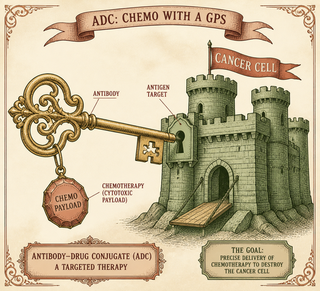
That targeting idea is why TROP2-directed ADCs have drawn so much attention in lung cancer. Earlier trials, including TROPION-PanTumor01, TROPION-Lung01, and TROPION-Lung05, showed that Dato-DXd could shrink tumors in some patients with advanced NSCLC, especially in non-squamous disease and in certain genomically defined groups.[2-4] In June 2025, the FDA granted accelerated approval to Dato-DXd for previously treated EGFR-mutated NSCLC after EGFR-directed therapy and platinum chemotherapy, based on pooled TROPION-Lung01 and TROPION-Lung05 data.[5]
TROP2 Is the Doorbell, Not the Whole House
The tempting story would be: high TROP2 equals good response, low TROP2 equals bad response, everyone goes home early. Cancer biology heard that and immediately knocked over the furniture.
ICARUS-LUNG01 suggests TROP2 expression alone is not enough. Some tumors may have TROP2 on the surface but still fail to internalize the drug efficiently. That is a big mechanistic deal. An ADC does not just need to bind. It needs to get swallowed by the tumor cell, like a Trojan horse that actually makes it past security.
The researchers found that resistance may be linked to a lack of cytoplasmic TROP2 staining. Translation: the target may be present, but the cellular trafficking machinery may not be helping Dato-DXd get where it needs to go. The receptor is answering the door but refusing to invite the drug inside. Rude, but biologically informative.
The Tumor’s Repair Crew May Be Too Good at Its Job
The other resistance clue was early activation of DNA repair pathways. This makes molecular sense. Dato-DXd’s payload damages DNA. If the tumor rapidly calls in its repair enzymes, the payload’s grand dramatic entrance becomes more of a mild inconvenience.
This is where pharmacology gets satisfying. The drug’s effect depends on a chain of events: bind TROP2, internalize, release DXd, damage DNA, overwhelm repair, trigger cell death, maybe wake up immune signaling along the way. Break any link in that chain and the response can fizzle. Tumors are not just bags of targets. They are systems, and frankly, some of them are annoyingly well managed.
ICARUS-LUNG01 also found that immune-related pathways were associated with response. That raises a tasty possibility: ADCs may not only deliver poison but also create enough tumor cell stress to make the immune system notice the mess. Your T cells may be the neighborhood watch, but sometimes they need the equivalent of a flaming couch on the lawn before they investigate.
Why This Matters
The big lesson is not simply that Dato-DXd works in some patients. We already had that signal from larger Dato-DXd studies.[2-4] The better lesson is that ICARUS-LUNG01 starts explaining why it works, and why it does not.
That matters because advanced NSCLC treatment is crowded with options, but not all patients benefit from each one. A biomarker that says “this tumor is likely to internalize Dato-DXd and fail at repairing the DNA damage” would be far more useful than a vague thumbs-up based on surface staining alone. If validated in phase 3 datasets, these findings could push ADC treatment toward smarter patient selection, fewer wasted months, and fewer unnecessary toxicities like stomatitis, nausea, fatigue, hair loss, and the lung inflammation risks clinicians watch carefully with DXd-based drugs.[1,5]
For now, ICARUS-LUNG01 gives us a sharper map. Dato-DXd is not just a missile aimed at TROP2. It is a full delivery-and-damage system, and the tumor has to cooperate just enough to let the trap spring. Cancer cells, naturally, would prefer not to. Molecules have boundaries too, apparently.
References
-
Planchard D, Cozic N, Mosele MF, et al. Efficacy, safety, and biomarker analysis of datopotamab deruxtecan in advanced non-small cell lung cancer: ICARUS-LUNG01 phase 2 study. Cancer Cell. 2026. DOI: 10.1016/j.ccell.2026.03.017
-
Ahn MJ, Tanaka K, Paz-Ares L, et al. Datopotamab deruxtecan versus docetaxel for previously treated advanced or metastatic non-small cell lung cancer: the randomized, open-label phase III TROPION-Lung01 study. Journal of Clinical Oncology. 2024. DOI: 10.1200/JCO-24-01544
-
Mosele MF, Westphalen B, Stenzinger A, et al. Datopotamab deruxtecan in advanced or metastatic non-small cell lung cancer with actionable genomic alterations: results from the phase II TROPION-Lung05 study. Journal of Clinical Oncology. 2025;43:1254-1265. DOI: 10.1200/JCO-24-01349
-
Shimizu T, Sands J, Yoh K, et al. First-in-human, phase I dose-escalation and dose-expansion study of TROP2-directed antibody-drug conjugate datopotamab deruxtecan in non-small-cell lung cancer: TROPION-PanTumor01. Journal of Clinical Oncology. 2023;41:4678-4687. DOI: 10.1200/JCO.23.00059
-
U.S. Food and Drug Administration. FDA grants accelerated approval to datopotamab deruxtecan-dlnk for EGFR-mutated non-small cell lung cancer. June 23, 2025. FDA approval notice
Disclaimer: The image accompanying this article is for illustrative purposes only and does not depict actual experimental results, data, or biological mechanisms.