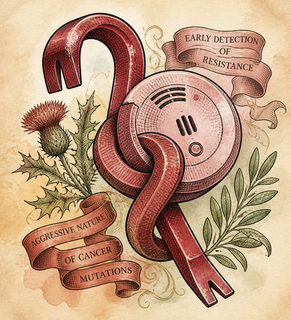
Recipe for a treatment headache: take one colorectal cancer cell, add a KRAS G12C mutation, simmer with a targeted inhibitor, then watch the tumor rummage through the pantry for emergency escape ingredients. Some cells grab new mutations. Some change their personality. Some apparently pull the fire alarm and call it “inflammation.” Cancer biology, as usual, arrives wearing a lab coat and carrying a crowbar.
The paper highlighted here, The cartography of KRAS inhibitor resistance in colorectal cancer, is a commentary on new work from Alonso and colleagues in Cancer Cell. The big idea is simple and nasty: when doctors block KRAS G12C in advanced colorectal cancer, the tumor does not fail in one tidy way. It fails like a bad hospital printer. Locally. Weirdly. Differently in every corner.
That matters because KRAS has been one of oncology’s most famous locked doors.
KRAS: The Stuck Accelerator
KRAS is a signaling protein. In normal cells, it helps control growth. It turns on. It turns off. Like a decent adult.
A KRAS mutation can jam that system in the “go” position. The cell keeps getting growth signals, which is great if you are trying to repair a scraped knee and terrible if you are building a tumor with delusions of grandeur.
KRAS mutations show up in a large share of colorectal cancers. KRAS G12C is a smaller slice, roughly 3% to 4% of metastatic colorectal cancer, but it has become a major target because drugs can bind that altered cysteine and trap KRAS in an inactive state. Finally, a handle on the greased pig.
Drugs like adagrasib and sotorasib changed the mood. In trials, KRAS G12C inhibitors worked better in colorectal cancer when paired with EGFR blockers such as cetuximab or panitumumab, because colorectal tumors are annoyingly good at reactivating upstream growth signals when KRAS gets blocked. Oncology calls this feedback signaling. Everyone else calls it “the tumor found the spare key.”
The Map Is the Message
Alonso and colleagues went looking for how resistance happens in actual patient samples. Not just “before treatment” and “after everything went wrong,” but also early on treatment. That is the useful part. If resistance is a house fire, they were checking the smoke detector before the roof collapsed.
They used targeted sequencing and single-cell spatial transcriptomics. Translation: they looked for DNA changes and also mapped which genes were active in cells sitting in different tumor neighborhoods.
The result was not one resistance mechanism. It was a patchwork.
Some resistant cancer cells had genetic changes that could restart RAS-MAPK signaling. That is the classic villain move: mutate around the drug.
But other cells did something sneakier. They shifted their cell state. They turned on programs linked to epithelial plasticity, inflammation, interferon signaling, YAP activity, fetal-like intestinal states, and other survival modes. Same tumor. Different zones. Different escape plans. Like a bank heist where every robber brought a separate getaway vehicle.
The Inflammation Alarm
One especially interesting finding was an early inflammatory response after KRAS inhibition. Within days to weeks, cancer cells showed pro-inflammatory signaling that seemed to help them survive treatment stress.
This is rude but biologically believable. Cancer cells under pressure do not just sit quietly and reconsider their life choices. They adapt. They send signals. They recruit pathways. They make the neighborhood sketchier.
The team also identified TBK1 as a possible target in this early inflammatory adaptation. In preclinical models, blocking TBK1 along with KRAS inhibition helped overcome resistance. That does not mean patients should expect a new combination tomorrow morning. Preclinical models are not people. Organoids do not have parking bills, immune histories, or liver metabolism.
But it gives researchers a lead. And in cancer treatment, a good lead is not a cure. It is a paramedic with the right address.
Why Patients Should Care
KRAS G12C colorectal cancer now has targeted therapy options. That is real progress. Adagrasib plus cetuximab and sotorasib plus panitumumab have both shown meaningful activity in previously treated metastatic disease. The FDA approved sotorasib with panitumumab in January 2025 for eligible patients with KRAS G12C-mutated metastatic colorectal cancer after prior chemotherapy.
But responses can be limited. Tumors adapt. Some may carry resistance-associated alterations before treatment even starts. Others may develop new genetic changes. Others may survive by switching cell states without changing the DNA playbook.
This paper’s lesson is practical: resistance is not just a mutation problem. It is a geography problem.
A single biopsy may miss the neighborhood where the tumor is already plotting. Blood-based tumor DNA can catch some genetic resistance, but it may miss non-genetic cell-state shifts. Spatial tools could help reveal where resistance is forming and what kind of combination therapy might block it.
The Next Move
The future probably looks less like one magic KRAS drug and more like smart combinations: KRAS inhibitor plus EGFR blockade, maybe plus another partner aimed at inflammatory adaptation, MAPK rebound, YAP signaling, or whatever escape hatch the tumor is using.
That sounds complicated because it is. Cancer is not a locked door. It is a building with bad wiring, hidden stairwells, and a security guard who left during lunch.
Still, mapping resistance gives clinicians and researchers something better than vibes. It gives coordinates. If these findings hold up in larger studies, KRAS therapy could become more precise, more durable, and less surprised when tumors try the usual nonsense.
The emergency is clear. The map is getting better. Now the job is to arrive before the tumor changes the street signs.
References
-
White M, Campbell AD, Sansom OJ. The cartography of KRAS inhibitor resistance in colorectal cancer. Cancer Cell. 2026. doi:10.1016/j.ccell.2026.05.010
-
Alonso S, Chu K, et al. Concurrent genetic and non-genetic resistance mechanisms to KRAS inhibition in colorectal cancer. Cancer Cell. 2026. doi:10.1016/j.ccell.2026.04.009
-
Yaeger R, Weiss J, Pelster MS, et al. Adagrasib with or without Cetuximab in Colorectal Cancer with Mutated KRAS G12C. New England Journal of Medicine. 2023;388:44-54. doi:10.1056/NEJMoa2212419
-
Fakih MG, Salvatore L, Esaki T, et al. Sotorasib plus Panitumumab in Refractory Colorectal Cancer with Mutated KRAS G12C. New England Journal of Medicine. 2023;389:2125-2139. doi:10.1056/NEJMoa2308795
-
Hofmann MH, Gerlach D, Misale S, Petronczki M, Kraut N. Expanding the Reach of Precision Oncology by Drugging All KRAS Mutants. Cancer Discovery. 2022;12:924-937. doi:10.1158/2159-8290.CD-21-1331
Disclaimer: The image accompanying this article is for illustrative purposes only and does not depict actual experimental results, data, or biological mechanisms.