In the hushed savanna of the human brain, the glioblastoma stalks its territory, not with claws or dramatic music, but with suspiciously well-managed energy bills.
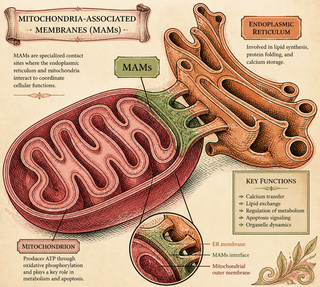
That is the creepy little spotlight from a new Nature Cell Biology paper: glioblastoma cells may get nastier when they tune the physical chatter between two tiny cell organs, the endoplasmic reticulum and mitochondria. Yes, even your cells have departments. Yes, they apparently hold meetings. No, HR cannot help us now.
The study centers on ERO1α, a protein with the name of a Wi-Fi password and the behavior of a backstage manager for tumor metabolism. Bassot and colleagues report that ERO1α sits at mitochondria-associated membranes, or MAMs, where the endoplasmic reticulum and mitochondria get close enough to pass biochemical notes under the desk. In glioblastoma models, more ERO1α lined up with worse patient survival, more aggressive tumor behavior, and stronger mitochondrial oxidative phosphorylation, meaning the cells could burn fuel more efficiently when the situation called for it [1].
The Cell Has a Suspicious Back Room
The endoplasmic reticulum, or ER, helps fold proteins and manage calcium. Mitochondria make energy, sense stress, and occasionally decide a cell should self-destruct, which is honestly a lot of responsibility for something shaped like a tiny bean.
MAMs are the contact zones between them. Think of them as loading docks where calcium, lipids, and stress signals move from one organelle to another. That sounds wholesome until cancer cells start using the loading dock like a smuggling tunnel.
Calcium is especially important here. Cells use calcium like a text alert system: tiny pulses can tell mitochondria to make more energy, shift metabolism, or respond to stress. In this paper, ERO1α helped regulate MAM structure and calcium-mediated functions. In plain English: it helped control how loudly the ER and mitochondria talk, and glioblastoma cells seemed to like that volume turned up.
Glioblastoma Is Annoyingly Good at Plan B
Glioblastoma is hard to treat for many reasons: it grows into brain tissue instead of forming a neat lump, it varies wildly from one region to another, and the blood-brain barrier makes drug delivery feel like trying to sneak a couch through airport security.
But one of its more maddening tricks is metabolic flexibility. Some tumors lean on glycolysis, the quick-and-dirty sugar-burning strategy. Others depend more on mitochondria and oxidative phosphorylation. A 2021 Nature Cancer study even identified a mitochondrial glioblastoma subtype with specific vulnerability to oxidative phosphorylation inhibitors [2]. Translation: not all glioblastomas are eating from the same buffet.
That matters because therapies often fail when tumors switch fuel sources. You block one pathway, and the cancer calmly opens another tab. Very rude. Very on-brand.
The new ERO1α paper connects that flexibility to ER-mitochondria contact sites. When ERO1α activity was high, glioblastoma cells showed more aggressive behavior in lab and animal models and boosted mitochondrial energy production. When researchers inhibited ERO1α, they saw antitumor effects, suggesting a possible druggable vulnerability [1].
Why This Is More Than Cellular Gossip
This is interesting because it moves the target from “kill fast-dividing cells” to “mess with the tumor’s logistics.” That is a different strategy. Instead of only attacking the engine, you go after the wiring that lets the engine adapt.
Other recent work backs up the general idea that glioblastoma metabolism is not decorative biology. Cancer Discovery researchers found that glioblastoma cells can rely on fatty acid metabolism and mitochondrial protection systems, with MCAD helping shield mitochondria from damaging lipid peroxidation [3]. Meanwhile, large-scale glioma studies show that tumor progression depends not just on mutations, but on shifting interactions with the tumor microenvironment, which is basically the cellular neighborhood watch if the neighborhood watch got bribed [4].
MAM biology also fits into a broader cancer story. Reviews of ER-mitochondria contact sites describe them as hubs for calcium signaling, lipid handling, mitochondrial function, stress responses, and cell death pathways [5]. In cancer, that hub can become a control panel for survival.
The Catch, Because Biology Loves a Catch
Before anyone starts naming an ERO1α-blocking drug “Mitochondria-Be-Gone,” we need the boring-but-vital caveats. This is preclinical work. Lab models and animal models are essential, but they are not patients. Glioblastoma in a real human brain brings extra complications: delivery across the blood-brain barrier, tumor heterogeneity, toxicity to normal brain cells, and the timeless villainy of recurrence.
Also, MAMs do normal useful things in healthy cells. Calcium signaling and mitochondrial metabolism are not tumor-exclusive hobbies. Any therapy aimed here would need precision, context, and a very serious safety conversation.
Still, the concept is sharp. If ERO1α helps glioblastoma cells stay metabolically nimble, then blocking it might make the tumor less adaptable, less aggressive, and more vulnerable to other treatments. That would be a meaningful shift: not a magic wand, but maybe a way to stop the tumor from constantly changing costumes in the middle of the chase.
At 2 a.m., that is the kind of result that makes you stare at the screen, whisper “wait, what,” and refill the coffee with the haunted determination of someone who has just realized the cell’s back room has a lock worth picking.
References
-
Bassot A, Violy L, Gorka L, et al. ERO1a fosters glioblastoma aggressiveness and metabolic flexibility by regulating mitochondria-associated membrane dynamics. Nature Cell Biology. 2026. https://doi.org/10.1038/s41556-026-01980-2
-
Garofano L, Migliozzi S, Oh YT, et al. Pathway-based classification of glioblastoma uncovers a mitochondrial subtype with therapeutic vulnerabilities. Nature Cancer. 2021;2:141-156. https://doi.org/10.1038/s43018-020-00159-4. PMCID: PMC7935068.
-
Puca F, Yu F, Bartolacci C, et al. Medium-chain acyl-CoA dehydrogenase protects mitochondria from lipid peroxidation in glioblastoma. Cancer Discovery. 2021;11(11):2904-2923. https://doi.org/10.1158/2159-8290.CD-20-1437. PMCID: PMC8711129.
-
Varn FS, Johnson KC, Martinek J, et al. Glioma progression is shaped by genetic evolution and microenvironment interactions. Cell. 2022;185(12):2184-2199.e16. https://doi.org/10.1016/j.cell.2022.04.038
-
Lim SM, Choi YJ, Oh SH. Relevance of the endoplasmic reticulum-mitochondria axis in cancer diagnosis and therapy. Experimental & Molecular Medicine. 2023. https://doi.org/10.1038/s12276-023-01137-3
Disclaimer: The image accompanying this article is for illustrative purposes only and does not depict actual experimental results, data, or biological mechanisms.