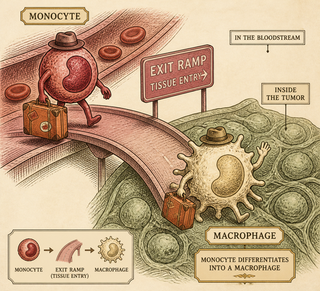
A monocyte leaves the bloodstream like a weary traveler rolling a suitcase through a hospital corridor, takes the exit ramp into a tumor, and somehow arrives as a macrophage or dendritic cell with a very specific job assignment.
That is the cellular travel story behind a new Cancer Cell study by Liu and colleagues, and yes, the cells brought receipts. The researchers used tiny natural mutations in mitochondrial DNA as built-in luggage tags to trace where innate immune cells came from and what they became inside human lung and ovarian cancers Liu et al., 2026.
The Tumor Neighborhood Has a Staffing Problem
When people hear “immune system,” they often think of T cells, the dramatic special forces of cancer immunotherapy. T cells get the movie poster. T cells get the fan mail. But inside many solid tumors, a huge share of the immune crowd belongs to innate immune cells: monocytes, macrophages, dendritic cells, neutrophils, and friends who show up early, react fast, and make a lot of local decisions.
At the bedside, this matters because immunotherapy does not fail in the abstract. It fails in a person who was hoping for more time, fewer scans with bad news, and one less hard conversation in a too-bright clinic room. Tumors are not just lumps of cancer cells. They are messy neighborhoods full of blood vessels, fibroblasts, immune cells, oxygen problems, chemical signals, and what I can only describe as biological office politics.
Myeloid cells, especially macrophages and monocytes, can either help fight cancer or help the tumor keep the peace in the worst possible way Goswami et al., 2023. Sometimes they act like cleanup crews. Sometimes they act like bouncers keeping T cells out of the club. Rude, but apparently effective.
The Clever Part: Mitochondria as Cell Passports
The challenge has been tracking innate immune cells in real human tumors. T cells and B cells carry receptor sequences that can work like name tags for clonal tracking. Innate immune cells do not give researchers that same convenient barcode. Classic cancer biology, always hiding the label on the back of the bottle.
So Liu and colleagues leaned on mitochondria, the little energy-making structures inside cells. Mitochondria carry their own DNA, and over time that DNA picks up somatic mutations. These mutations are not necessarily driving cancer. In this context, they function more like quiet family marks passed from parent cell to daughter cell.
This idea builds on earlier work showing that mitochondrial DNA mutations can trace cell lineages in human tissues while also linking those lineages to single-cell gene regulation data Ludwig et al., 2019, Lareau et al., 2021. In the new study, the team jointly measured chromatin accessibility and mitochondrial variants in 218,715 cells from matched tumors, nearby tissues, and blood from patients with lung and ovarian cancers.
That is a lot of cells. If each cell had a tiny clipboard, the lab would need a bigger break room.
What They Found in the Cellular Family Tree
The big result: tumor-resident myeloid cells, including macrophages and type 3 dendritic cells, were clonally related to monocytes in blood and tissue. In plain English, some immune cells inside the tumor looked like they came from circulating monocyte ancestors rather than being mysterious locals who had always lived there.
Even more interesting, the researchers found different clone “flavors.” Some clones leaned toward becoming dendritic cells. Others leaned toward macrophages. And those biases appeared linked to epigenetic differences already visible in circulating monocyte precursors before the cells entered the tumor.
That is the eyebrow-raising part. It suggests the tumor may not be the only place where these immune fates get decided. Some of the programming may start earlier, out in the bloodstream, before the cell walks into the tumor’s sketchy little neighborhood and gets handed a suspicious job description.
Why This Could Matter for Patients
If these findings hold up in larger studies, they could shift how researchers think about myeloid-targeted cancer therapy. Many treatments aim to reprogram macrophages, block suppressive myeloid signals, or improve T-cell access to tumors Barry et al., 2023. But if some monocytes are already biased before they arrive, then maybe future treatments could intercept the problem earlier.
That could mean blood-based biomarkers that tell clinicians which myeloid programs are active. It could mean smarter combinations with checkpoint inhibitors. It could mean designing therapies that nudge incoming monocytes away from “tumor helper” mode and toward “please stop assisting the cellular rebels” mode.
We are not there yet. This study is a map, not a medication. It does not prove that changing these clones will improve survival, shrink tumors, or spare anyone from chemo chair snack fatigue. But maps matter. In oncology, knowing where the road starts can change where treatment tries to put up the detour.
For patients, the hope is simple: fewer therapies chosen by guesswork, more therapies matched to the living ecosystem inside and around the tumor. Cancer care already asks people to tolerate enough uncertainty. Any tool that helps us see the hidden traffic patterns deserves attention.
References
-
Liu V, Sandor K, Yan PK, et al. Clonal lineage tracing of innate immune cells in human cancer. Cancer Cell. 2026. DOI: 10.1016/j.ccell.2026.05.006
-
Goswami S, Anandhan S, Raychaudhuri D, Sharma P. Myeloid cell-targeted therapies for solid tumours. Nature Reviews Immunology. 2023;23:106-120. DOI: 10.1038/s41577-022-00737-w
-
Barry ST, Gabrilovich DI, Sansom OJ, et al. Therapeutic targeting of tumour myeloid cells. Nature Reviews Cancer. 2023;23:216-237. DOI: 10.1038/s41568-022-00546-2
-
Ludwig LS, Lareau CA, Ulirsch JC, et al. Lineage tracing in humans enabled by mitochondrial mutations and single-cell genomics. Cell. 2019;176:1325-1339.e22. DOI: 10.1016/j.cell.2019.01.022. PMCID: PMC6408267
-
Lareau CA, Ludwig LS, Muus C, et al. Massively parallel single-cell mitochondrial DNA genotyping and chromatin profiling. Nature Biotechnology. 2021;39:451-461. DOI: 10.1038/s41587-020-0645-6. PMCID: PMC7878580
Disclaimer: The image accompanying this article is for illustrative purposes only and does not depict actual experimental results, data, or biological mechanisms.