A ketone body helping leukemia stem cells survive sounds like the kind of sentence that deserves a raised eyebrow, a second opinion, and maybe a nurse quietly saying, “Okay, science, let’s not get cute.” But that is exactly the strange little doorway this new Cell Stem Cell paper opens.
In acute myeloid leukemia, or AML, the hardest cells to deal with are often not the loud, fast-growing blasts that crowd the blood and bone marrow. They are the quieter leukemic stem cells, the ones that can tuck themselves away like bad tenants with excellent lease protection. Treatments may knock down much of the disease, but these stem-like cells can help AML come back later, which is the part no patient or care team wants to hear.
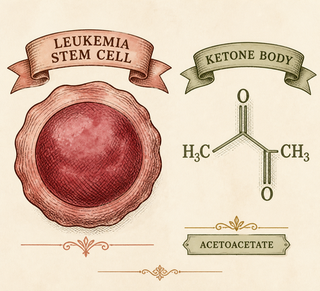
Han and colleagues studied those stubborn cells and found that they appear to run a private metabolic side hustle: making ketone bodies, especially β-hydroxybutyrate, or BHB, inside the leukemia cells themselves https://doi.org/10.1016/j.stem.2026.04.013.
The Liver’s Job, Apparently Outsourced
Ketones usually make people think of fasting, low-carb diets, or someone at brunch explaining ketosis with the confidence of a TED Talk and the volume of a leaf blower. Normally, the liver makes ketone bodies when carbohydrate supply is low, giving tissues an alternate fuel.
But this study suggests AML leukemic stem cells can make BHB on their own. The key enzyme was HMGCS2, a rate-limiting step in ketogenesis. The researchers found higher HMGCS2 in leukemic stem cells than in bulk leukemia blasts or normal blood-forming stem cells.
That distinction matters. A target that hits leukemia stem cells while largely sparing normal hematopoiesis is the kind of thing clinicians notice, because bone marrow is not a spare part you can order with overnight shipping.
Ferroptosis: Rusty Cell Death, But Make It Biology
The second half of the story is ferroptosis, a form of regulated cell death driven by iron and lipid peroxidation. In plain English: cell membranes contain fats, fats can oxidize, and if that oxidative damage gets out of control, the cell has a very bad day.
Cancer researchers like ferroptosis because some cancer cells sit close to that danger line already. AML cells, with their altered iron handling, oxidative stress, and lipid metabolism, may be especially vulnerable in certain contexts https://doi.org/10.1097/CM9.0000000000002642. It is less “poison the cell” and more “remove the fire extinguisher from a kitchen that was already making suspicious noises.”
In this new study, BHB seemed to help leukemic stem cells avoid ferroptosis. Mechanistically, BHB influenced the epigenetic regulation of FADS2, a fatty acid desaturase involved in phospholipid remodeling. That remodeling matters because the types of fats built into cell membranes affect how likely they are to undergo lipid peroxidation.
So the proposed chain looks like this: fatty acid oxidation feeds ketogenesis, HMGCS2 helps generate BHB, BHB changes lipid remodeling through FADS2, and the leukemic stem cell becomes less likely to die by ferroptosis. Neat, rude, and very on-brand for cancer biology.
Why This Feels Clinically Relevant
AML treatment has improved, especially with targeted therapies and venetoclax-based combinations. But relapse and resistance remain major problems, and leukemic stem cells are often part of that headache. Prior work has shown that AML stem cells rely heavily on mitochondrial metabolism and can adapt when one fuel source gets blocked. For example, relapsed AML stem cells can use nicotinamide metabolism to support amino acid metabolism and fatty acid oxidation, helping them resist venetoclax-based therapy https://doi.org/10.1016/j.stem.2020.07.021.
Recent reviews also point to lipid metabolism as a promising but tricky AML vulnerability, especially because fat handling intersects with oxidative stress, drug resistance, and the bone marrow niche https://doi.org/10.1038/s41375-025-02645-z. Translation: leukemia cells do not just eat differently. They decorate the whole break room.
This study adds a specific metabolic survival circuit to that picture. If future work confirms it in broader patient samples, HMGCS2, BHB production, FADS2-linked lipid remodeling, or ferroptosis sensitization could become therapeutic pressure points.
Please Do Not Blame Your Breakfast
One practical caveat: this paper is not saying a ketogenic diet causes AML or that patients should change diets to manipulate leukemia metabolism. The study focuses on ketogenesis inside leukemic stem cells. That is a different question from what someone eats during treatment, when appetite, nausea, weight loss, infections, and blood counts already make nutrition complicated enough to deserve its own tiny war room.
At the bedside, the hopeful part is not “ketones are bad.” The hopeful part is that leukemia stem cells may have exposed another dependency. Cancer cells survive by building escape routes. This work points to one of the doors, labels the hinges, and suggests there may be a way to jam it shut.
References
-
Han X, Wang K, Ma W, Zhu S, Guan J, Tian X, Zhao Z, Jiang L. A ketogenesis-ferroptosis axis maintains leukemic stem cell survival and leukemia progression. Cell Stem Cell. 2026. https://doi.org/10.1016/j.stem.2026.04.013
-
Dembitz V, James SC, Gallipoli P. Targeting lipid metabolism in acute myeloid leukemia: biological insights and therapeutic opportunities. Leukemia. 2025;39:1814-1823. https://doi.org/10.1038/s41375-025-02645-z
-
Lyu T, Li X, Song Y. Ferroptosis in acute leukemia. Chinese Medical Journal. 2023;136(8):886-898. https://doi.org/10.1097/CM9.0000000000002642
-
Jones CL, Stevens BM, Pollyea DA, et al. Nicotinamide metabolism mediates resistance to venetoclax in relapsed acute myeloid leukemia stem cells. Cell Stem Cell. 2020;27(5):748-764.e4. PMCID: PMC7655603. https://doi.org/10.1016/j.stem.2020.07.021
-
Wang Z, Yang Q, Yang Y, et al. Regulating ferroptosis in leukemic stem cells: from stemness preservation to targeted differentiation strategies. Stem Cell Reviews and Reports. 2026;22:296-323. https://doi.org/10.1007/s12015-025-11016-1
Disclaimer: The image accompanying this article is for illustrative purposes only and does not depict actual experimental results, data, or biological mechanisms.