Plant a garden long enough and you learn that the weeds were not always invaders from another planet. Some were sitting in the soil already, tiny and quiet, waiting for the wrong combination of rain, neglect, and cosmic bad luck to become everyone’s problem.
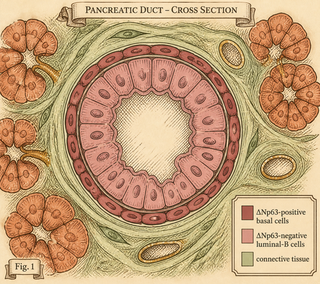
That is the unsettlingly useful idea behind this new study in Gut: some cellular features linked to aggressive pancreatic cancer may already exist, in a rare and organized way, inside healthy human pancreatic ducts. Not as cancer. Not as doom wearing a lab coat. Just as normal duct cells with identities scientists had not fully mapped before.
The paper looked at pancreatic ductal adenocarcinoma, or PDAC, the common and famously nasty form of pancreatic cancer, plus adenosquamous carcinoma of the pancreas, or ASCP, a rarer and also extremely rude variant. The researchers used spatial transcriptomics, single-cell RNA sequencing, multiplex immunofluorescence, and cell experiments to ask a deceptively simple question: what if tumors are not just chaotic blobs, but distorted echoes of the tissue they came from? (Van den Bossche et al., 2026)
The Pancreatic Duct Was Not Just Plumbing
The pancreas is usually described like a hardworking kitchen appliance tucked behind your stomach. It helps digest food and manage blood sugar. Its duct system carries digestive juices into the intestine, which sounds simple enough. A biological drainpipe. Very glamorous. Put it on a tote bag.
But this study argues that larger human pancreatic ducts are more layered than expected. The team found groups of Keratin-5 positive cells with gene patterns resembling basal and suprabasal cells seen in other tissues. At single-cell resolution, they separated these into two main populations: ΔNp63-positive basal cells, called BAS, and ΔNp63-negative luminal-B cells, called LUM-B.
That may sound like the cast list for a very niche sci-fi reboot, but the point is straightforward: the duct has distinct cell neighborhoods. Some cells sit in different physical positions, express different genes, and may have different abilities. The pancreas, it turns out, has zoning laws.
Meet ΔNp63, the Cellular Vibe Director
One standout was ΔNp63, a form of the p63 transcription factor. Transcription factors are proteins that help decide which genes get turned on. If the genome is a giant cookbook, transcription factors are the bossy people putting sticky notes on recipes.
The authors found that ΔNp63 could push cells toward a basal identity. That matters because basal-like pancreatic tumors have repeatedly been associated with worse outcomes and therapy resistance compared with classical tumors. Reviews and clinical studies have framed basal-like PDAC as the angrier sibling in the pancreatic cancer family, the one that shows up late, breaks the furniture, and refuses standard instructions (Zhou et al., 2021; Suurmeijer et al., 2022; Singh et al., 2024).
The twist here is that basal-like cancer programs may not be invented from scratch by the tumor. They may borrow from a real, native duct cell identity, then remix it badly. Cancer, as usual, is not creative so much as deeply unethical with existing materials.
PDAC Makes a Mess, ASCP Keeps the Floor Plan
Here is where the study gets especially interesting. In PDAC, the BAS and LUM-B signatures were linked to basal-like tumors and lower survival, but their spatial organization looked scrambled. The tumor seemed to preserve bits of the native duct program, then scatter them like someone dropped the pancreas map into a blender.
ASCP behaved differently. In those tumors, the BAS and LUM-B identities were more clearly preserved and spatially unmixed, closer to the layered organization seen in healthy ducts.
That distinction could matter because PDAC and ASCP are often grouped under the broad umbrella of pancreatic cancer treatment. But if one tumor type acts like a shredded version of duct architecture and another keeps the ductal blueprint more intact, lumping them together may be like giving the same gardening advice for tomatoes and poison ivy. Technically plants. Practically, please do not.
Why This Could Matter In Real Life
Pancreatic cancer desperately needs better ways to classify tumors, predict behavior, and choose treatment. Current molecular subtyping has already shown promise: basal-like tumors tend to have poorer survival, and large datasets suggest subtype can predict prognosis independent of other clinical factors (Singh et al., 2024). Other work shows that basal-like states can be plastic, meaning cancer cells may shift identities under pressure, like a villain changing disguises halfway through the movie (Pitter et al., 2022).
This new study adds a missing piece: the healthy tissue context. If researchers know which native duct cells resemble aggressive cancer programs, they can ask sharper questions. Do these cells contribute to tumor initiation? Can their markers help with earlier detection? Do ASCP and basal-like PDAC need separate drug strategies? Could ΔNp63-driven plasticity be interrupted?
Big caveat, because biology loves caveats: this is not a new treatment yet. It is a map. But good maps matter. You do not prune a garden by swinging hedge clippers in the dark and hoping for the best. You first figure out what is growing where.
References
-
Van den Bossche JL, Van der Vliet M, Michiels E, et al. Luminal-basal stratification of the native human pancreatic duct is differentially represented in pancreatic cancers. Gut. 2026. https://doi.org/10.1136/gutjnl-2025-337970
-
Zhou X, Hu K, Bailey P, et al. Clinical Impact of Molecular Subtyping of Pancreatic Cancer. Front Cell Dev Biol. 2021;9:743908. https://doi.org/10.3389/fcell.2021.743908
-
Suurmeijer JA, Soer EC, Dings MPG, et al. Impact of classical and basal-like molecular subtypes on overall survival in resected pancreatic cancer in the SPACIOUS-2 multicentre study. Br J Surg. 2022;109(11):1150-1155. https://doi.org/10.1093/bjs/znac272
-
Singh H, Xiu J, Kapner KS, et al. Clinical and Genomic Features of Classical and Basal Transcriptional Subtypes in Pancreatic Cancer. Clin Cancer Res. 2024;30(21):4932-4942. https://doi.org/10.1158/1078-0432.CCR-24-1164
-
Pitter KL, Grbovic-Huezo O, Joost S, et al. Systematic Comparison of Pancreatic Ductal Adenocarcinoma Models Identifies a Conserved Highly Plastic Basal Cell State. Cancer Res. 2022;82(19):3549-3560. https://doi.org/10.1158/0008-5472.CAN-22-1742
Disclaimer: The image accompanying this article is for illustrative purposes only and does not depict actual experimental results, data, or biological mechanisms.