Most cancers at least have the decency to announce themselves. High-grade serous carcinoma (HGSC) - the subtype responsible for about 80% of ovarian cancer deaths - does not. It throws vague symptoms (bloating, feeling full, mild pelvic discomfort) that every human over 40 experiences after a big burrito. So by the time it's caught, it's usually already redecorated the abdomen.
The numbers in this new Nature Reviews Cancer report are sobering: only half of patients survive past five years. And if you show up with advanced disease and don't carry a BRCA mutation, that drops to roughly 30%. After a decade of genuinely impressive science, that needle has barely moved. So the authors did the responsible adult thing and asked: what actually changed, and what do we do next?
Plot twist: it wasn't even the ovaries
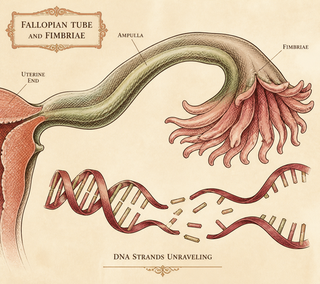
Here's the finding that reorganized the whole field. For ages we assumed ovarian cancer started in, you know, the ovary. Reasonable assumption. Turns out a big chunk of HGSC actually begins in the fallopian tubes - specifically in the fimbriae, the little finger-like ends that wave eggs toward the uterus. Tiny precancerous lesions set up shop there, then migrate over to the ovary and cause all the trouble.
Why does this matter beyond trivia night? Because if the cancer's hometown is the fallopian tube, then removing fallopian tubes - during routine procedures or as a standalone prevention step (opportunistic salpingectomy, if you want to impress someone) - becomes a legitimate prevention strategy. You're essentially shutting down the factory before it ships product.
Your cancer cells have a genome-shredding problem
HGSC has the highest proportion of BRCA1/BRCA2 mutations of any cancer, and it's wildly chromosomally unstable - meaning its DNA is in a constant state of disarray, like a filing cabinet someone shoved down a staircase. That's terrible for the patient but, weirdly, an exploitable weakness.
Enter PARP inhibitors, the past decade's biggest win. The logic is darkly elegant: cancer cells with broken BRCA already can't repair DNA properly. Block their backup repair system (PARP) too, and they shred themselves to death. This "synthetic lethality" approach has genuinely helped a lot of patients. The catch - because there's always a catch - is that tumors learn to dodge it, and resistance shows up. The report spends real time on understanding how that resistance evolves, which is the unglamorous but essential work.
The neighborhood matters as much as the house
The other big shift: scientists stopped treating tumors as lumps of bad cells and started studying the whole tumor microenvironment - the immune cells, blood vessels, and support structures around the cancer. HGSC turns out to be a master at keeping the immune system locked out, which is why immunotherapy that works wonders in melanoma has mostly flopped here. Figuring out how to talk the immune system back into the building is one of the field's headline goals.
So where are we headed? The authors lay out priorities: better early detection (a blood test that catches HGSC before symptoms would be the holy grail), smarter combination therapies, and using new single-cell and spatial technologies to map exactly how these tumors operate cell by cell. It's less "miracle cure tomorrow" and more "we finally understand the enemy well enough to fight it properly." Given where this disease started, that's not a small thing.
Reference
Balkwill FR, Laumont CM, Burdett N, et al. Rethinking ovarian cancer III: the past decade and future directions. Nature Reviews Cancer. 2026. DOI: 10.1038/s41568-026-00916-0. PMID: 41975230
Disclaimer: The image accompanying this article is for illustrative purposes only and does not depict actual experimental results, data, or biological mechanisms.