The sample tubes are lined up, the sequencing machines are humming, and years after a colorectal adenoma got snipped out, the gut is still out here leaving fingerprints. That is the basic plot of a new Cell Host & Microbe paper - and honestly, it is a little rude of the microbiome to keep receipts for more than a decade.
Researchers looked at stool from 354 women about 12 years after adenoma removal and compared them with 354 matched controls. They also profiled fecal metabolites in 184 matched pairs. And here is where it gets interesting: even after the adenoma was removed, the gut microbiome and metabolome still looked different from people who never had one in the first place.1
That matters because colorectal cancer usually does not appear out of nowhere like a bad plot twist. It often develops along an adenoma-carcinoma sequence - normal tissue to adenoma to cancer - with biology changing step by step. If gut microbes and their chemical byproducts track along that path, they might help us understand risk, prevention, and maybe one day screening that goes beyond "please put this in a cup and try not to think too hard about it."
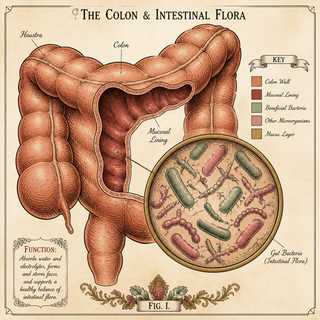
The gut is not a bystander - it is more like a chatty neighbor
Your colon is home to a packed city of microbes that digest food, make metabolites, interact with immune cells, and generally meddle in human affairs. Some of that meddling is helpful. Some of it looks a bit more like the neighborhood watch joining a biker gang.
This study asked a deceptively simple question: after an adenoma is removed, does the gut environment go back to baseline, or does it stay altered? The answer looks closer to "nope, still weird."
Compared with controls, people with a history of adenoma had distinct microbial composition. The pattern also overlapped with what other studies have seen in colorectal cancer. Quantitatively, the concordance with 14 independent CRC case-control datasets came in at a Pearson's rho of 0.26, with p < 0.0001.1 A rho of 0.26 is not the kind of number that bursts through the wall like the Kool-Aid Man, but in messy human microbiome data, it is real signal, not background kazoo noise.
A long memory in the microbiome
The authors found 31 microbes altered in both adenoma history and colorectal cancer, including Faecalibacterium prausnitzii and Flavonifractor plautii.1 If those names sound like a wizard duel, that is because microbiology refuses to be normal.
Why do these bugs matter? F. prausnitzii often gets attention as a potentially beneficial microbe because it is linked to anti-inflammatory effects and butyrate production.2 Changes in microbes like this can reflect a gut ecosystem that has shifted in ways relevant to carcinogenesis - inflammation, bile acid metabolism, barrier function, and immune signaling all show up in this neighborhood.34
The metabolomics results added another layer. Thirty metabolites and seven metabolic sub-pathways were associated with adenoma history, especially sphingolipids.1 That is a big deal because metabolites are the chemical chatter of the gut - the actual small molecules microbes and host cells make and exchange. If the microbiome is the cast, the metabolome is the script notes scribbled in the margins.
The paper also identified disease-specific microbe-metabolite links, including associations between Bilophila wadsworthia and alanine-containing dipeptides.1 Translation: the relationship between bugs and chemicals may not just be generally "off" - it may be altered in very specific ways tied to the adenoma-cancer continuum.
Why this is more than a very sophisticated poop story
Colorectal cancer remains one of the most common cancers worldwide, and a lot of prevention hinges on finding and removing adenomas before they turn dangerous.5 Colonoscopy does that well, but it is not exactly beloved. No one has ever said, "Great news, my weekend plans involve bowel prep."
If these microbiome and metabolome signatures hold up across broader populations, they could eventually help with risk stratification - identifying who might benefit from closer surveillance, lifestyle changes, or future noninvasive testing. Not tomorrow. Not next Tuesday. But the direction is intriguing.
And here is where it gets interesting again: these altered signatures were still detectable roughly 12 years after resection.1 That suggests one of two things - either adenoma risk leaves a long biological echo, or the underlying gut environment that helped the adenoma develop never fully resets. Possibly both. Neither option is exactly comforting, but both are informative.
The fine print, because the p-value is not a personality
This was not proof that microbes cause future colorectal cancer. It was largely observational, involved women in a specific cohort, and measured associations rather than direct mechanisms.1 Microbiome studies also have a long history of being scientifically exciting and logistically annoying. Diet, medications, exercise, geography, and who knows what else can all move the numbers around.
Still, the strength here is the long follow-up, the matched design, the combination of metagenomics plus metabolomics, and the comparison with 14 external CRC datasets.1 That is not a casual Tuesday spreadsheet. It is a serious attempt to place adenoma-associated gut changes on the same biological road as colorectal cancer.
The larger message is simple: removing a polyp may end one visible chapter, but the surrounding ecosystem may keep whispering that the story is not entirely over. And if we learn to listen better - with microbes, metabolites, and good old-fashioned clinical follow-up - we may get smarter about who needs the closest watch.
References
Disclaimer: The image accompanying this article is for illustrative purposes only and does not depict actual experimental results, data, or biological mechanisms.
-
Nogal A, Wang K, Thompson KN, et al. Long-lasting gut microbiome and fecal metabolome alterations after colorectal adenoma removal and their relationship to colorectal cancer. Cell Host Microbe. 2026; DOI: 10.1016/j.chom.2026.05.001 ↩↩↩↩↩↩↩↩
-
Martin R, Miquel S, Chain F, et al. The commensal bacterium Faecalibacterium prausnitzii is protective in inflammatory bowel disease. Review of current evidence and therapeutic prospects. Microb Cell Fact. 2017;16(1):1-11. PMCID: PMC5483500 ↩
-
Janney A, Powrie F, Mann EH. Host-microbiota maladaptation in colorectal cancer. Nature. 2020;585(7826):509-517. DOI: 10.1038/s41586-020-2729-3 ↩
-
Osadchiy V, Martin CR, Mayer EA. The gut-brain axis and the microbiome: mechanisms and clinical implications. While broader than colorectal neoplasia, this review covers microbiome-host signaling relevant to metabolite biology. Clin Gastroenterol Hepatol. 2019;17(2):322-332. PMCID: PMC6469458 ↩
-
Xi Y, Xu P. Global colorectal cancer burden in 2020 and projections to 2040. Transl Oncol. 2021;14(10):101174. DOI: 10.1016/j.tranon.2021.101174 ↩