A healthy body spends all day doing elite-parent multitasking - praising the well-behaved cells, redirecting the weirdly aggressive ones, and occasionally yelling, "Absolutely not," when a rogue cell starts licking the metaphorical electrical outlet. Cancer is what happens when one of those troublemakers stops listening, recruits friends, and somehow convinces the neighborhood to mind its own business. Now a new class of drugs called antibody-drug conjugates, or ADCs, is showing up like the strict assistant coach who knows exactly which player to bench.
The scouting report: what even is an ADC?
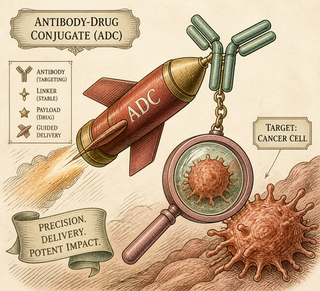
ADCs are basically guided missiles with better bedside manners. They combine two parts: an antibody that recognizes a target on cancer cells, and a chemotherapy payload that does the actual damage. The antibody finds the tumor. The drug rides shotgun. Once the ADC binds its target and gets pulled into the cell, the payload gets released and starts wrecking the place from the inside.
If plain old chemotherapy is like watering your whole lawn with herbicide and hoping the weeds suffer more than the roses, ADCs try to hit a specific weed with a dart. Not perfect, but a lot less chaotic.
This matters in gynecologic cancers - mainly ovarian, endometrial, and cervical cancers - where treatment can get ugly fast after standard options stop working. The review by Moore and colleagues lays out how ADCs have moved from intriguing roster prospects to actual starters in this space.1
Current starters on the field
Right now, three ADCs have made the big leagues for previously treated gynecologic cancers.
Mirvetuximab soravtansine targets folate receptor alpha, a protein often found at high levels on ovarian cancer cells. It is approved for folate receptor alpha-positive ovarian cancer after prior treatment. In the MIRASOL trial, it beat chemotherapy on several key outcomes in this patient group, which is the oncology equivalent of winning on the road and covering the spread.2
Trastuzumab deruxtecan targets HER2, a familiar name in breast cancer that also shows up in some gynecologic tumors. If a tumor strongly expresses HER2, this ADC can be an option regardless of where the cancer started. This "tumor-agnostic" angle is a big deal because cancer therapy usually loves paperwork and categories.3
Tisotumab vedotin targets tissue factor and has been approved for recurrent or metastatic cervical cancer. Cervical cancer has badly needed more offensive firepower, so this drug stepping onto the court matters.4
Why oncologists are paying attention
ADCs are attractive because they try to solve one of cancer treatment's oldest problems: how do you hit the tumor hard without flattening the rest of the patient?
That does not mean these drugs are gentle woodland creatures. They still cause side effects, sometimes serious ones. Eye toxicity with mirvetuximab soravtansine, lung inflammation with trastuzumab deruxtecan, and bleeding or eye issues with tisotumab vedotin are very real concerns.[^1,^3,^4] This is less "magic bullet" and more "precision tool that still comes with a warning label the length of a CVS receipt."
But the upside is real. ADCs can open options for patients whose cancers have already shrugged off prior therapy. In ovarian and cervical cancers especially, that is not a minor footnote. That is the game.
The annoying part: cancer adjusts
Naturally, tumors are being terrible sports about this.
Some cancers stop expressing the target. Some change how they process the ADC after it gets inside. Some learn resistance tricks that make the payload less effective. Cancer cells, as usual, are like a team down 20 in the fourth quarter still somehow finding ways to commit fouls and ruin everyone's evening.
That is why this review spends time on target selection, resistance mechanisms, and sequencing. Sequencing just means figuring out when to use these drugs and in what order relative to chemotherapy, immunotherapy, and other targeted treatments. Get that wrong and you may burn through good players too early. Get it right and you could extend disease control in a meaningful way.1
Combo plays could change the scoreboard
One of the most interesting angles here is combining ADCs with immune checkpoint inhibitors. The theory is pretty clever: ADCs kill tumor cells and may help expose cancer to the immune system, while checkpoint inhibitors remove the brakes from T cells. One softens up the defense, the other sends in the pass rush.
This is not just lab-coat fan fiction. ADC-immunotherapy combinations are already being tested across multiple tumor types, and early results have fueled serious interest in whether they can produce deeper or longer-lasting responses.[^5,^6] If that works consistently in gynecologic cancers, we may be watching the early tape on a future title contender.
What this means in real life
For patients, ADCs represent something more concrete than molecular hype. They expand the menu. They create more chances after relapse. They push treatment closer to the long-promised goal of matching the drug to the biology instead of carpet-bombing everything and hoping for the best.
The catch is that this approach depends on good biomarker testing, careful side-effect management, and continued trials to sort out who benefits most. Precision medicine sounds glamorous until you remember someone has to decide which test to run, how much target expression counts, and what to do when the biology gets weird. Which it absolutely will. Biology loves weird.
Still, the momentum is obvious. In gynecologic oncology, ADCs are no longer benchwarmers. They are in the rotation, putting up real numbers, and forcing the rest of the treatment playbook to adapt.
That is not a final score. But it is a very live game.
References
Disclaimer: The image accompanying this article is for illustrative purposes only and does not depict actual experimental results, data, or biological mechanisms.
-
Moore KN, Yeku OO, Howitt BE, Youssoufian H, Liu JF. Antibody-drug conjugates in gynaecological cancers: opportunities and challenges. Nat Rev Clin Oncol. 2026. doi:10.1038/s41571-026-01164-9 ↩↩
-
Moore KN, Oza AM, Colombo N, et al. MIRASOL: mirvetuximab soravtansine versus chemotherapy in platinum-resistant ovarian cancer with high folate receptor-alpha expression. N Engl J Med. 2024;390(17):1605-1617. doi:10.1056/NEJMoa2313038 ↩
-
Modi S, Jacot W, Yamashita T, et al. Trastuzumab deruxtecan in previously treated HER2-low advanced breast cancer. N Engl J Med. 2022;387(1):9-20. doi:10.1056/NEJMoa2203690
Note: This landmark paper is in breast cancer, but it helped define the broader ADC playbook and HER2-targeting strategy relevant across solid tumors. ↩ -
Coleman RL, Lorusso D, Gennigens C, et al. Efficacy and safety of tisotumab vedotin in recurrent or metastatic cervical cancer. Lancet Oncol. 2021;22(5):609-619. doi:10.1016/S1470-2045(21)00056-5 ↩
-
Banerjee S, Oza AM, Birrer MJ, et al. Antibody-drug conjugates in ovarian cancer: current status and future directions. Gynecol Oncol. 2024;174:25-34. doi:10.1016/j.ygyno.2024.03.012 ↩
-
Meric-Bernstam F, Hamilton E, Beeram M, et al. Zanidatamab zovodotin and other next-generation ADC strategies in HER2-expressing solid tumors. J Clin Oncol. 2023;41(16_suppl):abstr 3002. Available via PubMed and meeting archives. ↩