OncoBriefs - Oncology Research News

May 16, 2026

When the main pipe gets occupied

When the main pipe gets occupied

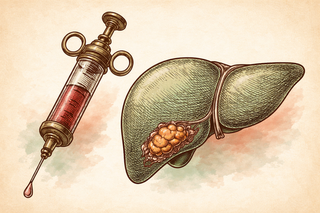
The paper by Yan and colleagues takes aim at one of the nastiest versions of liver cancer: hepatocellular carcinoma, or HCC, that has grown into the portal vein and formed a portal vein tumor thrombus, usually shortened to PVTT.[1] In plain English, the cancer is not just sitting in the liver being...
May 16, 2026

Your Gut Is Not a Side Character

Your Gut Is Not a Side Character

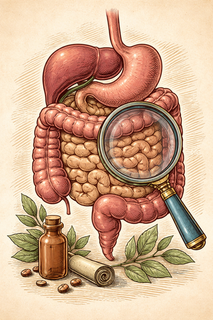
When I was nine, I spent a summer afternoon eating white bread, hot dogs, and exactly one token apple slice because that seemed like enough diplomacy with the fruit bowl. By sunset my stomach was staging a coup, and I learned a lesson children learn the hard way: your gut keeps receipts.

May 15, 2026

A Trojan horse for the surgical leftovers

A Trojan horse for the surgical leftovers

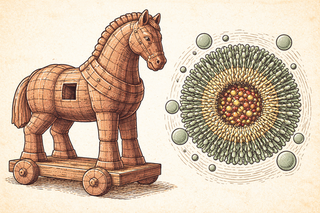
The new paper by Zhang and colleagues takes aim at that exact post-op problem with a very sneaky-sounding invention: an injectable "Trojan horse" hydrogel placed where the tumor used to be (1). The idea is simple enough to explain over fries and complicated enough to make cancer biology look like...

May 15, 2026

A vaccine for cancer? Yes, that is a real sentence

A vaccine for cancer? Yes, that is a real sentence

The treatment here combined pembrolizumab, an immune checkpoint inhibitor, with DNA vaccines. Pembrolizumab blocks PD-1, which is one of the molecular "calm down, do not overreact" signals on T cells. That is useful when your immune system is trying not to torch your healthy tissues, but it is less...

May 15, 2026

Meet the immune cell with a split personality

Meet the immune cell with a split personality

ILC2 stands for group 2 innate lymphoid cell. Basically, these are tissue-resident immune cells that hang out at barrier sites like the lungs and gut, where they normally help with parasite defense, allergic responses, and tissue repair. In other words, they are part medic, part alarm system, part...

May 15, 2026

Sold to the Highest Bidder: One Tiny Tumor Trap, Going Once

Sold to the Highest Bidder: One Tiny Tumor Trap, Going Once

Going once, going twice, sold - to the scrappiest little nanoplatform in the room, a gadget that basically waits for cancer cells to show their fake VIP badge and then starts chemical mayhem on-site.

May 15, 2026

The Cancer Vaccine That Waits for the Green Light

The Cancer Vaccine That Waits for the Green Light

If Dune: Part Two taught us anything in 2024, it is that winning the fight is not just about showing up with weapons - it is about timing, terrain, and springing the trap when your opponent thinks the coast is clear. That is basically the chess match in a new ACS Nano paper, published online April...

May 15, 2026

The Tumor’s Little Wiring Hack

The Tumor’s Little Wiring Hack

The key player here is calreticulin, a protein that can act like an "eat me" sign when stressed or dying cancer cells display it on their surface. That matters because immunogenic cell death, or ICD, is not just cancer cells dying. It is cancer cells dying loudly enough that the immune system...

May 15, 2026

When a cancer treatment gets smarter by being less monogamous

When a cancer treatment gets smarter by being less monogamous

Cancer drugs often fail because they pick one enemy in a room full of accomplices. That is the paradox sitting at the center of this new paper: the tumor is not just a bad cell problem, it is a bad neighborhood problem, and bringing one very stern bouncer to a riot rarely ends well.

May 14, 2026

A cancer blood test sensor just sniffed out miRNA-21 down to 0.36 attomolar and matched qRT-PCR in patient serum with an R² of 0.98. That is the ending. The rewind is where things get fun, because the trick was not some sci-fi laser circus, but a very practical idea: stop roughing up the delicate transistor while you glue the biology onto it.

A cancer blood test sensor just sniffed out miRNA-21 down to 0.36 attomolar and matched qRT-PCR in patient serum with an R² of 0.98. That is the ending. The rewind is where things get fun, because the trick was not some sci-fi laser circus, but a very practical idea: stop roughing up the delicate transistor while you glue the biology onto it.

MicroRNAs are short RNA snippets that help control which genes get expressed and when. Think of them as the group chat moderators of the cell. Quiet most days, wildly influential when things go off the rails. In cancer, certain microRNAs show up at odd levels in blood and other fluids, which is why...

May 14, 2026

Lung Cancer Screening at 10: The Party Started, but Half the Guests Still Aren't Here

Lung Cancer Screening at 10: The Party Started, but Half the Guests Still Aren't Here

Obituary: "Wait until lung cancer causes symptoms, then scramble." It had a long run, mostly powered by bad odds and crossed fingers, and medicine should really stop sending it flowers.

May 14, 2026

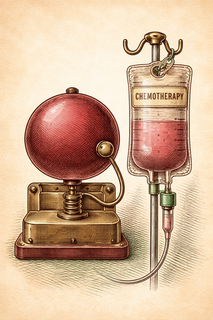
Medicare Built a Chemotherapy Heist Alarm. The Alarm Barely Went Off.

Medicare Built a Chemotherapy Heist Alarm. The Alarm Barely Went Off.

The Oncology Care Model, or OCM, was supposed to fix a very American problem: we pay for cancer care in ways that sometimes reward more stuff, not better care. But OCM had a built-in paranoia twist. Since a payment episode started when a patient got systemic therapy, critics worried practices might...

May 14, 2026

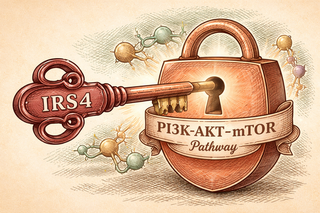
The Tumor’s Favorite Unauthorized Intern

The Tumor’s Favorite Unauthorized Intern

IRS4 belongs to the insulin receptor substrate family, which sounds bland enough to be filed next to staplers.[2] In practice, these proteins help pass messages from the cell surface to growth pathways inside the cell. One of those pathways is PI3K-AKT-mTOR, the molecular equivalent of a gas pedal...

May 14, 2026

When Cancer Survival Wins the Hand, the Deck Is Not Empty

When Cancer Survival Wins the Hand, the Deck Is Not Empty

Beating a first cancer can feel like dragging a mountain of chips to your side of the table, only to notice the dealer quietly shuffling another deck. That, in a slightly rude nutshell, is what this new U.S. study examined: not recurrence, not spread, but a genuinely new cancer appearing later in...

May 14, 2026

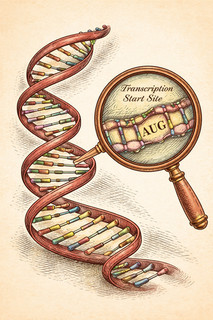
When RNA Starts Lying, Cancer Biology Gets Weird

When RNA Starts Lying, Cancer Biology Gets Weird

A healthy body parents its cells the way a decent adult handles a sugar-fueled toddler in a store: constant supervision, quick redirects, and the occasional hard stop before somebody knocks over the entire display. Most cells cooperate. A few go feral. Cancer, as usual, is what happens when the...

May 14, 2026

When Your Breast Tissue Posts "Currently Obscuring Small Masses, No Filter"

When Your Breast Tissue Posts "Currently Obscuring Small Masses, No Filter"

If dense breast tissue had a social media bio, it would absolutely read: "Thick, mysterious, and accidentally blocking the radiologist's view." Not evil. Not dramatic. Just standing there like a fog machine in a detective movie while everybody tries to spot the actual problem.

May 13, 2026

Digging Up a Tumor's Weak Spots, One Vesicle at a Time

Digging Up a Tumor's Weak Spots, One Vesicle at a Time

Brush away enough molecular dust and a tumor starts to look less like a solid mass and more like an archaeological site - layers of defenses, hidden tunnels, and the occasional booby trap for any drug dumb enough to walk in through the front door. That is the mood of this new ACS Nano paper, which...

May 13, 2026

Electric fields, but make them useful

Electric fields, but make them useful

Tumor-treating fields, or TTFields, already have a real clinical role in glioblastoma. They use low-intensity alternating electric fields, delivered through arrays on the scalp, to mess with dividing tumor cells. Think less Frankenstein, more very targeted cellular bureaucratic sabotage. The fields...

May 13, 2026

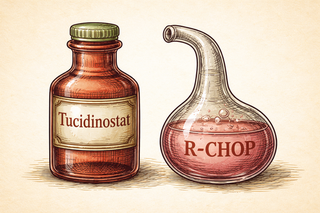
Recipe for a Better Lymphoma Plan: take one stubborn cancer, add standard chemo, fold in an epigenetic drug, and hope the whole thing does not catch fire in the toxicology section.

Recipe for a Better Lymphoma Plan: take one stubborn cancer, add standard chemo, fold in an epigenetic drug, and hope the whole thing does not catch fire in the toxicology section.

That, more or less, is the plot of a new randomized clinical trial in JAMA looking at tucidinostat plus R-CHOP for a nasty subtype of diffuse large B-cell lymphoma called MYC/BCL2 double-expressor lymphoma, or DEL for short. DEL is basically DLBCL with two molecular troublemakers, MYC and BCL2,...

May 13, 2026

Ten million cells. That is the part that makes this study behave less like a regular cancer paper and more like air traffic control for a city made of cells.

Ten million cells. That is the part that makes this study behave less like a regular cancer paper and more like air traffic control for a city made of cells.

Most studies zoom in. This one zooms out without going blurry. In Nature Communications, Liang and colleagues introduce CellNiche, a machine-learning system built to read spatial omics data at ridiculous scale and still keep track of who is standing next to whom, who is acting suspiciously, and...