That, in essence, is the premise of a recent Nature Cancer review on tertiary lymphoid structures, or TLSs - little immune-cell hangouts that can pop up inside or near tumors and might tell us who benefits from immunotherapy, and maybe even how to make more people benefit from it in the first place.1 Which is a pretty wild sentence if you stop and think about it. Cancer is already rude enough. Now we find out the neighborhood around it can either host a scrappy anti-tumor block party or become the immunologic equivalent of a strip mall parking lot.
The tumor’s surprise side project
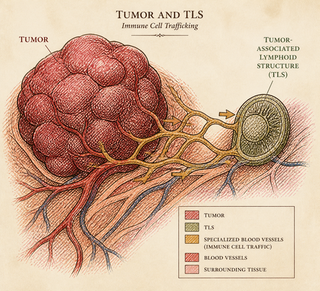
TLSs are organized clusters of immune cells that resemble lymph nodes, but they form in places where you did not order a lymph node. They often contain B cells, T cells, dendritic cells, and specialized blood vessels that help immune cells get in and out.23 In plain English: they are local command centers where the immune system can meet, swap notes, and potentially coordinate an attack.
That matters because immunotherapy does not fail only because T cells are lazy. Often they are excluded, exhausted, misdirected, or stuck outside the metaphorical nightclub while the tumor bouncer says, "Not tonight." TLSs may help solve part of that problem by creating a local site for immune priming and organization right next to the action.14
The review by Kim and colleagues looks at where TLSs fit into cancer immunotherapy now - as biomarkers and as possible therapeutic targets.1 Translation: can they help us predict which patients will respond, and can we intentionally promote them to improve outcomes?
Why people keep talking about these little immune villages
Across several cancer types, the presence of TLSs has been associated with better prognosis and, in some studies, stronger responses to immune checkpoint inhibitors.356 That has made them catnip for the cancer-immunology world. Sorry, "catnip" is not a technical term, but it should be.
One reason TLSs are so appealing is that they may capture something more useful than a simple yes-no readout like "PD-L1 high" or "T cells present." A TLS suggests that the immune system is not just showing up - it may be organized. And as anyone who has watched a group project implode knows, organization is half the battle.
Importantly, not all TLSs are equal. Mature TLSs with germinal-center-like features may mean something very different from looser lymphoid aggregates.23 That is one of the main points this field keeps running into: the biology is promising, but the definitions can get slippery fast. Two pathologists can agree that "there is some immune stuff here" and still argue, with impressive stamina, about whether it counts as a bona fide TLS.
Biomarker dream, pathology headache
As biomarkers, TLSs are attractive because they are visible in tissue and tied to a plausible mechanism. But the practical issues are very real. How do you define a TLS consistently? Which stains do you use? Does location matter - inside the tumor, at the invasive margin, nearby but not quite there? How much maturity counts? If this sounds fussy, welcome to translational oncology, where every exciting idea eventually meets a spreadsheet and starts sweating.
Recent work has tried to standardize TLS evaluation and clarify their clinical value across tumor types.25 Reviews in high-impact journals have also emphasized that B cells and TLS biology may play underappreciated roles in immunotherapy response, particularly in settings where we used to obsess almost exclusively over T cells.34 Fair enough. T cells have had a long run as the main characters.
Can we build more of them on purpose?
This is where the review gets especially interesting. TLSs are not just potential readouts - they might be targets. If therapies could induce or mature TLSs, maybe they could create a more immunotherapy-friendly microenvironment.146
Possible strategies include manipulating chemokines, stromal cells, dendritic cells, vasculature, or local inflammation to encourage TLS formation.12 Radiation, some targeted therapies, cancer vaccines, and intratumoral immune approaches have all been discussed as ways to reshape the immune landscape and potentially support TLS development.14 That said, this is the part where my inner grad student starts whispering, "cool idea, please show me the randomized data."
Because yes, the concept is exciting. But tumors are not Lego sets. You cannot just snap in one adorable mini-lymph-node and assume the immune system will suddenly become The Avengers. TLS biology is context dependent, cancer-type specific, and probably influenced by timing, anatomy, treatment history, and enough cell-cell signaling to make your laptop overheat.
Why this could matter in the real world
If TLSs pan out, they could help doctors do at least three useful things:
- Predict response to immunotherapy more accurately
- Stratify patients for trials or combination treatments
- Design therapies that convert "cold" tumors into more inflamed, immune-responsive ones156
That is the real appeal. Not just a prettier pathology slide, but a way to match patients to treatments better - and maybe expand who gets durable benefit.
For now, though, the field needs standardized scoring, stronger prospective studies, and a better handle on cause versus correlation.125 A TLS might mark a productive anti-tumor response, help drive one, or both. Biology loves refusing multiple-choice questions.
Still, the overall message lands: tumors are ecosystems, not just lumps of rogue cells, and the immune architecture around them matters. Sometimes a lot. TLSs may turn out to be one of the clearest examples of that. Tiny structures, big implications, and just enough complexity to keep the rest of us stress-refreshing PubMed.
References
Disclaimer: The image accompanying this article is for illustrative purposes only and does not depict actual experimental results, data, or biological mechanisms.
-
Kim HM, Joglekar T, Cascone T, Bruno TC. The future of tertiary lymphoid structures in cancer immunotherapy as biomarkers and therapeutic targets. Nat Cancer. 2026. doi:10.1038/s43018-026-01188-1 ↩↩↩↩↩↩↩↩
-
Dieu-Nosjean MC, Giraldo NA, Kaplon H, et al. Tertiary lymphoid structures, drivers of the anti-tumor responses in human cancers. Immunol Rev. 2022;320(1):138-161. doi:10.1111/imr.13112 ↩↩↩↩↩
-
Helmink BA, Reddy SM, Gao J, et al. B cells and tertiary lymphoid structures promote immunotherapy response. Nature. 2020;577(7791):549-555. doi:10.1038/s41586-019-1922-8 | PMCID: PMC7045980 ↩↩↩↩
-
Cabrita R, Lauss M, Sanna A, et al. Tertiary lymphoid structures improve immunotherapy and survival in melanoma. Nature. 2020;577(7791):561-565. doi:10.1038/s41586-019-1914-8 | PMCID: PMC7050860 ↩↩↩↩
-
Sautès-Fridman C, Petitprez F, Calderaro J, Fridman WH. Tertiary lymphoid structures in the era of cancer immunotherapy. Nat Rev Cancer. 2023;23(12):716-726. doi:10.1038/s41568-023-00605-2 ↩↩↩↩
-
Schumacher TN, Thommen DS. Tertiary lymphoid structures in cancer. Science. 2022;375(6576):eabf9419. doi:10.1126/science.abf9419 ↩↩↩