Large B-cell lymphoma would absolutely post, "Feeling aggressive. Might ignore standard chemo later. #NoFilter #BuiltDifferent." And honestly, that is the whole problem. For years, the default treatment for many people with this fast-moving blood cancer has been R-CHOP - a five-drug combo that sounds like either a robot uprising or a mediocre law firm. It has helped a lot of patients. But not enough. Some lymphomas blast right through it, and others come back like the villain in a spy movie who definitely fell off the train but somehow returns in the sequel.
That is why Marcel Nijland's Lancet piece on moving beyond R-CHOP matters. It is not about tossing out a famous regimen for fun. It is about a very practical question: can we do better for people with large B-cell lymphoma by using smarter, more tailored treatments up front and after relapse? Short version: the field is finally acting like it knows cancer is a shape-shifter, not a cardboard cutout.
R-CHOP: the old reliable that is starting to show its age
R-CHOP has been the workhorse for diffuse large B-cell lymphoma, the most common kind of large B-cell lymphoma, for more than 20 years. It combines rituximab with four chemotherapy drugs and has cured many patients, which is no small thing. In oncology, "workhorse" usually means "this thing has been carrying the entire barn on its back while everyone quietly panics."
But large B-cell lymphoma is not one disease wearing one nametag. It is a whole crowd of biologically different cancers. Some are more likely to respond to standard treatment. Others show up wearing molecular disguises, rerouting survival signals and dodging damage like tiny criminal masterminds. The result is that a one-size-fits-all approach has always had limits.
The plot twist: the villain has multiple aliases
One big reason R-CHOP does not work equally well for everyone is that large B-cell lymphoma comes in subtypes with different biology. Gene-expression profiling and newer molecular classifications have shown that these tumors do not all rely on the same machinery. Some are driven by B-cell receptor signaling, some by altered epigenetic programs, some by rearrangements in genes like MYC, BCL2, or BCL6 - basically the cellular equivalent of finding out your suspect has three passports and a fake mustache.
That matters because treatment can get smarter when doctors know what the tumor is actually doing. Recent research has pushed the field toward precision medicine, risk-adapted treatment, and immune-based strategies rather than just cranking up chemotherapy and hoping for the best.
Enter the new crew: antibodies, cell therapy, and targeted tricks
This is where things get fun - by which I mean scientifically exciting, not "fun" like assembling Ikea furniture.
Several newer approaches are changing the treatment landscape:
Polatuzumab-based regimens
The POLARIX trial tested polatuzumab vedotin plus R-CHP against standard R-CHOP in previously untreated diffuse large B-cell lymphoma. The idea is wonderfully sneaky: attach a toxic payload to an antibody, send it to B cells, and let the tumor basically sign for its own package. That trial showed improved progression-free survival, suggesting that swapping in a targeted agent may help some patients without completely reinventing frontline therapy.1
CAR T-cell therapy
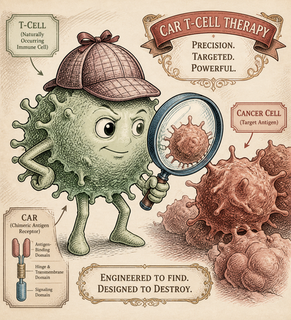
Now we get to my beloved T cells - the little action heroes of the immune system! CAR T-cell therapy takes a patient's own T cells, gives them a molecular mugshot of the cancer, and sends them back in like a heist crew that has studied the floor plan. In relapsed or refractory large B-cell lymphoma, anti-CD19 CAR T-cell therapies have produced durable responses and have now moved earlier in treatment for some patients.23
Bispecific antibodies
These are another delightfully devious trick. Bispecific antibodies grab a cancer cell with one arm and a T cell with the other, basically forcing an introduction like, "You two need to talk. Right now." Agents such as glofitamab and epcoritamab are showing strong activity in relapsed disease and may become even more important as treatment pathways evolve.45
Why this matters outside the hematology conference hotel carpet
If this progress holds up, the real-world impact could be huge. Better frontline treatment means more people cured the first time. Better salvage options mean fewer patients hitting the terrifying wall of "we're running out of things to try." And more tailored therapy means less of the old oncology habit of treating biological complexity with the medical equivalent of a frying pan.
There are still real challenges, of course. These newer therapies can be expensive, logistically complicated, and not equally available everywhere. Some require specialized centers. Some come with dangerous immune side effects, because turning T cells into elite operatives is amazing right up until they decide to kick down too many doors. And researchers still need better ways to match the right patient to the right strategy.
The big takeaway
The message from this Lancet article is not that R-CHOP was a mistake. It is that the field has finally outgrown the idea that one famous regimen should remain the unquestioned lead actor forever. Large B-cell lymphoma has always been more complicated than that. Now the treatment toolbox is catching up.
And as someone who will always root for the immune system's tiny bodyguards, I have to say this is the good stuff: fewer blunt instruments, more molecular detective work, more T-cell espionage, more unmasking the villain before it escapes through the vents!
References
Nijland M. Moving beyond R-CHOP in large B-cell lymphoma. Lancet. 2026. doi:10.1016/S0140-6736(26)01069-X
Disclaimer: The image accompanying this article is for illustrative purposes only and does not depict actual experimental results, data, or biological mechanisms.
-
Tilly H, Morschhauser F, Sehn LH, et al. Polatuzumab vedotin in previously untreated diffuse large B-cell lymphoma. N Engl J Med. 2022;386(4):351-363. doi:10.1056/NEJMoa2115304 ↩
-
Westin JR, Nastoupil LJ. CAR T cells for large B-cell lymphoma - who, when, and how? Blood. 2023;141(11):1267-1277. doi:10.1182/blood.2022018727 ↩
-
Locke FL, Miklos DB, Jacobson CA, et al. Primary results of ZUMA-7: a phase 3 randomized trial of axicabtagene ciloleucel versus standard-of-care therapy in relapsed/refractory large B-cell lymphoma. Lancet. 2022;399(10343):2294-2308. doi:10.1016/S0140-6736(22)00320-3 ↩
-
Hutchings M, Carlo-Stella C, Morschhauser F, et al. Glofitamab, a novel, bivalent CD20-targeting T-cell-engaging bispecific antibody, induces durable complete remissions in relapsed or refractory B-cell lymphoma: a phase 1 trial. J Clin Oncol. 2021;39(18):1959-1970. doi:10.1200/JCO.20.03175 ↩
-
Thieblemont C, Phillips T, Ghesquieres H, et al. Epcoritamab in relapsed or refractory large B-cell lymphoma. N Engl J Med. 2023;389(14):1303-1315. doi:10.1056/NEJMoa2302140 ↩