A stage III lung tumor can resemble a nightclub with a terrible bouncer policy, while your immune system looks more like a capable guest list manager waving frantically from the sidewalk. The problem is not always that the T cells forgot the address. Sometimes the tumor keeps the door jammed, the lights low, and the whole neighborhood unpleasant enough that the immune system simply cannot get in and do its job.
That, in a nutshell, is why this new TRAILBLAZER study on retlirafusp alfa is worth a raised eyebrow and maybe a second drink.
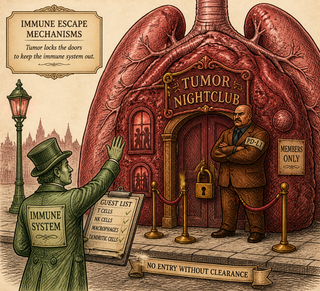
The two-lock problem
In non-small cell lung cancer (NSCLC), one of the best-known immune escape tricks involves PD-L1. Tumor cells use PD-L1 like a fraudulent "do not disturb" sign, telling T cells to stand down when they absolutely should not. Drugs that block PD-1 or PD-L1 try to rip that sign off the door.
But tumors are annoyingly industrious. They often also use TGF-beta, a signaling molecule with many jobs in normal biology, to build a kind of cellular fog machine around themselves. TGF-beta can suppress immune attack, encourage fibrosis, and make the tumor microenvironment feel less like a battleground and more like a swamp in dress shoes.
So researchers asked a very reasonable question: what if one drug could tackle both of these escape routes at once?
Enter retlirafusp alfa, a bifunctional fusion protein that targets PD-L1 and traps TGF-beta. One molecule, two headaches for the tumor. Cancer biology does love a gadget.
What the trial actually did
This phase 2 trial looked at patients with unresectable stage III NSCLC who did not have EGFR or ALK alterations. That matters because those tumors often follow different treatment paths.
The treatment was given before the main local therapy, which is what "neoadjuvant" means - a fancy word for softening up the problem before the bigger move. Patients received retlirafusp alfa either:
- With chemotherapy, or
- Alone, in patients with high PD-L1 expression
After that induction treatment, a local multidisciplinary team decided whether patients should go on to surgery or radiotherapy, followed by consolidation retlirafusp alfa.
This is the interesting twist: the strategy was response-adapted. Instead of treating every tumor like the same badly behaved houseplant, the team adjusted the next step based on how things were going.
The numbers with actual pulse
With a median follow-up of 39.4 months, the updated results looked encouraging.
For patients in the combination arms, the 3-year event-free survival (EFS) rate was 50.5%, and the 3-year overall survival (OS) rate was 68.3%. In the small monotherapy group with high PD-L1 expression, the 3-year EFS and OS rates were 77.1% and 87.5%, respectively.
Now, giant flashing caveat: those monotherapy numbers come from a tiny group. Ten patients is not a crowd. It is barely a decent group chat. So nobody should sprint to grand conclusions there.
Still, the surgical subgroup stood out. Among the 27 patients who underwent surgery after induction treatment, the 3-year EFS was 69.5% and OS was 84.9%. Patients treated with radiotherapy also had meaningful outcomes, but the surgery group did better.
That does not prove surgery is magically superior in every case. It does suggest something clinically important: if immunotherapy helps convert some "unresectable" tumors into cases where surgery becomes realistic, that could change the map for a subset of patients.
Why this matters beyond the conference-slide glow
Stage III NSCLC lives in one of oncology's trickiest neighborhoods. It is often potentially curable, but treatment decisions can get messy fast. You are balancing local control, distant relapse risk, fitness for surgery, and the uncomfortable fact that tumors rarely read the guidelines.
This study points toward a future where induction immunotherapy is not just added on, but used to reshape the whole plan. If a bifunctional drug can both wake up immune attack and dismantle some of the tumor's defensive scenery, more patients might become candidates for surgery - or at least for better long-term control.
That is the real allure here. Not merely "drug works," but "drug may help redraw what is possible."
The fine print, because biology always sends one
Before we start carving victory statues, a few limits matter.
This was a phase 2 proof-of-concept study, not a definitive phase 3 practice-changing trial. Some arms were very small. Patient selection mattered a lot, especially with PD-L1-high disease. And the treatment pathway involved careful multidisciplinary judgment, which is exactly how good cancer care should work but also means results may depend on expert teams making smart calls in real time.
Also, TGF-beta biology is complicated enough to make a watchmaker sigh. Blocking it can be useful, but it is not a cartoon villain switch. Researchers still need larger studies to confirm who benefits most, when surgery should follow, and how this approach stacks up against current standards.
The larger plot twist
For years, immunotherapy in lung cancer has often sounded like a story about taking the brakes off T cells. That is true, but incomplete. Sometimes you also need to clear the road, drain the moat, and perhaps file a formal complaint with the bouncer.
Retlirafusp alfa is interesting because it tries to do exactly that - remove one immune checkpoint while loosening another layer of tumor-made suppression. In this updated TRAILBLAZER analysis, that strategy produced durable survival signals and made the surgery question newly interesting, which is not a small thing in stage III lung cancer.
Cancer, ever the overachieving little rebel, rarely yields to simple plans. But every now and then, a study comes along that suggests the door is not locked - just blocked by two very rude pieces of furniture.
References
-
Pan Y, Yang X, Zhou Q, et al. Neoadjuvant retlirafusp alfa (anti-PD-L1/TGF-beta bifunctional fusion protein) with or without chemotherapy in unresectable stage III non-small cell lung cancer: updated results from the phase 2 TRAILBLAZER trial. Signal Transduct Target Ther. 2026. doi:10.1038/s41392-026-02779-1
-
Paz-Ares L, O'Brien M, Mauer M, et al. Perioperative nivolumab plus chemotherapy versus chemotherapy alone in resectable non-small-cell lung cancer. N Engl J Med. 2024;390(19):1756-1769. doi:10.1056/NEJMoa2312246
-
Forde PM, Spicer J, Lu S, et al. Neoadjuvant nivolumab plus chemotherapy in resectable lung cancer. N Engl J Med. 2022;386(21):1973-1985. doi:10.1056/NEJMoa2202170
-
Provencio M, Nadal E, Insa A, et al. Neoadjuvant chemoimmunotherapy for the treatment of stage IIIA resectable non-small-cell lung cancer (NADIM II): a phase 2, randomized, controlled trial. Lancet Oncol. 2023;24(1):86-97. doi:10.1016/S1470-2045(22)00605-4
-
Nakajima EC, Drezner N, Li X, et al. The role of TGF-beta in the tumor microenvironment and therapeutic implications in cancer: a review. J Hematol Oncol. 2023;16:67. doi:10.1186/s13045-023-01437-6 (review)
Disclaimer: The image accompanying this article is for illustrative purposes only and does not depict actual experimental results, data, or biological mechanisms.