Cancer treatment often works by sending in elite specialists, yet tumors keep thriving in places where those specialists can barely get through the door. That is the odd little contradiction at the center of this new Cell paper: maybe the better move is not sending more exhausted immune veterans, but dispatching expandable young recruits that can move in, settle down, and become the kind of anti-tumor cells the neighborhood actually needs.
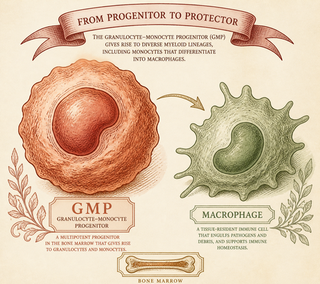
That recruit, in this case, is the granulocyte-monocyte progenitor - or GMP, which sounds less like a cancer-fighting cell and more like a logistics certification. But stick with me. These cells sit upstream of several myeloid immune cell types, including macrophages, the body’s cleanup crew, bouncers, and occasional furniture movers all rolled into one.
Why researchers are flirting with immune cells that are not T cells
Most people have heard of CAR-T therapy by now: immune cells get genetically outfitted with a kind of custom target-recognition gadget called a chimeric antigen receptor, then sent back into the body to hunt cancer. It has been a huge deal in blood cancers, and a much more annoying slog in solid tumors, where the tumor microenvironment behaves like a nightclub with an extremely hostile door policy.
Macrophages have looked tempting because they naturally enter tumors and eat things for a living. Love that for them. The catch is that engineered macrophages are hard to grow in large numbers, difficult to genetically modify, and not especially reliable once infused into the body. In other words, great instincts, terrible scalability.
This new study by Yue Shi and colleagues asks a clever question: what if, instead of engineering mature macrophages, you engineer their expandable progenitors first? Shi et al., Cell (2026), DOI: https://doi.org/10.1016/j.cell.2026.05.043
A stemmy workaround with a surprisingly practical vibe
The authors developed culture conditions that let mouse and human GMPs expand for long periods outside the body while still keeping their progenitor identity and their ability to turn into myeloid cells later. That matters a lot. If you can grow a renewable supply of these cells, you have something much closer to a manufacturing platform and much less like a one-off artisanal immune product made by three sleep-deprived postdocs and a centrifuge held together by optimism.
They also found that myeloperoxidase - an enzyme better known for its role in antimicrobial chemistry - helps regulate GMP proliferation. That is a nice mechanistic bonus, because every flashy cell therapy paper eventually has to answer the question, "Fine, but why are these cells behaving this way?" Here, the authors actually brought receipts.
Once transferred into mice, the expanded GMPs did not just drift around uselessly like conference attendees near the pastry table. They seeded hematopoietic niches, generated donor-derived myeloid cells, and in a chronic granulomatous disease model even helped restore antibacterial defense. So these progenitors were not merely alive - they were productive.
Then came the cancer part, which is where things get spicy
The team engineered these GMPs with CARs and tested them against CD19-positive leukemia and HER2-positive solid tumors. The resulting cells gave rise to abundant tumor-infiltrating macrophages and suppressed tumor growth in mouse models.
That is the headline result, but the most interesting twist may be the CAR design itself. The authors built a CAR that includes an IgG Fc domain - basically a handle that can recruit the host’s own Fc receptor-bearing phagocytes. Translation: not only do the engineered cells do some of the fighting, they may also call in local backup. Less lone-wolf action hero, more well-connected dinner host who knows exactly whom to seat next to whom.
Even better, this Fc-containing CAR helped prime T cells across MHC mismatch in allogeneic models. That is a fancy way of saying the therapy may help awaken broader anti-tumor immunity even when donor and recipient are not perfectly matched. For immunotherapy people, that is catnip.
Why this could matter outside the mouse kingdom
If these results hold up, expandable GMPs could solve several nagging cell therapy problems at once: scale, engineering, persistence, and tumor access. That is a pretty ambitious to-do list.
There is already growing interest in engineered myeloid cell therapies because myeloid cells are naturally good at getting into tumors, especially the solid ones that often shrug at T-cell approaches. Recent reviews have highlighted both the promise and the headaches of CAR-macrophage strategies, including manufacturing barriers and uncertain in vivo behavior Klichinsky et al., Nat Biotechnol 2020, DOI: https://doi.org/10.1038/s41587-020-0462-y; Xu et al., Signal Transduct Target Ther 2024, DOI: https://doi.org/10.1038/s41392-024-01787-8.
This paper basically says: what if we stop trying to force fully mature macrophages into acting like a clean, scalable product and instead work one developmental step earlier? Biologically, that makes a lot of sense. Mature macrophages are stubborn, highly specialized, and not thrilled about being reprogrammed. Progenitors are more pliable. They are the interns, yes, but the competent kind who end up quietly running the place.
Before we all start ordering GMP therapy like takeout
A few caveats. This is still preclinical work. Mouse success has a long and slightly embarrassing history of not translating cleanly to humans. Cell therapies can also bring safety issues, from off-target inflammation to weird biodistribution to manufacturing hiccups that only appear when you scale up from "promising paper" to "actual hospital product."
And while recruiting host phagocytes and priming T cells sounds terrific, immune systems are moody ecosystems. Sometimes they rally. Sometimes they throw a cytokine tantrum.
Still, this study opens a genuinely fresh lane in cancer immunotherapy. Instead of relying only on elite immune assassins, it proposes a renewable source of engineered progenitors that can move into the bone marrow, produce myeloid descendants, and flood tumors with cells built to recognize cancer. That is not a small tweak. That is a change in strategy.
If CAR-T is the sniper, GMP-based therapy may be the urban planning department. Less glamorous, maybe, but sometimes the way to beat a bad neighborhood is not one heroic raid - it is moving in and changing who lives there.
References
-
Shi Y, Guo Z, Pan C, et al. Expansion and CAR engineering of granulocyte-monocyte progenitors for cellular immunotherapy. Cell. 2026. DOI: 10.1016/j.cell.2026.05.043
-
Klichinsky M, Ruella M, Shestova O, et al. Human chimeric antigen receptor macrophages for cancer immunotherapy. Nature Biotechnology. 2020;38(8):947-953. DOI: 10.1038/s41587-020-0462-y
-
Xu Z, Wang Y, Deng J, et al. CAR-macrophage therapy for cancer: mechanisms, progress, and challenges. Signal Transduction and Targeted Therapy. 2024;9. DOI: 10.1038/s41392-024-01787-8
-
Mantovani A, Allavena P, Marchesi F, Garlanda C. Macrophages as tools and targets in cancer therapy. Nature Reviews Drug Discovery. 2022;21(11):799-820. DOI: 10.1038/s41573-022-00520-5
-
Cassetta L, Pollard JW. Tumor-associated macrophages. Current Biology. 2023;33(6):R246-R248. DOI: 10.1016/j.cub.2023.01.056
Disclaimer: The image accompanying this article is for illustrative purposes only and does not depict actual experimental results, data, or biological mechanisms.