The tumor microenvironment has started to feel a bit like the disappearance of Amelia Earhart - everybody agrees something important is happening in the landscape, but for a long time we’ve only had partial maps and a lot of educated squinting. This new review argues that two players may explain a surprising amount of the mystery: cancer-associated fibroblasts, or CAFs, and tertiary lymphoid structures, or TLS. One often builds barriers. The other can set up local immune command posts. Same neighborhood, wildly different zoning laws.
Meet the sketchy real estate developers
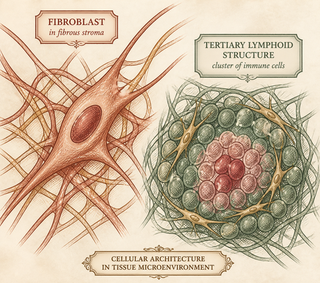
If you zoom out, tumors are not just piles of malignant cells. They’re ecosystems. A tumor brings in immune cells, blood vessels, connective tissue, signaling molecules, and a whole lot of bad incentives. Among the busiest residents are cancer-associated fibroblasts - support cells that, in healthy tissue, usually help maintain structure and repair damage. In cancer, some of them go off-script.
CAFs can remodel the extracellular matrix, which is the scaffold around cells. That sounds tidy and harmless, like reorganizing a garage. In practice, it can create a dense, fibrous maze that makes it harder for immune cells to get where they need to go. If your T cells are the security team, CAFs can act like the contractor who accidentally-on-purpose keeps bricking up the doors.
But - because biology enjoys ruining all simple stories - CAFs are not one thing. They’re a mixed crowd. Some CAF subsets seem to suppress immunity and help tumors resist treatment. Others may support antigen presentation or even help organize immune responses. Calling all CAFs “bad” is a bit like calling all people in hoodies suspicious. Statistically sloppy, and likely to get you yelled at by the data.
TLS: the pop-up immune headquarters
Now for the more cheerful tenant: tertiary lymphoid structures. These are organized clusters of immune cells that form in tissues outside the usual lymph nodes. Think of them as pop-up field offices for the immune system. Instead of making T cells and B cells commute from some distant headquarters, TLS can help them coordinate locally, right next to the tumor.
That matters because anti-tumor immunity is not just about whether immune cells exist. It’s also about whether they can gather, get briefed, expand the right clones, and do something useful before the tumor changes the locks again.
Across multiple cancers, the presence of TLS has often been linked with better prognosis and stronger responses to immune checkpoint blockade. Not always, not universally, and not in a neat one-size-fits-all way - because tumors refuse to behave for the convenience of reviewers - but often enough to get serious attention.
It’s not just who’s there. It’s where they’re standing.
The big idea in this review is beautifully simple: tumor immunity depends on spatial architecture. Not just cell types. Not just genes. Geography.
A tumor can have plenty of immune cells on paper and still be functionally “cold” if those cells are stuck at the edges, fenced off by stromal barriers, or stranded in the wrong micro-neighborhood. Meanwhile, a tumor with mature TLS may have little local hubs where immune activation actually happens.
That makes CAFs and TLS a bit like rival urban planners. CAF-heavy regions can create immune exclusion - dense infrastructure, bad traffic flow, hostile vibes. TLS-rich regions can create immune organization - places where T cells and B cells meet, compare notes, and get to work. It’s less “battlefield” and more “city planning, but the permits are being filed by chaos.”
Why people in clinics might care
This matters because immunotherapy still works unevenly. Some patients get durable responses. Others get side effects without much benefit. One reason may be that we’ve been classifying tumors too bluntly.
This review suggests a more spatial way of thinking: not just “Does the tumor have immune cells?” but “Are those cells blocked, scattered, or properly organized?” That could help with patient stratification - a phrase nobody would put on a cocktail menu, but a very useful one. If CAF states and TLS maturity help predict response, doctors may eventually sort patients more accurately and choose combinations more intelligently.
Possible strategies include:
- Reprogramming stromal cells so CAFs stop acting like anti-immune bouncers
- Inducing or maturing TLS so local immune responses become more effective
- Combining these approaches with checkpoint inhibitors rather than hoping one drug can fix a badly designed neighborhood on its own
The review also points to upstream players like innate lymphoid cells and myeloid organizer cells that may help spark TLS formation. In other words, there may be earlier levers in the system than we appreciated. Tumor biology, naturally, has discovered middle management.
The catch, because there is always a catch
This is a review, not a single decisive experiment. It pulls together evidence from spatial transcriptomics, single-cell studies, and tumor analyses across cancer types. That makes it useful as a framework, but not a final verdict.
There are still big open questions. Which CAF subsets are harmful, and when? What makes a TLS mature enough to help? Can we induce TLS safely without stirring up the wrong kind of inflammation? Will these patterns hold across tumor types, stages, ancestries, and treatment settings, or are we staring at a confounding variable in a lab coat?
Those questions matter because the history of oncology is littered with ideas that looked brilliant until human biology introduced itself.
The larger point
What makes this paper interesting is that it shifts the conversation from “Which cells are present?” to “How is the immune landscape built?” That is a more realistic view of cancer as an ecosystem and, frankly, a more useful one. A good immune response is not just about staffing levels. It’s about access, communication, and local infrastructure. The epidemiologist in me wants to call this location, location, location - except with fewer charming bungalows and more cytokines.
If this framework keeps holding up, it could sharpen how we classify tumors and how we design immunotherapy combinations. And that would be a real upgrade from our current strategy, which sometimes resembles trying to fix urban congestion by mailing everyone a whistle.
References
-
Tang H, Shi Y, Ge Q, Wang R, Yang J, Zhu Y, Liu S, Xu W. Cancer-associated fibroblasts and tertiary lymphoid structure orchestrate the spatial architecture of tumor immunity. J Hematol Oncol. 2026;19:?. doi:10.1186/s13045-026-01814-6
-
Binnewies M, Roberts EW, Kersten K, et al. Understanding the tumor immune microenvironment and spatial architecture. Nat Med. 2018;24(5):541-550. doi:10.1038/s41591-018-0014-x
-
Helmink BA, Reddy SM, Gao J, et al. B cells and tertiary lymphoid structures promote immunotherapy response. Nature. 2020;577(7791):549-555. doi:10.1038/s41586-019-1922-8
-
Petitprez F, de Reyniès A, Keung EZ, et al. B cells are associated with survival and immunotherapy response in sarcoma. Nature. 2020;577(7791):556-560. doi:10.1038/s41586-019-1906-8
-
Kieffer Y, Hocine HR, Gentric G, et al. Single-cell analysis reveals fibroblast clusters linked to immunotherapy resistance in cancer. Cancer Discov. 2020;10(9):1330-1351. doi:10.1158/2159-8290.CD-19-1384
-
Mariathasan S, Turley SJ, Nickles D, et al. TGF-beta attenuates tumour response to PD-L1 blockade by contributing to exclusion of T cells. Nature. 2018;554(7693):544-548. doi:10.1038/nature25501
Disclaimer: The image accompanying this article is for illustrative purposes only and does not depict actual experimental results, data, or biological mechanisms.