We regret to inform you that the old idea of blood production as a tidy, fixed assembly line has passed away after a long decline, survived by several annoyed stem cell biologists and one mountain of single-cell data. In lieu of flowers, please send better models.
That retirement feels deserved, because this new Cell Stem Cell paper shows that when your body faces infection, inflammation, or tissue repair, the blood-forming system does not just mash the "make more immune cells" button. It uses multiple routes - some shared, some situation-specific - to crank up production of myeloid cells, the body's fast-response crew for microbial trouble and inflammatory chaos.1
Your bone marrow is not a factory - it's more like an emergency transit system
Under normal conditions, hematopoietic stem and progenitor cells - HSPCs, because science loves an acronym the way toddlers love glitter - sit in the bone marrow and generate all the different blood cells your body needs. During stress, they switch into emergency myelopoiesis, a rapid program that boosts production of myeloid cells such as neutrophils and monocytes.[^2,^3]
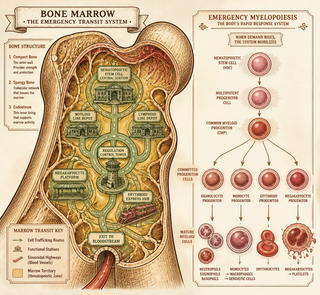
That matters because emergency myelopoiesis sits at the crossroads of infection, recovery from injury, chronic inflammation, and leukemia. Push too little and you fail to fight threats. Push too much, or in the wrong way, and the whole system starts looking less like public health planning and more like rush-hour traffic designed by a raccoon.
The question has been whether different emergencies trigger basically the same marrow response, or whether the system uses distinct molecular playbooks depending on the insult.
Scientists made a map because apparently the marrow needed one
Swann and colleagues tackled this by building two tools from single-cell RNA sequencing data in mouse HSPCs: HemaScribe, for more consistent cell annotation, and HemaScape, a quantitative model of blood-cell differentiation.1 They then used these tools across a broad set of emergency myelopoiesis conditions.
In plain English: they did not just count cells. They tried to map how blood-making cells move through their developmental choices under pressure, and which gene programs switch on along the way.
That sounds technical because it is technical. But the payoff is refreshingly practical. The study found that emergency myelopoiesis is not one monolithic response. Different inflammatory or regenerative challenges amplify myeloid output at different levels of the stem-and-progenitor hierarchy. Some lean harder on early stem-like compartments, others on downstream progenitors.
If you care about treatment, that distinction is not academic wallpaper. It tells you where the system bends first when stressed - and where disease might hijack it.
The really juicy part: a shared "panic mode" module
The most interesting finding is that the authors identified a myeloid progenitor-based activation module that appears across diverse inflammatory settings and is also conserved in humans.1
That is a big deal. In population terms, conserved biology is the closest thing biomedicine gets to finding the same suspicious financial transaction in multiple countries. You start wondering whether you have uncovered a common mechanism rather than a local oddity or an especially charismatic mouse.
Even more intriguing, this module was linked to outcomes in adult and pediatric acute myeloid leukemia (AML). AML often exploits immature blood-cell programs, so finding an emergency-response program that echoes inside leukemia suggests that cancer may be borrowing a normal stress pathway and turning it into a long-term lease.
Cancer is like that - take one adaptive process, remove adult supervision, and suddenly the neighborhood zoning board has lost control.
Why this could matter outside a sequencing lab
If these findings hold up, they could help researchers do at least three useful things.
First, they may improve how we interpret inflammatory blood states in infection, aging, and chronic disease. We already know inflammation can reshape blood formation, but this paper offers a more organized framework for how that reshaping happens.[^2,^4]
Second, they could refine AML risk stratification and biology. If leukemia cells or their precursors activate conserved emergency myelopoiesis modules, those signals might help classify disease behavior or identify therapeutic vulnerabilities.[^5,^6]
Third, they may support more precise ways to boost immune recovery after chemotherapy, transplantation, or severe infection. Instead of treating myelopoiesis as one generic faucet, you might eventually tune different points in the system depending on the clinical problem.
That said, let us not sprint past the caution tape. This work relies heavily on mouse single-cell datasets and modeling, even though the human conservation angle strengthens its relevance. Translation into actual therapies will require replication, functional validation, and the usual long parade of "promising" findings that must survive biology's favorite hobby: refusing to behave the same way twice.
The bigger picture, minus the hype fog
One reason this paper lands well is that it respects a truth epidemiologists and stem cell biologists both learn sooner or later: averages can hide a lot of mess. "More myeloid cells" sounds simple until you ask which cells, from which precursor state, under what inflammatory trigger, in what species, and with what downstream consequence. Congratulations - now you have met confounding, but with bone marrow.
By showing both shared and distinct molecular response modules in emergency myelopoiesis, this study gives the field a more realistic map of hematopoietic activation. And when the map gets better, the odds improve that future diagnostics and treatments will stop wandering around like tourists with no signal.
References
Disclaimer: The image accompanying this article is for illustrative purposes only and does not depict actual experimental results, data, or biological mechanisms.
-
Swann JW, Fung JH, Chen Z, Olson OC, Collins A, Lhakhang T, et al. Quantitative molecular cartography of emergency myelopoiesis reveals conserved modules of hematopoietic activation. Cell Stem Cell. 2026; DOI: 10.1016/j.stem.2026.05.007 ↩↩↩
-
King KY, Goodell MA. Inflammatory modulation of HSCs: viewing the HSC as a foundation for the immune response. Nat Rev Immunol. 2021;21(11):685-698. DOI: 10.1038/s41577-021-00559-5 ↩
-
Schultze JL, Mass E, Schlitzer A. Emerging principles in myelopoiesis at homeostasis and during infection and inflammation. Nat Rev Immunol. 2019;19(9):595-609. DOI: 10.1038/s41577-019-0180-3 ↩
-
Haas S, Trumpp A, Milsom MD. Causes and consequences of hematopoietic stem cell heterogeneity. Cell Stem Cell. 2021;28(6):1030-1047. DOI: 10.1016/j.stem.2021.05.003 ↩
-
van Galen P, Hovestadt V, Wadsworth Ii MH, Hughes TK, Griffin GK, Battaglia S, et al. Single-cell RNA-seq reveals AML hierarchies relevant to disease progression and immunity. Cell. 2019;176(6):1265-1281.e24. DOI: 10.1016/j.cell.2019.01.031 PMCID: PMC6731189 ↩
-
Miles LA, Bowman RL, Merlinsky TR, Csete IS, Ooi AT, Durruthy-Durruthy R, et al. Single-cell mutation analysis of clonal evolution in myeloid malignancies. Nature. 2020;587(7834):477-482. DOI: 10.1038/s41586-020-2864-x ↩