The court of cancer biology has spent years hearing the same star witness: killer T cells. Verdict? They matter. A lot. But this new Science paper files an appeal and brings in a surprise witness - CD4 T cells, the immune system’s so-called “helper” squad, which may be doing far more than handing out orange slices on the sidelines.
A team led by Lian and colleagues reports that tumor-specific CD4 T cells can go after the tumor stroma - the non-cancer support system around a tumor - rather than just trying to help kill tumor cells directly. That matters because tumors are not lone wolves. They live in a whole creepy little neighborhood of blood vessels, support cells, and immune-suppressing accomplices. If you can wreck the neighborhood, the tumor may have a much harder time staying in business.
Not Just the Star Striker
Most immunotherapy hype has centered on CD8 T cells, the classic assassins that recognize and kill cancer cells. Fair enough - they’re the highlight-reel players. But anyone who watches enough sports knows championships are not won by one flashy scorer and five guys standing around looking inspirational.
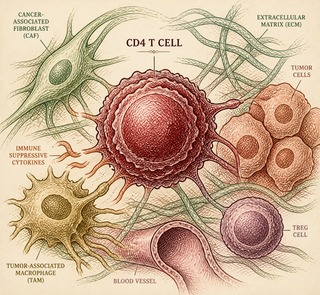
CD4 T cells have traditionally been framed as coordinators. They help other immune cells get organized. Useful, yes. Sexy, not always. This paper argues they may also drive a direct anti-tumor strategy by recognizing antigens presented within the tumor environment and then reshaping that environment in ways the tumor really does not enjoy.
That is a big tactical shift. Instead of trying only to punch the cancer cell in the face, the immune system may also slash the tires, lock the supply closet, and cut the Wi-Fi.
The Tumor’s Home Field Advantage
Tumors often survive because they build a friendly home stadium. That “stadium” is the stroma - connective tissue, blood vessels, fibroblasts, and immune cells that can either fight cancer or, annoyingly, help it. Some tumors become masters of turning this space into a heavily defended bunker.
The new study, based on the abstract and paper details available through PubMed, describes a tumor stroma-targeting mechanism involving antigen-specific CD4 T cells. The headline idea is that these T cells do not just hover nearby offering emotional support. They can activate other components of the immune system - including myeloid cells and inflammatory pathways such as tumor necrosis factor-alpha - to damage the tumor’s support structure.
Think of it as less “sniper shot” and more “take over the loading dock so the whole arena shuts down.”
Why This Is Sneakily a Big Deal
This matters because direct tumor killing has limits. Tumor cells mutate. They hide. They lose the antigens that therapies are trained to recognize. They basically keep changing jerseys mid-game and then acting shocked that defenders lose track of them.
The stroma is different. It is often more genetically stable than the tumor itself, which could make it a sturdier target. If CD4 T cells can reliably recognize and disrupt this support network, that opens a second front in the war. And in cancer, second fronts are good. Tumors love a one-lane road. Researchers are trying to build a freeway interchange.
There is also a practical angle. Some patients do not respond well to therapies aimed mainly at revving up CD8 T cells. A CD4-driven strategy could broaden the playbook, especially in tumors where the microenvironment is doing most of the dirty work.
The Playbook Behind the Play
Mechanistically, this fits with a growing appreciation that CD4 T cells can do much more than “help.” They can produce cytokines, recruit and activate myeloid cells, alter blood vessel growth, and reprogram the local immune scene. In other words, they are less assistant coach, more defensive coordinator with anger issues.
That idea aligns with recent work showing that successful immunotherapy often depends not just on killing tumor cells, but on changing the tumor ecosystem itself. Reviews in top journals have emphasized how the tumor microenvironment shapes treatment response and resistance, and why stromal and myeloid targets are becoming hotter than ever in cancer research 12.
What Could This Mean for Real Patients?
If these findings hold up and translate beyond preclinical systems, they could influence how we design vaccines, cell therapies, and combination immunotherapies. Instead of asking only, “How do we get more killer T cells into tumors?” researchers might also ask, “How do we train CD4 T cells to make the tumor’s neighborhood completely unlivable?”
That could pair well with checkpoint inhibitors, adoptive T cell therapies, or treatments that target suppressive myeloid cells. It also hints at a world where the best immunotherapy roster is not built around one MVP, but around smarter line combinations.
Of course, this is where the replay review kicks in. Mouse findings do not automatically become human victories. Tumor microenvironments differ across cancers. And any immune strategy strong enough to torch supportive tissue has to be watched carefully for collateral damage. Biology loves complexity the way referees love making everything take longer.
Final Score
This paper adds to a growing argument that CD4 T cells deserve a promotion in cancer immunology. Not honorary captain. Actual impact player. By targeting the tumor’s support system, they may offer a way around some of the biggest weaknesses of current immunotherapy.
For years, the field treated CD4 cells like the setup crew. This study suggests they may be out there flipping the whole arena lights off.
References
Disclaimer: The image accompanying this article is for illustrative purposes only and does not depict actual experimental results, data, or biological mechanisms.
-
Binnewies M, Roberts EW, Kersten K, et al. Understanding the tumor immune microenvironment and its therapeutic implications. Nat Med. 2018;24(5):541-550. doi:10.1038/s41591-018-0014-x ↩
-
Bejarano L, Jordāo MJC, Joyce JA. Therapeutic targeting of the tumor microenvironment. Cancer Discov. 2021;11(4):933-959. doi:10.1158/2159-8290.CD-20-1808 ↩
-
Lian Q, Nie J, Singh J, et al. CD4. Science. 2025. doi:10.1126/science.ads7910. PubMed: 42313973 ↩
-
Sharma P, Hu-Lieskovan S, Wargo JA, Ribas A. Primary, adaptive, and acquired resistance to cancer immunotherapy. Cell. 2017;168(4):707-723. doi:10.1016/j.cell.2017.01.017 ↩
-
Hiam-Galvez KJ, Allen BM, Spitzer MH. Systemic immunity in cancer. Nat Rev Cancer. 2021;21(6):345-359. doi:10.1038/s41568-021-00347-z ↩