One of the ruder habits of cancer is that it rarely loses all at once. Even when a drug works beautifully at first, a few cells can hang back like the last party guests who somehow survive cleanup, sunrise, and your increasingly obvious hints. In EGFR-mutant non-small-cell lung cancer, those holdouts are often called drug-tolerant persister cells, or DTPs. They do not fully resist treatment yet. They just endure it. Which, biologically speaking, is a pretty annoying talent.
A new Cancer Cell paper looks at how these persister cells survive EGFR tyrosine kinase inhibitors such as osimertinib, and it lands on a target with real therapeutic appeal: TROP2.[1] The basic idea is deliciously simple by cancer-biology standards, which usually resemble a wiring diagram drawn by a caffeinated octopus. If the earliest surviving cells light up TROP2, maybe you can hit them before they become fully resistant and send the whole tumor back into business.
Meet the freeloaders: drug-tolerant persister cells
EGFR-mutant lung cancers often respond dramatically to EGFR inhibitors. That is the good news. The bad news is that some cells slip into a temporary survival mode. They are not thriving. They are not exactly winning. But they are still there, lurking in the molecular bushes and waiting for the drug pressure to ease or for new resistance mechanisms to evolve.[2,3]
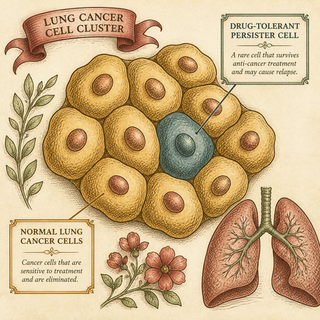
Researchers have cared about these cells for a while because they may be the seedbed for later relapse. Think of them as the tiny bunker community that survives the first strike and then slowly rebuilds civilization, except in this version civilization is a tumor and nobody is rooting for it.
This new study found that TROP2 becomes dynamically upregulated during DTP formation. That matters because TROP2 is already a known cell-surface target in several epithelial cancers, and there are already antibody-drug conjugates, or ADCs, built to exploit it.[1,4] ADCs are basically guided missiles with paperwork - an antibody finds a target on the cell surface, and a toxic payload comes along for the ride.
Why TROP2 pops up right when things get dangerous
The mechanistic story here is neat. The authors show that c-Myc normally represses TROP2 transcription. When EGFR inhibition shuts down the MAPK pathway, c-Myc levels fall. With that brake removed, TROP2 expression rises.[1]
Translation into non-lab-English: the very act of treating the cancer helps create a state in which these surviving cells display a new flag. Not because the cells are being generous, obviously. Cancer has never once volunteered useful information out of kindness. But treatment changes the signaling landscape, and TROP2 becomes part of the persister-cell survival setup.
That gives clinicians and drug developers an opening. Instead of waiting for resistance to fully emerge and then scrambling, maybe you hit the cells during this weird in-between phase when they are vulnerable in a new way.
The combo move: osimertinib plus a TROP2-targeting ADC
The ADC in this paper is sacituzumab tirumotecan (sac-TMT), paired with osimertinib.[1] In preclinical models, that combination suppressed the emergence of DTPs and delayed tumor relapse. That is the headline, and it is a meaningful one.
Why is this interesting? Because the field has spent years dealing with resistance after it arrives, like putting out a kitchen fire after the smoke alarm has already gone full banshee. This work asks whether we can intervene earlier - during the drug-tolerant phase - before those cells turn into a full-blown resistant population.[2,3,5]
Even more intriguing, the paper reports preliminary efficacy from an ongoing phase 2 trial testing first-line sac-TMT plus osimertinib in patients with advanced EGFR-mutant NSCLC.[1] Preliminary is doing a lot of work in that sentence, and as anyone who has optimized the same assay for six straight months knows, biology loves to humble a clean story. Still, the translational logic here is strong.
Why people in the clinic might care
For patients with EGFR-mutant lung cancer, targeted therapy can buy substantial time, but resistance remains the recurring villain. If a combination like this truly delays resistance, it could extend the period when the disease is controlled with targeted treatment, potentially postponing the need for later-line therapies and all the baggage that comes with them.
There is also a broader concept here. Persister cells are not unique to this one cancer-drug pairing. Across oncology, researchers increasingly suspect that these early-surviving cell states are where much of the future trouble begins.[2,5] So this paper is not just about TROP2 or even just about lung cancer. It is part of a larger shift from asking, "How do we treat resistant tumors?" to asking, "How do we stop resistance from getting started in the first place?"
That is a much smarter fight.
The caveats, because the pipettes demand honesty
A few things still need sorting out. Will TROP2 expression in patients reliably mark the right cells at the right time? How durable is the benefit? What toxicities show up when you combine an EGFR inhibitor with a TROP2-directed ADC? And can tumors wriggle out of this trap too, because tumors do love a sequel.
Still, this is exactly the sort of work that feels worth watching: mechanistic, clinically connected, and aimed at the miserable little cell population that keeps ruining everybody's nice response curves.
References
-
Liao J, Yao W, Yu Y, et al. Targeting TROP2 in drug-tolerant persister cells delays EGFR tyrosine kinase inhibitor resistance in non-small-cell lung cancer. Cancer Cell. 2026;S1535-6108(26)00191-4. doi:10.1016/j.ccell.2026.05.020. PubMed: 42314664
-
Rehman SK, Haynes J, Collignon E, et al. Colorectal cancer cells enter a diapause-like DTP state to survive chemotherapy. Cell. 2021;184(1):226-242.e21. doi:10.1016/j.cell.2020.11.018
-
Marine JC, Dawson SJ, Dawson MA. Non-genetic mechanisms of therapeutic resistance in cancer. Nat Rev Cancer. 2020;20(12):743-756. doi:10.1038/s41568-020-00302-4
-
Goldenberg DM, Stein R, Sharkey RM. The emergence of trophoblast cell-surface antigen 2 (TROP-2) as a novel cancer target. Oncotarget. 2018;9(48):28989-29006. doi:10.18632/oncotarget.25615. PMCID: PMC6173412
-
Hata AN, Rajapakse VN, et al. Minimal residual disease and drug-tolerant persisters in cancer therapy. Trends Cancer. 2021;7(8):665-682. doi:10.1016/j.trecan.2021.03.012
Disclaimer: The image accompanying this article is for illustrative purposes only and does not depict actual experimental results, data, or biological mechanisms.