Cancer is not content to be a mere vandal. It behaves more like a smug property developer with terrible ethics - rezoning tissue, bribing the local security force, and somehow getting awful construction approved year after year. The paper behind a new AI tool called CANVAS asks a sharp question: if tumors are building these shady little cities, can we read their urban plan from an ordinary pathology slide?
That would be a big deal. Right now, the most detailed ways to map a tumor's "neighborhoods" usually require expensive spatial profiling technologies that are brilliant, intricate, and about as easy to scale as hand-carving every brick in Manhattan. By contrast, the standard H&E slide - the pink-and-purple biopsy image pathologists use every day - is already everywhere. If you could squeeze more information out of that humble slide, oncology might gain a much cheaper way to understand who has a dangerous tumor, who might respond to immunotherapy, and which microscopic districts are quietly running the whole operation.
A tumor is not one thing - it's a whole city block
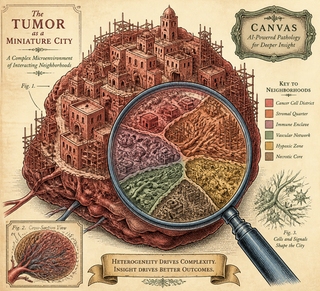
We often talk about "the tumor" as if it were a single blob with a bad attitude. It isn't. A tumor is more like a crowded block of apartments, alleyways, scaffolding, plumbing, security checkpoints, and extremely suspicious tenants. Cancer cells live there, obviously, but so do immune cells, fibroblasts, blood vessels, and extracellular matrix - the structural framework that can act like either sensible scaffolding or a bureaucratic nightmare.
This local layout matters. The tumor microenvironment shapes how cancer grows, spreads, and dodges treatment. In lung cancer and many other cancers, the difference between a tumor that responds to immunotherapy and one that shrugs it off may depend not just on which cells are present, but where they sit relative to one another. A T cell in the right alleyway might be a bodyguard. The same T cell marooned outside the action is basically a security guard locked in the parking garage.
Researchers have known this for a while, and recent reviews on spatial biology have hammered home the point: location is biology, not decoration.12
CANVAS: reading the floor plan from the wallpaper
In this Cell paper, Li and colleagues built CANVAS, short for cellular architecture and neighborhood-informed virtual AI-driven spatial profiling.3 The basic idea is surprisingly elegant.
First, the team created a large atlas from more than 18 million cells in 457 patients with non-small cell lung cancer, using 41-plex spatial proteomics. That gave them a detailed map of what kinds of cellular neighborhoods tend to exist in tumors. They identified 10 reproducible cellular neighborhoods, recurring patterns of local organization in the tumor microenvironment.
Then came the clever bit. They trained AI to infer those neighborhood patterns from ordinary H&E histology images alone. In other words, they taught a model to look at a routine pathology slide and make an educated spatial guess about the hidden ecological layout beneath it. It's a bit like learning to predict the wiring, plumbing, and tenant politics of a building just by studying the facade - absurd on paper, but apparently possible with enough data and computational nerve.
They then tested this system in more than 5,000 patients across 9 cancer types. CANVAS helped with prognosis, classification of tumor "ecotypes," and prediction of immunotherapy outcomes. That last part is where ears really perk up in oncology clinics.
Why this is interesting beyond the usual AI drumroll
AI in pathology can sometimes sound like a startup pitch trapped in an elevator with a press release. But this study is interesting for a more grounded reason: it tries to bridge elite, high-dimensional spatial biology and routine clinical practice.
Spatial omics methods are powerful, but they are not yet everyday tools in most hospitals. They can be expensive, technically demanding, and hard to deploy at scale.24 H&E slides, by contrast, are the plain bread of pathology. Not glamorous, but everywhere, affordable, and surprisingly versatile.
So if CANVAS holds up, it could let clinicians extract some of the architectural logic of tumors without needing every patient to undergo advanced multiplex spatial profiling. That would not replace direct molecular measurements, but it could help prioritize who needs what, and where more detailed testing might matter most.
It also fits a broader trend: using AI to pull clinically meaningful signals from standard pathology images, including predictions about molecular features, prognosis, and treatment response.56 The difference here is the emphasis on cellular neighborhoods - not just what a tumor is made of, but how its residents cluster, segregate, and cooperate like a deeply corrupt zoning board.
The catch, because biology enjoys humility
Before we declare victory and hand the keys of the city to the algorithm, a few caution signs belong on the sidewalk.
First, this kind of model depends on the quality and diversity of the training data. Histology varies across institutions, scanners, staining protocols, and tumor types. AI can be brilliant right up until it meets a slide prepared by a lab it has never seen and starts acting like a tourist with no map.
Second, prediction is not the same as direct measurement. CANVAS infers spatial organization from morphology. That's useful, but it still needs careful validation in prospective clinical settings.
Third, even strong prognostic or immunotherapy-associated signals do not automatically tell us what to do differently for an individual patient on Tuesday morning in clinic. The translational leap from "this pattern predicts outcome" to "this changes treatment decisions" is where many elegant ideas discover gravity.
Still, this is exactly the kind of work that makes modern pathology feel less like static wallpaper and more like a readable blueprint. Tumors leave clues in their structure. We are finally getting better at reading the building code.
The bigger picture
The long-term appeal here is obvious: cheaper, scalable spatial insight from a test hospitals already use. If reproducible, CANVAS could help identify patients with more hostile tumor ecosystems, refine immunotherapy selection, and bring spatial biology closer to everyday oncology instead of keeping it in the penthouse suite of specialized research labs.
And honestly, it's hard not to admire the concept. Cancer has spent decades redesigning the neighborhood to suit itself. It would be satisfying if a routine pathology slide turned out to be enough for us to spot the crooked permits.
References
Disclaimer: The image accompanying this article is for illustrative purposes only and does not depict actual experimental results, data, or biological mechanisms.
-
Jackson HW, Fischer JR, Zanotelli VRT, et al. The single-cell pathology landscape of breast cancer. Nature. 2020;578(7796):615-620. doi:10.1038/s41586-019-1876-x ↩
-
Lewis SM, Asselin-Labat ML, Nguyen Q, et al. Spatial omics and multiplexed imaging to explore cancer biology. Nat Methods. 2021;18(9):997-1012. doi:10.1038/s41592-021-01203-6 ↩↩
-
Li Y, Li Z, Quinton R, et al. Cellular architecture and neighborhood-informed virtual spatial tumor profiling from histopathology. Cell. 2026. doi:10.1016/j.cell.2026.05.031 ↩
-
Bagaev A, Kotlov N, Nomie K, et al. Conserved pan-cancer microenvironment subtypes predict response to immunotherapy. Cancer Cell. 2021;39(6):845-865.e7. doi:10.1016/j.ccell.2021.04.014 ↩
-
Echle A, Grabsch HI, Quirke P, et al. Clinical-grade detection of microsatellite instability in colorectal tumors by deep learning. Gastroenterology. 2020;159(4):1406-1416.e11. doi:10.1053/j.gastro.2020.06.021 ↩
-
Bilal M, Raza SEA, Azam A, et al. Development and validation of a weakly supervised deep learning framework to predict tumor mutational burden from histopathology images in non-small cell lung cancer. JAMA Oncol. 2023;9(9):1221-1229. doi:10.1001/jamaoncol.2023.2468 ↩