Cancer was already a rude enough houseguest. Now it turns out some tumors may also be calling the nervous system for backup, ordering fresh wiring, and using your body's own communication grid like a stolen Wi-Fi password.
That is the big idea behind a recent review in Molecular Cancer on neuron-tumor crosstalk - the strange, slightly sci-fi relationship between cancer cells and nerves Jia et al., 2026. The authors describe something they call tumor neuron hijack, which sounds like a rejected cyberpunk movie title but is, annoyingly, real biology. In plain English: tumors do not just grow next to nerves. They can recruit them, reshape them, and use nerve signals to help themselves survive, spread, dodge the immune system, and even amplify pain.
Your nerves are not just for stubbing your toe
Most of us think of nerves as the body's messaging cables. They help you feel heat, move your hand, and regret texting your ex. But tumors can tap into those same lines.
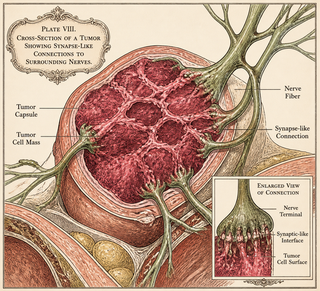
In the brain, cancers like gliomas may plug directly into existing neural circuits. They can form synapse-like connections with neurons and borrow metabolic support, which is about as unsettling as finding out the villain has access to the building security feed. Outside the brain, many solid tumors do a different trick - they encourage new nerve growth into the tumor using growth factors and guidance signals, almost like laying fresh telecom lines into enemy territory.
This matters because nerves do not just transmit sensation. They release neurotransmitters and neuropeptides that can influence how tumor cells grow, migrate, and respond to treatment. Sympathetic nerves, parasympathetic nerves, and sensory nerves each bring their own molecular chatter to the neighborhood. And the neighborhood, in cancer, is rarely charming.
The sketchy neighborhood gets sketchier
A tumor is not just a pile of rebellious cells. It is a whole ecosystem - blood vessels, immune cells, connective tissue, chemical signals, and, apparently, nerves. The review argues that the most important action may happen in the three-way conversation between nerves, immune cells, and tumor cells.
That triad can push the immune system from "keep watch" to "shrug emoji." Neural signaling can help build an immunosuppressive tumor microenvironment, making it harder for immune cells to attack. If your immune system is the galaxy's security force, the tumor has figured out how to jam the comms and bribe the guards with neurotransmitters.
This idea fits with a growing body of research showing that the nervous system can shape inflammation, immunity, and tumor behavior across multiple cancer types. A 2024 review in Nature Reviews Cancer summed up the expanding evidence that neural signaling is not a side plot in oncology - it may be part of the main script (Monje et al., 2024). Likewise, a 2023 review in Cancer Cell discussed how cancers exploit neural circuits and neuroactive molecules during progression (Faulkner and colleagues, 2023).
Pain is not just collateral damage
One of the most useful parts of this paper is that it does not treat cancer pain as a sad side effect off in the corner. The authors argue that pain can be part of the feedback loop.
Tumor-nerve interactions can trigger and worsen neuropathic pain, and that pain reflects deeper biological disruption. In some settings, the same crosstalk that hurts can also help the tumor adapt and progress. That is a grim little plot twist, but an important one. Pain might be more than a symptom - it could be a clue to what the tumor is doing with local nerve networks.
This has real-world implications. If doctors can interrupt the nerve signals feeding tumor growth and pain at the same time, that could improve both survival strategies and quality of life. That is a two-for-one deal oncology rarely gets.
Can we cut the lines?
This is where things get interesting. If tumors depend on neural input, then targeting nerve-related pathways might become part of cancer therapy.
The review points to several ideas already in play:
- repurposing drugs that affect neurotrophic signaling
- blocking synapse-like communication between neurons and tumor cells
- reprogramming neural signals that support tumor metabolism or immune escape
- combining neural-targeting strategies with immunotherapy
That last one may be especially promising. If nerve signals help create an immune-suppressive zone, then interrupting those signals could make immunotherapy work better. Not guaranteed, of course. Biology loves making us think we found the final boss, only to reveal three more behind it. Still, the logic is strong enough that this is becoming a serious translational area, not just a cool conference slide.
Recent work has also tied tumor innervation and neural remodeling to outcomes in cancers such as pancreatic, prostate, and breast cancer (Amit et al., 2020), (Banh et al., 2020). Reviews in high-impact journals over the past few years have reinforced the same message: nerves are active players, not innocent bystanders (Monje et al., 2024), (Cole et al., 2022).
Why this paper sticks with you
What makes this review memorable is not one single experiment. It is the frame. It asks us to stop picturing cancer as a lonely cluster of bad cells and start seeing it as a system-level infiltrator - one that can manipulate circuitry, metabolism, immunity, and sensation across the body.
That does not mean every cancer behaves this way to the same degree. It does mean the old map was missing some roads.
And that is the unnerving, oddly elegant takeaway: tumors may not just grow in the body. They may learn to network with it.
References
-
Jia B, Zhao L, Tang M, et al. Neuron-tumor crosstalk in cancer: molecular mechanisms and translational advances. Mol Cancer. 2026. DOI: 10.1186/s12943-026-02715-5
-
Monje M, et al. Cancer neuroscience: mechanisms and therapeutic opportunities. Nat Rev Cancer. 2024. DOI: 10.1038/s41568-024-00743-3
-
Faulkner S, et al. Neural regulation of cancer progression and the tumor microenvironment. Cancer Cell. 2023. DOI: 10.1016/j.ccell.2023.06.005
-
Amit M, et al. Loss of p53 drives neuron reprogramming in head and neck cancer. Nature. 2020. DOI: 10.1038/s41586-020-03178-5
-
Banh RS, et al. Neurons release serine to support pancreatic cancer metabolism. Science. 2020. DOI: 10.1126/science.aax7168
-
Cole SW, et al. The biology of the cancer-neuroscience interface. Nat Rev Clin Oncol. 2022. DOI: 10.1038/s41571-022-00631-5
Disclaimer: The image accompanying this article is for illustrative purposes only and does not depict actual experimental results, data, or biological mechanisms.