You leave leftovers in the fridge one day too long, crack the lid, and immediately understand that some environments are supposed to stay exactly the way they are. Your colon works a bit like that - not in the gourmet sense, thankfully, but in the "change the conditions and weird things start thriving" sense. A recent Molecular Cell commentary asks a sharp question: does extra oxygen in the gut help drive colorectal cancer? That is not a sentence anyone wanted on their bingo card, yet here we are.
The sketchy neighborhood gets streetlights
Most of your colon is naturally low in oxygen. That matters because the local residents - trillions of microbes - evolved for that setting. It is their dimly lit apartment complex. Quiet. Anaerobic. No one asking questions.
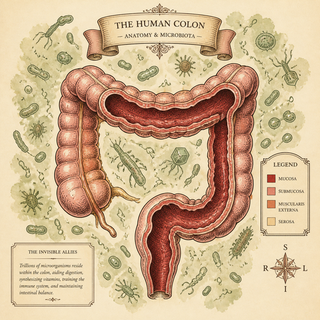
The paper by Larabi and Bäumler comments on new work from Spiga and colleagues suggesting that when this low-oxygen balance gets disrupted, the microbial neighborhood changes in ways that may favor colorectal cancer [1]. In plain English: if the gut becomes more oxygenated than usual, some bacteria that like or tolerate oxygen may gain an edge, while microbes that prefer the usual low-oxygen setup may lose ground. And that shift could nudge inflammation, metabolism, and tumor growth in the wrong direction.
Cancer biology loves a side plot. This one involves oxygen, microbes, and a colon that may be less stable than we thought.
Why oxygen is a big deal in a place built to avoid it
We usually hear about oxygen in cancer as a tumor problem. Too little oxygen inside tumors - hypoxia - can make cancers harder to treat. Fair enough. But the gut flips the script. Here, the normal state is already low oxygen, especially in the lumen where most microbes live [2]. That low-oxygen status helps maintain a particular microbial ecosystem.
If more oxygen leaks into that system - from inflammation, barrier damage, altered blood flow, or tumor-related changes - it may act like a remodeling project no one approved. Bacteria that can use respiratory metabolism may expand. Some of those microbes have already been linked to colorectal cancer or inflammatory conditions that raise cancer risk [3-5].
One major suspect is Bacteroides fragilis, especially toxin-producing strains. This bacterium has been associated with colorectal tumor development through inflammation, barrier disruption, and signaling effects on host cells [3]. It is not the only player, but it is one of those microbes that keeps showing up near the crime scene.
What the new idea changes
The interesting twist here is causal direction.
For years, researchers have asked whether certain bacteria contribute to colorectal cancer. They do. But this newer framing asks a more annoying and more useful question: what if the gut environment itself - especially oxygen availability - selects for the bacteria that then help cancer along?
That matters. A lot.
Because if oxygenation is part of the setup, then the microbiome is not just a cast of suspicious characters. It is also responding to the lighting, the doors, the plumbing, the whole building code. Tumors may alter the local environment. Inflammation may alter it too. Then the altered environment favors microbes that make things even worse. Congratulations, we have a feedback loop. Biology's favorite disaster carousel.
This idea fits with broader work showing that colorectal cancer is not just rogue epithelial cells growing out of control. It is also a disease of the surrounding ecosystem - microbes, immune cells, metabolites, mucus, and oxygen gradients all elbowing each other in a very crowded room [4,5].
Why this could matter in real life
If these findings hold up, they could change how researchers think about prevention, screening, and treatment.
One possibility is better risk detection. If gut oxygenation or oxygen-sensitive microbial shifts show up early, they might help identify people heading toward trouble before a tumor becomes obvious.
Another is microbiome-targeted therapy. Instead of only trying to kill cancer cells, clinicians might eventually try to restore the gut's low-oxygen balance or block the bacteria that exploit oxygen-rich conditions. That could involve diet, bacterial therapeutics, microbial metabolites, or more precise antimicrobial strategies. Not sexy in a movie-trailer way, but potentially very useful in the "avoid colon cancer" way.
It also raises questions for inflammation-heavy diseases like inflammatory bowel disease, where colorectal cancer risk is already elevated. Chronic inflammation may increase oxygen availability in the gut and reshape microbial communities [2,4]. If so, oxygen might be one of the hidden connectors between inflammation and cancer.
The catch, because there is always a catch
This is a compelling model, but no one gets to declare victory after one clever mechanistic story.
We still need to know how consistently gut oxygenation changes across patients, whether it happens early enough to matter clinically, and which microbes are true drivers versus opportunists who just showed up after the damage started. Cancer ecosystems are messy. They do not read flowcharts.
We also need human data that connect oxygen changes, microbial shifts, and tumor behavior in ways that are reproducible across populations. Mouse models are useful. Human colons, meanwhile, did not get the memo about behaving neatly.
Still, this is the kind of idea worth chasing. It links host biology to the microbiome with a concrete mechanism. It may explain why some bacterial communities become dangerous in the first place. And it turns oxygen - usually treated as background scenery - into a possible active player in colorectal cancer.
That is a big shift. Quietly sinister. Like finding out the thermostat has been helping the burglar.
References
-
Larabi AB, Bäumler AJ. Does gut oxygenation drive colorectal cancer? Mol Cell. 2026;86(11):2487-2489. doi:10.1016/j.molcel.2026.05.021
-
Zheng L, Kelly CJ, Colgan SP. Physiologic hypoxia and oxygen homeostasis in the healthy intestine. A review of mucosal oxygen biology relevant to host-microbe balance. Cell Mol Gastroenterol Hepatol. 2015;1(3):278-290. PMCID:PMC4392332
-
Cheng WT, Kantilal HK, Davamani F. The mechanism of Bacteroides fragilis toxin contributes to colon cancer formation. Malays J Med Sci. 2020;27(4):9-21. doi:10.21315/mjms2020.27.4.2 PMCID:PMC7476463
-
Janney A, Powrie F, Mann EH. Host-microbiota maladaptation in colorectal cancer. Nature. 2020;585(7826):509-517. doi:10.1038/s41586-020-2729-3
-
Garrett WS. The gut microbiota and colon cancer. Science. 2019;364(6446):1133-1135. doi:10.1126/science.aaw2367
Disclaimer: The image accompanying this article is for illustrative purposes only and does not depict actual experimental results, data, or biological mechanisms.