Brushing dirt off an archaeological site, you don’t uncover one neat artifact - you find layers, trade routes, old fires, broken tools, and the story of how a whole civilization changed. That’s basically what this new review on cancer in China does. It doesn’t just count tumors. It digs through decades of shifting habits, ageing, screening, pollution, infections, and healthcare expansion to show how cancer in China is changing shape in real time - and why that matters far beyond China’s borders.
China has about 17% of the world’s population, but roughly 25% of the world’s cancer burden. That is not a typo, and it is not a small public health footnote tucked in the back of the book. It means more than 5 million new cancer cases each year, affecting patients, families, hospitals, and health systems on a huge scale.1
And if you’re someone sitting in an infusion chair - or beside one - this kind of paper matters because it asks a very human question: what kinds of cancers are showing up, who is getting them, and is the system keeping up?
The old map is fading, the new one is messy
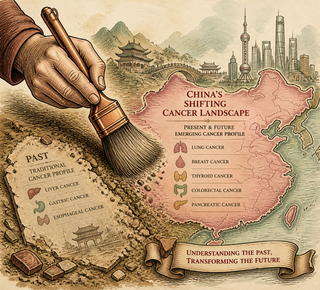
One of the biggest takeaways from this review is that China’s cancer landscape is shifting.
Historically, cancers like oesophageal, gastric, and liver cancer were especially common in China. Those are still important, but the rates have been falling substantially.1 That’s good news, even if cancer biology never lets anyone celebrate for too long without adding a footnote.
At the same time, cancers more common in high-income countries are rising - lung, colorectal, prostate, thyroid, female breast, and cervical cancers.1 Some of that increase comes from population ageing and better diagnosis. If you look harder, you find more. Science: occasionally just a very expensive flashlight. But lifestyle changes also matter - smoking, obesity, diet, air pollution, infections, and reproductive patterns all help shape who gets what.
This is what makes the review interesting. It’s not just “more cancer.” It’s a transition from one cancer profile to another, while the country still has to deal with both.
Why this hits patients where they live
For patients, cancer trends are not abstract curves on a graph. They decide where screening gets funded, which clinics get built, what specialists are in short supply, and whether diagnosis comes early or late.
China has launched national cancer control efforts since the 1980s, including screening programs and broader prevention policies.1 But when a country this large sees rapid demographic change, the healthcare system can feel like it’s trying to renovate the house while everyone is still living in it.
Take screening. It can save lives, but only if people can actually access it, trust it, afford follow-up care, and get treatment without falling into logistical purgatory. A screening program without timely diagnosis and treatment is a bit like installing smoke detectors in a building with no fire exits. Helpful, yes. Sufficient, no.
That matters for colorectal, cervical, breast, and lung cancer especially, where early detection can change the whole story.23
Risk factors: the villains are annoyingly familiar
A lot of the drivers here are the usual suspects, which is both frustrating and clarifying.
Tobacco remains a giant problem, especially for lung cancer.4 Air pollution also matters. Chronic infections such as hepatitis B and Helicobacter pylori have historically fueled liver and stomach cancers, though prevention and treatment efforts have helped push some of those rates down.15 Meanwhile, rising obesity, less physical activity, and more “modern” dietary patterns are helping power increases in colorectal and breast cancer.26
None of this is mysterious. Cancer risk factors are like raccoons in your attic - ignore them for long enough and they absolutely become everyone’s problem.
The challenge isn’t just science - it’s scale
What makes China especially important is scale. If China improves prevention, screening, and treatment, the global cancer burden changes. Full stop.
But the challenges are real: uneven healthcare access between regions, pressure from an ageing population, workforce demands, rising costs, and the need to match cancer services to a rapidly changing disease pattern.1 A city with advanced molecular testing and targeted therapy is not the same story as a rural area where access may be patchier. Cancer care can get very futuristic very quickly, but patients still need basics first - diagnosis, pathology, surgery, radiation, drugs, transport, time off work, and support that does not vanish after the first appointment.
That’s why this review lands as more than an epidemiology update. It’s a reminder that cancer control is not one miracle pill riding in on a white horse. It’s policy, prevention, vaccination, cleaner air, tobacco control, screening, treatment infrastructure, and making sure survival does not depend too heavily on your postal code.
What happens next?
If the trends in this review hold up, China’s cancer future will depend on two things at once: continuing to reduce infection-related and historically common cancers, while getting much better at preventing and treating the rising wave of colorectal, breast, lung, prostate, and cervical cancers.1
For the rest of the world, this is not a distant story. China’s cancer burden will shape global research priorities, drug demand, screening strategies, and public health planning. When one-quarter of the world’s cancer burden shifts, everybody feels the floor move.
And for patients, the core hope is simple: fewer preventable cancers, more cancers caught early, and better odds after diagnosis. Not glamorous. Not flashy. Just the kind of progress that lets more people keep ordinary plans - school pickup, work deadlines, bad coffee, family dinners, annoying group chats. Which, frankly, is the good stuff.
References
Disclaimer: The image accompanying this article is for illustrative purposes only and does not depict actual experimental results, data, or biological mechanisms.
-
Xia C, Li H, Wu C, Chen W. Cancer burden and control in China: landscape, trends and challenges. Nat Rev Clin Oncol. 2026. doi:10.1038/s41571-026-01165-8 ↩↩↩↩↩↩↩
-
Sung H, Ferlay J, Siegel RL, et al. Global cancer statistics 2020: GLOBOCAN estimates of incidence and mortality worldwide for 36 cancers in 185 countries. CA Cancer J Clin. 2021;71(3):209-249. doi:10.3322/caac.21660 ↩↩
-
Allemani C, Matsuda T, Di Carlo V, et al. Global surveillance of trends in cancer survival 2000-14 (CONCORD-3). Lancet. 2018;391(10125):1023-1075. doi:10.1016/S0140-6736(17)33326-3 ↩
-
Hecht SS. Tobacco smoke carcinogens and lung cancer. J Natl Cancer Inst. 2022;114(10):1320-1328. doi:10.1093/jnci/djac080 ↩
-
Sung H, Hyun N, Leach CR, et al. Association of hepatitis B virus vaccination and liver cancer trends. JHEP Rep. 2022;4(9):100570. doi:10.1016/j.jhepr.2022.100570 ↩
-
Vadiveloo M, Scott M, Quatromoni P, et al. Diet, obesity, and colorectal cancer risk: recent evidence and clinical implications. Gut. 2023;72(9):1752-1763. doi:10.1136/gutjnl-2022-32834 ↩