A lot of cancer treatment works by smashing tumor cells and hoping the immune system notices the wreckage. Fair plan. Except in solid tumors, the body's top messengers - dendritic cells - often get trapped, underpowered, and generally treated like a startup team asked to launch a product with one laptop and no Wi-Fi.
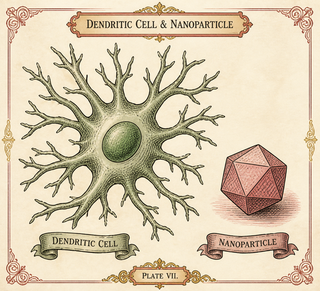
That is the problem behind a new Nature Nanotechnology paper from Zhang and colleagues, who built a nanoparticle system to help dendritic cells inside tumors do more of what they are supposed to do: grab tumor bits, package the evidence, and alert the rest of the immune system that something criminal is happening nearby. Their platform has a long, very grant-friendly name - intratumoural generation of immunopresentation vesicles after tumour exposure - but the basic pitch is refreshingly clear. Make better immune mail from inside the tumor, then let that mail reach the lymph nodes where bigger immune decisions get made. Zhang et al., 2026
The tumor's favorite move: lock the security team in the basement
Your immune system does not kill cancer just because cancer exists. It needs receipts.
Those receipts are often tumor antigens - bits of tumor material that immune cells can show to T cells as proof that a target deserves attention. The specialists that do this showing are dendritic cells, which are basically the body's most overworked product managers. They collect the weird stuff, label it, and brief the strike team.
The problem is that solid tumors are lousy places for good antigen presentation. Even when radiation or chemotherapy kills tumor cells and creates plenty of debris, there may not be enough functional dendritic cells around to process that material well. And the ones that are there can be impaired by the tumor microenvironment, which is less "healthy tissue" and more "sketchy neighborhood with terrible management."
So you get a frustrating setup: lots of tumor destruction, not enough immune follow-through.
Nanoparticles with a very specific mission
The authors designed plant-derived nanoparticles coated with nanohydroxyapatite and delivered them into tumors. Their goal was not simply to kill cells directly. Instead, they wanted to reprogram dendritic cells within the tumor so those cells would become more active and generate more antigen-presenting vesicles.
Think of vesicles as tiny sealed packets of information. In this case, they carry antigen-presenting signals that can travel to lymph nodes, where T cells get activated. If ordinary antigen presentation is like sending one stressed employee to explain the crisis, this approach tries to create a whole fleet of well-prepared briefing packets. Very scalable. Very "immune system SaaS."
Mechanistically, the nanoparticles appeared to work by modulating intracellular immune conversion and calcium signaling, both of which matter for dendritic-cell activation and vesicle production. Calcium signaling, in particular, shows up all over cell biology like that one middleware platform nobody wanted to learn but somehow runs the whole company.
What the study found
Across several solid tumor models, the platform boosted the in vivo production of these dendritic-cell-derived antigen-presenting vesicles. That translated into stronger antigen presentation in lymph nodes and a more robust systemic immune response.
The really interesting part is the combo strategy. When paired with radiotherapy, the nanoparticle system produced better antitumor effects than radiotherapy alone. That makes intuitive sense. Radiation can create tumor antigens by damaging cancer cells, but antigens without effective presentation are a little like unread Slack messages during a corporate meltdown. This platform tries to solve the handoff problem.
The big idea is not "we killed the tumor with a fancy particle." It is "we improved the tumor-to-immune-system communication pipeline." In immuno-oncology, that is a big deal.
Why this matters beyond one mouse paper
Cancer immunotherapy has already shown that if you can get T cells properly activated, they can do impressive work. But many patients with solid tumors do not respond well enough, partly because the early steps of immune activation are weak. Poor antigen presentation is one of the bottlenecks.
Other recent work has emphasized the same broad point: dendritic cells are central to productive antitumor immunity, and improving their number or function could make other therapies work better, including checkpoint blockade and radiation (Wculek et al., 2020; Binnewies et al., 2023). There is also growing interest in nanomedicine approaches that reshape the tumor microenvironment or improve immune priming, though making these systems reliable in patients remains a nontrivial exercise in scientific humility (Riley et al., 2021).
Radiotherapy plus immunotherapy is another active area, because radiation can turn tumors into antigen sources while immunotherapy can, in theory, exploit that moment. In practice, the connection between those two steps often underperforms. Reviews over the past few years have repeatedly pointed to antigen presentation and dendritic-cell biology as missing links (Herrera et al., 2022).
That is what makes this paper interesting. It targets a practical bottleneck rather than just adding another blunt-force weapon.
The catch, because biology always keeps a few bugs in production
This is still preclinical work. We do not yet know how well this will translate to human tumors, which are messier, more variable, and generally less cooperative than laboratory models. Intratumoral delivery can also be easier to discuss in a paper than to deploy across all cancer settings in the clinic. Safety, manufacturability, dosing, and reproducibility all matter here.
And while "plant-derived nanoparticles coated with nanohydroxyapatite" sounds delightfully futuristic, the road from elegant mechanism to approved therapy is where many promising cancer ideas meet regulatory reality and a stack of forms tall enough to have its own zip code.
Still, the concept is sharp: instead of only generating more tumor debris, amplify the immune system's ability to present that debris as actionable evidence. If that holds up, it could strengthen the impact of radiotherapy and perhaps other treatments that depend on immune recognition.
In startup terms, this is not a full market launch. It is a strong beta with a smart product thesis. And in cancer research, a better immune briefing system might be exactly the infrastructure upgrade the field needs.
References
-
Zhang J, Du J, Xing K, et al. Amplifying tumour antigen presentations from intratumourally entrapped dendritic cells. Nat Nanotechnol. 2026. doi: 10.1038/s41565-026-02204-2
-
Wculek SK, Cueto FJ, Mujal AM, Melero I, Krummel MF, Sancho D. Dendritic cells in cancer immunology and immunotherapy. Nat Rev Immunol. 2020;20(1):7-24. doi: 10.1038/s41577-019-0210-z
-
Binnewies M, Roberts EW, Kersten K, et al. Understanding the tumor immune microenvironment as a guide for effective cancer immunotherapy. Nat Rev Clin Oncol. 2023;20(5):323-339. doi: 10.1038/s41571-023-00722-4
-
Riley RS, June CH, Langer R, Mitchell MJ. Delivery technologies for cancer immunotherapy. Nat Rev Drug Discov. 2021;20(3):175-196. doi: 10.1038/s41573-020-0091-8
-
Herrera FG, Bourhis J, Coukos G. Radiotherapy combination opportunities leveraging immunity for the next oncology practice. Trends Immunol. 2022;43(6):447-466. doi: 10.1016/j.it.2022.03.004
Disclaimer: The image accompanying this article is for illustrative purposes only and does not depict actual experimental results, data, or biological mechanisms.