Drug delivery in the bladder is a little like public transit during rush hour: you can put the medicine on the right line, but that does not mean it gets off at the right stop, walks through the turnstile, and actually reaches the sketchy neighborhood where the tumor is throwing chairs.
That is the problem behind a new Nature Nanotechnology paper with a title that sounds like someone let a robotics lab, an algae biologist, and an AI engineer share one espresso machine: “Machine-intelligent multimodal algebot for intracavitary chemotherapy.” Lin and colleagues built tiny drug-carrying algae microrobots, steered them with magnets, watched them with imaging, and used them to push chemotherapy deeper into bladder tumors in mice.[1]
Yes, algae. Yes, robots. No, your smoothie is not safe.
The Bladder Is Convenient, but Annoying
Bladder cancer often starts in the inner lining of the bladder. That makes local treatment possible: doctors can put drugs directly into the bladder through a catheter, a strategy called intravesical therapy. Compared with flooding the whole bloodstream with chemotherapy, this is pleasingly local. Very “deliver the pizza to the actual house,” not “throw slices from a helicopter.”
But the bladder is not just an empty bag politely waiting for medicine. It has mucus, folds, tissue barriers, urine dilution, and the deeply unhelpful habit of emptying itself. Current intravesical drugs can struggle to stay put and penetrate tumor tissue. Reviews of bladder drug delivery keep coming back to the same lab-bench headache: contact time and penetration matter, and both are hard.[2,3]
Anyone who has spent three months optimizing one assay only to discover the reagent was the problem can respect the cruelty here. The drug may be potent, but if it cannot physically reach the cells, it is basically a very expensive motivational speaker.
Enter the Algebot
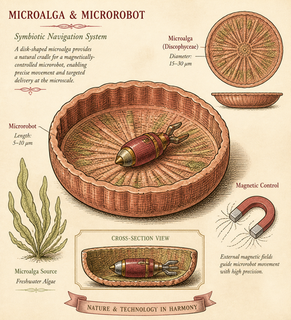
The team used Coscinodiscus granii, a disk-shaped microalga with a naturally porous silica shell. Think of it as a tiny decorative soap dish, except instead of holding soap it can hold doxorubicin, a classic chemotherapy drug.
The researchers hollowed and modified these algae shells, added magnetic iron oxide particles so they could be controlled from outside the body, and sealed drug cargo inside with a polydopamine coating. The result: a doxorubicin-loaded magnetic algae microrobot, or DMCG.
The clever part is not just “tiny thing carries drug.” We have had tiny things carrying drugs for a while, and many of them look perfect in Figure 1 before reality walks in wearing muddy boots. The trick here is motion. Under rotating magnetic fields, the algebots can roll, tumble, gather into swarms, and swirl in place. That swirling creates local fluid movement, which helps drive drug molecules into tissue instead of letting them loiter in the bladder like teenagers outside a convenience store.
AI Gets the Steering Wheel
The paper also adds machine-intelligent image feedback. In plain English: the system uses imaging to track where the microrobot swarm is, then adjusts magnetic control so the swarm can navigate toward the target and switch behavior when it arrives.
This matters because the bladder is folded and variable. It is not a clean plastic dish, despite what our most optimistic experimental diagrams imply. The authors tested navigation in bladder-like phantoms with folds and narrow passages, then moved into animal experiments using ultrasound guidance.
In mouse bladder tumor models, the drug-loaded algebots increased drug permeation more than tenfold compared with conventional intravesical instillation. After one week of therapy, tumor burden fell to less than 3% of the conventional free-drug group, with no detectable systemic toxicity under the tested conditions.[1] That is the kind of result that makes a tired postdoc stare at the graph, blink twice, and immediately ask where the controls are.
To be clear: this is preclinical mouse work. It is not a human treatment yet. Mouse bladders are not human bladders, and “works beautifully in a controlled experiment” is a phrase that has broken many hearts and at least three Western blot rigs.
Why This Is More Than a Cute Robot Story
The bigger idea is that drug delivery may need motion, feedback, and local physics, not just better chemistry. A passive drug in the bladder has to diffuse through barriers. These algebots actively move to the target, release cargo, and stir the local fluid to help penetration.
That puts this work in a broader wave of smarter local bladder therapies. Other groups are testing sustained-release intravesical systems such as TAR-200, which delivers gemcitabine over time and has shown strong clinical activity in BCG-unresponsive non-muscle-invasive bladder cancer.[4] Separately, imaging-guided microrobots have been explored for targeted therapy in bladder tumor models.[5] The field is clearly tired of pouring medicine into the bladder and hoping for the best. Fair. Hope is not a pharmacokinetic strategy.
If future studies confirm safety, scalability, clearance, and real tumor benefit in larger animals and humans, algebot-guided chemotherapy could become a new way to make local treatment more precise. Less drug wasted. More drug where it belongs. Fewer healthy tissues dragged into the drama.
For now, the study is a sharp reminder that cancer therapy is not only about finding the right molecule. Sometimes it is about getting that molecule through traffic, past security, into the right building, and into the room where the cellular rebels are holding their very illegal meeting.
References
-
Lin L, Li H, Zhou Q, et al. Machine-intelligent multimodal algebot for intracavitary chemotherapy. Nature Nanotechnology. 2026. DOI: 10.1038/s41565-026-02195-0
-
Ghodoussipour S, et al. A systematic review of novel intravesical approaches for the treatment of patients with non-muscle-invasive bladder cancer. European Urology. 2025. DOI: 10.1016/j.eururo.2025.02.010
-
Lu Y, Wang S, Wang Y, Li M, Liu Y, Xue D. Current researches on nanodrug delivery systems in bladder cancer intravesical chemotherapy. Frontiers in Oncology. 2022;12:879828. DOI: 10.3389/fonc.2022.879828
-
Daneshmand S, et al. TAR-200 for Bacillus Calmette-Guérin-unresponsive high-risk non-muscle-invasive bladder cancer. Journal of Clinical Oncology. 2025. DOI: 10.1200/JCO-25-01651
-
Li L, Zhang Y, Dabiri JO, et al. Imaging-guided bioresorbable acoustic hydrogel microrobots. Science Robotics. 2024;9:eadp3593. DOI: 10.1126/scirobotics.adp3593
Disclaimer: The image accompanying this article is for illustrative purposes only and does not depict actual experimental results, data, or biological mechanisms.