The standout difference in this study is its scouting report on MED4, a tiny Mediator-complex subunit that seems to keep metastatic breast cancer cells benched instead of letting them storm back onto the field.
That is a weird sentence, yes. Cancer biology does that to a person.
Breast cancer can sometimes play the longest, rudest game imaginable. A primary tumor gets treated. Scans look clean. Everyone exhales. Then, years later, a few cancer cells that had wandered off early decide it is comeback season. These cells are called disseminated tumor cells, and when they stop dividing but stay alive, scientists call that metastatic dormancy. Think of them as microscopic players sitting in the locker room, pads on, waiting for a whistle nobody wants blown.
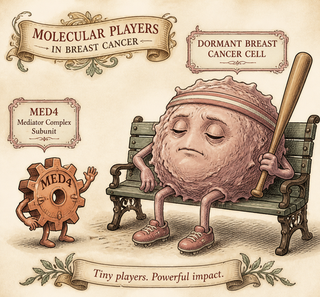
Bae and colleagues, writing in Nature Cell Biology, asked a sharp question: what keeps those cells asleep, and what lets them wake up? Their answer points to MED4, a component of the Mediator complex, which usually helps manage gene transcription. In this paper, MED4 looks less like a hype man for gene activity and more like a defensive coordinator yelling, "Do not let the metastasis run the ball" https://doi.org/10.1038/s41556-026-01984-y.
The Dormancy Playbook
Dormancy matters because breast cancer relapse can happen long after initial treatment, especially in estrogen receptor-positive disease. Reviews over the past few years have emphasized the same uneasy truth: dormant cells are hard to find, hard to study, and annoyingly good at not dying https://doi.org/10.1038/s41523-021-00269-x, https://doi.org/10.1038/s41388-025-03529-3.
These cells are not doing nothing. They are not biologic furniture. They are alive, stressed, adapting, and listening to signals from their neighborhood: immune cells, blood vessels, stiffness, oxygen levels, and the extracellular matrix, which is basically the tissue scaffolding around cells. If the tumor microenvironment were a stadium, the extracellular matrix would be the turf. Change the turf, and suddenly the whole game plays differently.
MED4: Small Player, Big Defensive Impact
The team used a genome-scale genetic screen in mouse models to look for genes that control metastatic reactivation. MED4 showed up as a gatekeeper. When the researchers reduced MED4 dosage, metastatic cells were more likely to escape dormancy and grow.
The key detail is haploinsufficiency, a word that sounds like a rejected fantasy football metric but means this: losing just one working copy of a gene can be enough to change cell behavior. The study reports that MED4 haploinsufficiency appears common in metastatic breast cancer and links it with poorer outcomes.
That is the scoreboard moment. Not "MED4 is gone completely." More like "MED4 is down a starter, and the defense starts missing tackles."
The Plot Twist Is in the Enhancers
MED4 belongs to the Mediator complex, famous for helping genes get turned on. So you might expect less MED4 to mean less gene activation. Biology, naturally, looked at that expectation and threw a trick play.
The study found that MED4 normally suppresses certain enhancer marks: H3K4me1, associated with enhancer priming, and H3K27ac, associated with enhancer activation. Enhancers are stretches of DNA that help control when genes fire. If genes are players, enhancers are the coaching staff with clipboards and suspiciously strong opinions.
When one Med4 allele was lost, enhancer control loosened. That pushed cancer cells toward extracellular matrix remodeling and integrin-mediated mechanotransduction. Translation: the cells changed their surroundings, sensed mechanical cues through integrins, and used those signals to start growing again.
That is not just a molecular footnote. It connects gene regulation to physical force. The cancer cells did not merely read new instructions. They remodeled the field, felt the bounce, and started running routes.
Why This Could Matter
If these results hold up in larger human studies, MED4 status could become part of relapse-risk scouting. Patients whose tumors show MED4 haploinsufficiency might have a higher risk of dormant metastatic cells waking up. That does not mean a MED4 test is ready for clinic tomorrow morning with a branded mug and a press tour. It means MED4 could help identify who needs closer monitoring or future therapies aimed at keeping dormant cells asleep.
The therapeutic angle is especially interesting because MED4 loss points downstream to pathways involving the extracellular matrix, integrins, and mechanotransduction. Those are more druggable than "please make one missing gene copy behave." Recent work on breast cancer dormancy keeps circling the same challenge: we need models and targets that capture the strange survival tactics of dormant cells, not just fast-growing tumors https://doi.org/10.3389/fcell.2022.929893, https://doi.org/10.1126/sciadv.adl0165.
For now, MED4 is not a cure. It is a promising piece of the scouting report. But in a disease where metastatic recurrence often decides the final score, learning why some cells stay benched and others re-enter the game is exactly the kind of tape review oncology needs.
References
-
Bae SS, Ling HH, Zhang J, et al. Mediator subunit MED4 enforces metastatic dormancy in breast cancer. Nature Cell Biology. 2026. DOI: 10.1038/s41556-026-01984-y
-
Bushnell GG, Deshmukh AP, den Hollander P, et al. Breast cancer dormancy: need for clinically relevant models to address current gaps in knowledge. npj Breast Cancer. 2021;7:66. DOI: 10.1038/s41523-021-00269-x
-
Barnieh FM, Morton J, Olanrewaju O, et al. Decoding the adaptive survival mechanisms of breast cancer dormancy. Oncogene. 2025;44:3759-3773. DOI: 10.1038/s41388-025-03529-3
-
Ring A, Nguyen-Sträuli BD, Wicki A, Aceto N. Clinical and biological aspects of disseminated tumor cells and dormancy in breast cancer. Frontiers in Cell and Developmental Biology. 2022;10:929893. DOI: 10.3389/fcell.2022.929893
-
Barney LE, Peyton SR. Outlook and opportunities for engineered environments of breast cancer dormancy. Science Advances. 2024. DOI: 10.1126/sciadv.adl0165
Disclaimer: The image accompanying this article is for illustrative purposes only and does not depict actual experimental results, data, or biological mechanisms.