Brains love drama at microscopic scale. In this new Neuron study, researchers watched a special kind of human neural stem cell move through fetal brain tissue and found that these cells use not one travel method, but two. One is a mitosis-time shove. The other is a quieter, more common glide that happens between divisions. Biology, naturally, made the weirder option the main one.
The cells with the expansion pack
The stars here are basal radial glial cells, usually shortened to bRG cells. These are neural stem cells that matter a lot in the developing human neocortex - the brain region that handles higher-order jobs like language, planning, and the sort of life choices that lead you to read about fetal cell movement for fun.
Scientists have known for a while that bRG cells help the human cortex grow large and folded. They are far more abundant in humans than in species with smoother, smaller cortices. But one basic question stayed annoyingly open: how do these cells actually spread through the growing cortex?
That is not a small detail. If you want to understand how the human brain gets built - or what goes wrong in brain disease - you need to know how the workers move around the construction site.
Two ways to move house
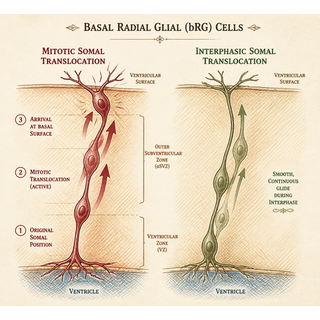
Using live imaging of human fetal tissue and cortical organoids, the authors saw two distinct ways bRG cells shift their cell bodies through the cortex.
The first was already known: mitotic somal translocation, or MST. This happens around cell division. The cell rounds up and moves in a way that depends on actomyosin - the force-generating machinery cells use when they need to squeeze, pull, or generally behave like tiny bags of muscle.
The second was the surprise: interphasic somal translocation, or IST. This happens during interphase, meaning the cell is not dividing. It is just moving. Quietly. Efficiently. Like someone who leaves a party without saying goodbye.
And this was not some side behavior. The team found that 85% of bRG translocation came from IST.
That matters because it flips the emphasis. The main way these cells colonize the human cortex is not the flashy mitosis-associated move. It is the between-divisions one.
The cell has a winch, apparently
The mechanics are where this gets especially good.
The researchers showed that IST depends on microtubules, the cell’s internal scaffold-and-rail system. More specifically, it relies on dynein, a motor protein that moves cargo along microtubules, and LIS1, a dynein activator famous for its role in brain development. The machinery gets recruited to the nuclear envelope through the LINC complex, which physically links the nucleus to the cell’s internal skeleton.
In plain English: the cell seems to hook its nucleus to a motorized transport setup and pull it along. Your brain starts as a highly organized moving day. Nobody labels the boxes.
By contrast, MST is controlled by the mitotic cell-rounding pathway, which is a different physical program. So these two movement modes are not just the same engine in different weather. They are distinct systems.
Why this is more than developmental trivia
This study helps explain how the human neocortex gets populated during development. The authors estimate that these translocations add up to about 0.67 mm per month of gestation. In an embryo, that is meaningful territory.
It also gives researchers a framework for understanding what happens when these systems fail. Problems with proteins like LIS1 have already been linked to severe developmental brain disorders, including lissencephaly, where the brain develops abnormally smooth folds [1]. If bRG cells cannot move properly, the architecture of the cortex may never get assembled the way it should.
Then came the bonus plot twist: the same two movement modes showed up in bRG-related glioblastoma cells.
That does not mean fetal development and brain cancer are the same thing. It does mean tumors may reuse old developmental tricks. Cancer loves recycling. Morally, it remains a bad system.
Why cancer people should care
This is not an oncology paper in the usual sense, but it brushes right up against one. Glioblastoma is a devastating brain tumor, and one reason it is so hard to treat is that its cells move, infiltrate, and refuse to stay politely in one place.
If glioblastoma cells borrow movement programs from bRG cells, that gives scientists a sharper map of the machinery behind tumor spread. Motors like dynein, regulators like LIS1, and structural links like the LINC complex become more interesting as possible points of vulnerability - though turning that idea into treatment is a long road, and biology rarely hands out easy wins.
Still, this is how progress often starts. First you learn the trick. Then you figure out how to interrupt it.
The bigger picture, minus the lecture voice
What I like about this paper is its simplicity at the core. Watch the cells. Notice they move in two ways. Prove the two ways use different machinery. Then connect that to both normal brain growth and a nasty tumor.
That is elegant science. Also a reminder that development is not just about what cells become. It is about where they go, when they move, and what molecular engine gets them there.
The human cortex did not get large by magic. It got large because cells had places to be.
References
-
Reiner O, Sapir T. LIS1 functions in normal development and disease. Curr Opin Neurobiol. 2013;23(6):951-956. doi:10.1016/j.conb.2013.08.001
-
Kalebic N, Huttner WB. Basal progenitor morphology and neocortex evolution. Trends Neurosci. 2020;43(10):777-792. doi:10.1016/j.tins.2020.07.001
-
Andrews MG, Nowakowski TJ. Human brain development through the lens of single-cell biology. Annu Rev Genomics Hum Genet. 2021;22:393-414. doi:10.1146/annurev-genom-121320-081639
-
Cuddapah VA, Robel S, Watkins S, Sontheimer H. A neurocentric perspective on glioma invasion. Nat Rev Neurosci. 2014;15(7):455-465. doi:10.1038/nrn3765
-
Wimmer R, Brunet Avalos C, Lestienne P, et al. Two translocation mechanisms drive neural stem cell dissemination into the human fetal cortex. Neuron. 2026. doi:10.1016/j.neuron.2026.02.002
Disclaimer: The image accompanying this article is for illustrative purposes only and does not depict actual experimental results, data, or biological mechanisms.