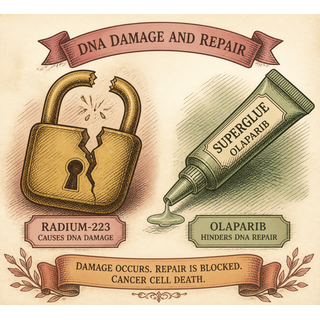
That is basically the plot of this paper exchange about olaparib plus radium-223 in men with castration-resistant prostate cancer that has spread to bone. It sounds like the title of a very niche buddy-cop movie, but the biology is actually pretty elegant: one treatment damages DNA, the other makes it harder for cancer cells to fix that damage. In pharmacology terms, this is the molecular equivalent of breaking a lock and then supergluing the locksmith’s fingers together. Rude, yes. Also potentially useful.
The paper itself is a response/commentary on the COMRADE phase II trial, which tested whether adding olaparib to radium-223 beats radium-223 alone in this tough form of prostate cancer. Even without a full abstract here, the setup tells you why people care. Men with metastatic castration-resistant prostate cancer - mCRPC if you enjoy acronyms and emotional fatigue - often run out of clean treatment options, especially when bone metastases start driving pain, fractures, and all the other ways cancer likes to ruin the furniture.
Why this combo makes molecular sense
Let’s meet the cast.
Radium-223 is a radioactive drug that homes in on areas of active bone turnover, which is convenient because prostate cancer loves to colonize bone like an unwanted houseguest who also sets off smoke bombs. Once there, radium-223 emits alpha particles, which cause highly localized DNA damage, especially double-strand breaks. Alpha particles do not mess around. They travel only a short distance, but where they land, they hit like a bouncer with a physics degree.
Olaparib, meanwhile, is a PARP inhibitor. PARP enzymes help cells repair certain kinds of DNA damage, particularly single-strand breaks. Block PARP, and those lesions can snowball into more lethal damage when cells replicate. Tumors with defects in homologous recombination repair - think BRCA1, BRCA2, ATM, and friends - can be especially vulnerable. That whole concept is called synthetic lethality, which sounds like a metal band but is actually one of the slickest ideas in cancer pharmacology.
Put those together and the logic is pretty tasty:
- Radium-223 inflicts DNA damage in bone metastases
- Olaparib weakens repair capacity
- Cancer cells, already living one espresso shot away from catastrophe, may tip over
At least on paper, it is a nice pairing. In real humans, of course, biology likes to add fine print in six-point font.
The big hope: more damage where the tumor lives
The interesting part here is not just “two drugs are better than one,” because oncology has tried that sentence many times and often regretted it. The more specific hope is that bone-dominant prostate cancer might be an ideal place for this combo.
Bone metastases are not passive lumps. They are more like a chaotic construction site where tumor cells, bone cells, immune cells, and signaling molecules all keep yelling over each other. Radium-223 exploits that weird neighborhood by localizing to bone. Olaparib then acts like the colleague who removes the backup batteries from the emergency flashlight. If the tumor depends on DNA repair to survive that radioactive hit, maybe you get deeper control.
This idea fits with broader evidence in prostate cancer. PARP inhibitors have already shown benefit in selected men with homologous recombination repair alterations, especially BRCA2-mutated disease.[1,2] Radium-223, for its part, improved survival and delayed skeletal events in symptomatic mCRPC with bone metastases years ago.[3] So COMRADE asks a very reasonable question: can one plus one equal more than two, or at least more than “manageable clinic paperwork”?
The catch, because there is always a catch
Combination therapy in cancer is like trying to improve coffee by adding espresso, cold brew, and anxiety. Sometimes it works. Sometimes everyone gets tachycardia.
The challenge here is toxicity, especially hematologic toxicity. Bone metastases already stress the marrow. Radium-223 can suppress blood counts. Olaparib can also cause anemia and other marrow-related adverse effects. So if you combine them, you are asking the body’s blood-cell factory to keep producing while a war is happening in the basement.
That is why trial design matters so much. Who benefits most? Men with DNA repair gene alterations? Those with less marrow involvement? Patients earlier in the disease course before the bone compartment turns into a biological demolition derby? These are not side questions - they are the whole game.
And then there is the modern oncology plot twist: a biologically sensible combo is not automatically a clinically meaningful one. We want better survival, less pain, fewer skeletal complications, and tolerable side effects - not just prettier mechanistic diagrams.
Why this still matters
Even if the final answer on this exact regimen ends up being “promising, but with caveats,” the concept matters a lot. It points toward a more mechanism-driven way of treating advanced prostate cancer: match a tumor’s vulnerabilities with a therapy that exploits where it lives and how it survives.
That means more than enthusiasm for PARP inhibitors. It means thinking carefully about DNA damage response pathways, bone-targeted radiopharmaceuticals, and patient selection. Oncology is moving away from “give everybody the same hammer” and toward “which wiring fault does this tumor actually have?” Frankly, about time. Cancer cells have been freelancing with the genome for years. It is nice to see drug design catch up.
If future studies can identify the right subgroup, the real-world impact could be substantial: more time before progression, less bone pain, and maybe fewer patients bouncing from one half-effective therapy to the next like they are stuck in the world’s worst subscription service.
A quick bottom line
This paper spotlights a treatment idea with genuine pharmacologic charm: damage tumor DNA in bone, then block repair. That is not magic. It is just very targeted cruelty at the molecular level, which is sort of oncology’s love language.
The remaining question is the one that always separates elegant theory from useful medicine: who gets enough benefit to justify the risk? If researchers can answer that cleanly, this strategy could become more than a clever combo. It could become a smarter way to treat a brutal stage of prostate cancer.
References
-
de Bono J, Mateo J, Fizazi K, et al. Olaparib for Metastatic Castration-Resistant Prostate Cancer. N Engl J Med. 2020;382(22):2091-2102. doi:10.1056/NEJMoa1911440
-
Abida W, Campbell D, Patnaik A, et al. Rucaparib in Men with Metastatic Castration-Resistant Prostate Cancer Harboring a BRCA1 or BRCA2 Gene Alteration. J Clin Oncol. 2020;38(32):3763-3772. doi:10.1200/JCO.20.01035
-
Parker C, Nilsson S, Heinrich D, et al. Alpha Emitter Radium-223 and Survival in Metastatic Prostate Cancer. N Engl J Med. 2013;369(3):213-223. doi:10.1056/NEJMoa1213755
-
Clarke NW, Ali A, Ingleby FC, et al. Addition of Radium-223 to Abiraterone Acetate and Prednisolone or Prednisone in Castration-Resistant Prostate Cancer with Bone Metastases: A Randomised, Double-Blind, Placebo-Controlled, Phase 3 Trial. Lancet Oncol. 2019;20(3):408-419. doi:10.1016/S1470-2045(18)30860-X
-
Sartor O, de Bono J, Chi KN, et al. Lutetium-177-PSMA-617 for Metastatic Castration-Resistant Prostate Cancer. N Engl J Med. 2021;385(12):1091-1103. doi:10.1056/NEJMoa2107322
Disclaimer: The image accompanying this article is for illustrative purposes only and does not depict actual experimental results, data, or biological mechanisms.