Brushing sand off an old ruin is one thing. Brushing back the layers of a cancer cell to find the hidden switchboard that keeps it alive is another - and this new paper does exactly that, with all the gentle subtlety of bringing ultrasound, electricity, and inflammatory cell death to the party. Cancer biology, bless its chaotic little heart, never does anything the easy way.
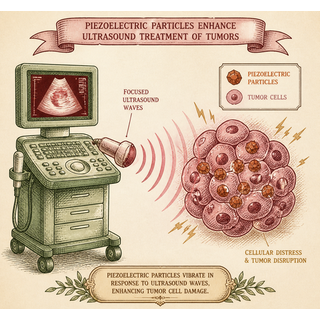
A recent study in Advanced Materials describes a strategy with a very sci-fi name and a surprisingly earthy idea: use ultrasound to wake up tiny piezoelectric particles inside tumors, generate local electrical stimulation without wires, stress the cancer cells hard enough to trigger pyroptosis - a loud, inflammatory kind of cell death - and hopefully get the immune system to notice that something suspicious is happening next door Qi et al., 2025.
First: what on earth is pyroptosis?
Most people have heard of apoptosis, the tidy version of cell death - the cellular equivalent of quietly cleaning out your desk and leaving your badge on the counter. Pyroptosis is not that. Pyroptosis is the smoke alarm going off, the windows flying open, and half the neighborhood stepping onto the porch to see what happened.
It is an inflammatory form of cell death. The cell swells, bursts, and releases distress signals that can rally immune cells. In cancer, that matters because tumors often behave like sketchy tenants who keep the curtains closed and pretend nobody’s home. If you can make tumor cells die in a way the immune system actually notices, you may get a stronger anti-tumor response.
Recent reviews have highlighted pyroptosis as a promising route for cancer therapy, especially because it can help turn “cold” tumors - the ones that immune cells ignore - into “hotter,” more inflamed tumors that are easier for immunotherapy to attack (Xia et al., 2022; Tan et al., 2021).
The weirdly clever trick
The central problem is this: how do you make cancer cells enter pyroptosis on purpose, without causing mayhem everywhere else?
This paper focuses on ER stress. The endoplasmic reticulum, or ER, is the cell’s folding-and-shipping department. When it gets overloaded or damaged, the cell starts to panic. If that stress spills over to the mitochondria - the energy-producing side of town - the whole place can unravel.
The authors built an ER-targeted piezoelectric nanoplatform. In plain English, they used tiny particles designed to gather near the ER and produce electrical stimulation when hit with ultrasound. No battery pack. No wires. Just ultrasound from outside the body and a nanoparticle acting like a microscopic power converter. Tiny gadgetry inside a tumor sounds like something a Bond villain would patent, but here the goal is to make cancer cells self-destruct.
According to the study, this wireless electrostimulation pushed ER stress and ER-mitochondria crosstalk, which then drove pyroptosis. That inflammatory death appears to have improved anti-tumor immune activity in their experimental models Qi et al., 2025.
Why researchers care about ER-mitochondria gossip
Cells do not keep their organelles in neat little separate offices. The ER and mitochondria are constantly exchanging signals, calcium, and metabolic instructions. When that conversation goes bad, cells can tip from coping into catastrophe.
That matters in cancer because tumors are excellent at surviving stress. Low oxygen? Fine. Nutrient shortage? They improvise. Immune attack? They start cheating. So if researchers can exploit a pressure point where ER stress spills into mitochondrial dysfunction, they may find a way to overcome some of that stubborn resistance.
This idea fits with a broader trend in oncology: don’t just poison tumors, change the neighborhood around them. Immunotherapy works best when cancer cells wave enough red flags for T cells and other immune cells to join the brawl. Reviews on the tumor microenvironment and immunogenic cell death keep circling back to the same lesson - dead cancer cells are not all equal. Some die quietly. Others leave behind the biological equivalent of a siren and a broken front door (Galluzzi et al., 2020; Hernandez et al., 2022).
The part where we keep our feet on the ground
Before we all start declaring victory and throwing confetti at the ultrasound machine, a few sober notes.
This is still early-stage work. Fancy nanoplatform papers often look terrific in controlled experimental systems, then run into the very rude realities of biology: delivery problems, off-target effects, scaling issues, manufacturing headaches, and tumors that behave less like obedient lab models and more like raccoons in a shed.
There is also a balancing act with pyroptosis itself. Inflammation can help anti-tumor immunity, but too much inflammation in the wrong place can be harmful. The dream is precise, local immune activation - not turning the body into one giant overreaction.
And then there is the practical question every cancer technology eventually faces: can this be delivered safely, repeatedly, and affordably in real patients? A treatment can be elegant on paper and still become a logistical pumpkin by midnight.
Why this paper is still fun to watch
Even with those caveats, this study is interesting because it combines several hot areas at once: nanomedicine, ultrasound activation, immunogenic cell death, and organelle-level stress signaling. It is less “one more way to kill tumor cells” and more “what if we could force tumors to die noisily enough that the immune system finally stops scrolling past?”
If the findings hold up and can be expanded, approaches like this could help boost immunotherapy in tumors that currently resist it. That would be especially useful in cancers where the immune system remains locked out, underactivated, or just plain bamboozled.
Cancer has a talent for acting like a weed that grows back after you thought you got the roots. This kind of strategy aims not only to yank the weed, but to stir up the soil so the whole garden notices.
References
-
Qi G, Chen Z, Li J, Fu Z, Li Z, Jin Y. Electro-Pyroptosis Immunotherapy of Cancer via Endoplasmic Reticulum-Mitochondria Crosstalk Evoked by Ultrasound-Activated Wireless Electrostimulation. Adv Mater. 2025. DOI: 10.1002/adma.73770
-
Xia X, Wang X, Cheng Z, Qin W, Lei L, Jiang J, Hu J. The role of pyroptosis in cancer: pro-cancer or pro-"host"? Signal Transduct Target Ther. 2022;7:9. DOI: 10.1038/s41392-022-00959-0
-
Tan Y, Sun R, Liu L, Yang D, Xiang Q, Li L. Tumor suppressor Dr. Jekyll and tumor promoter Mr. Hyde: pyroptosis in cancer. Cancer Lett. 2021;522:56-68. DOI: 10.1016/j.canlet.2021.03.041
-
Galluzzi L, Vitale I, Warren S, et al. Consensus guidelines for the definition, detection and interpretation of immunogenic cell death. J Immunother Cancer. 2020;8(1):e000337. PMCID: PMC7801319
-
Hernandez C, Huebener P, Schwabe RF. Damage-associated molecular patterns in cancer: a double-edged sword. Nat Rev Clin Oncol. 2022;19:541-561. DOI: 10.1038/s41571-022-00646-z
Disclaimer: The image accompanying this article is for illustrative purposes only and does not depict actual experimental results, data, or biological mechanisms.