Some cancer mutations swagger into the spotlight like blockbuster villains, but resistance pathways are often the scrappy side characters nobody bothered to cast on the poster - right up until they hijack the whole plot. That seems to be the vibe of a new paper on KRAS G12C-mutant non-small cell lung cancer, where researchers report that tumors can push back against KRAS G12C inhibitors by flipping on FAK/SRC signaling, a survival route that acts like an emergency backup generator when the main power gets cut off.
And yes, modern oncology continues to sound less like medicine and more like a very expensive sci-fi series with too many spin-offs.
The original mission: shut down mutant KRAS
KRAS is one of cancer biology's most notorious troublemakers. It is a signaling protein that helps cells decide when to grow, divide, and survive. In many cancers, KRAS gets stuck in the "on" position. The G12C mutation, seen especially in some lung cancers, gave drug developers a rare opening: a specific molecular handle they could actually grab. That led to KRAS G12C inhibitors such as sotorasib and adagrasib, which were a big deal because KRAS had long been treated like the "you can't sit with us" target of cancer drug discovery.
These drugs work. But not forever in every patient. Tumors, being the deeply annoying evolutionary opportunists they are, often adapt.
That is the setup for this study: if you block mutant KRAS, what escape tunnel does the cancer dig next?
Tumors hate being cornered
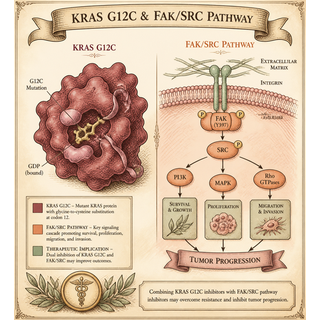
The new study points to the FAK/SRC pathway as one of those escape routes. FAK stands for focal adhesion kinase, and SRC is another signaling protein with a long history in cancer biology. Together, they help cells sense their surroundings, stick to neighboring structures, and transmit growth and survival signals. If KRAS is one command console, FAK/SRC is more like the backup comms system hidden in the walls.
The authors describe this as adaptive feedback signaling. Translation: when you shut one pathway down, the cancer cell does not politely accept defeat. It starts rerouting traffic. That can reactivate growth programs and soften the impact of the drug.
This is a recurring theme in targeted therapy. Cancer is less a single bad switch and more a wiring problem in a spaceship built by raccoons. You cut one glowing cable, and three others start sparking behind a panel you did not even know existed.
Why FAK/SRC matters here
In KRAS G12C-mutant lung cancer, resistance has already been linked to several mechanisms, including receptor tyrosine kinase signaling, secondary mutations, and pathway reactivation through MAPK or other parallel networks. This paper adds weight to the idea that cell adhesion and external signaling machinery also matter - not just the mutant oncogene itself, but the whole neighborhood around it.
That is interesting for a practical reason. If FAK/SRC helps tumors survive KRAS blockade, then combination therapy could be the next move. Instead of sending one drug in like a lone hero with a dramatic soundtrack, you send a small squad: one agent blocks KRAS G12C, another blocks the rescue beacon.
That idea fits with the broader field. Reviews over the past few years have highlighted that resistance to KRAS G12C inhibitors often emerges through feedback activation of RTK-SHP2-MAPK signaling, epithelial plasticity, and bypass circuits that let tumor cells keep proliferating despite the original target being hit [Awad et al., Nat Rev Clin Oncol, 2021, PMID: 34811467; https://doi.org/10.1038/s41571-021-00574-6]. Other work has emphasized combination strategies involving SHP2, EGFR, SOS1, MEK, and immune approaches to prevent or delay that escape [Ryan et al., Cancer Discov, 2020, PMCID: PMC8178176; https://doi.org/10.1158/2159-8290.CD-20-0561].
The bigger picture: this is not just about one mutation
What makes this paper worth watching is that it pushes us to think beyond the target and toward the network. Cancer cells are not passive lumps waiting for a pharmaceutical smiting. They are little systems engineers under stress. Block KRAS, and they consult the emergency manual. Block that too, and they start improvising with whatever molecular duct tape is nearby.
For patients, that matters because resistance is often the difference between a strong early response and a relapse months later. If doctors can predict which backup systems a tumor is likely to activate, treatment could become more proactive. Maybe that means biomarker testing for FAK/SRC activity. Maybe it means rational upfront combinations in carefully selected patients. Maybe it means learning when combination therapy is worth the added toxicity and when it is not.
That last part is important. More drugs are not automatically better. Combination therapy can bring more side effects, more cost, and more complexity. The dream is not to carpet-bomb every pathway like a panicked sci-fi admiral. The dream is to identify the specific resistance circuitry that actually matters in a given tumor and block it with precision.
Where this could go next
If these findings hold up in further preclinical and clinical work, they could help shape the next generation of treatment strategies for KRAS G12C-mutant NSCLC. Researchers may test KRAS inhibitors alongside FAK inhibitors, SRC inhibitors, or related pathway blockers. They may also look for which tumors are most dependent on this feedback loop and whether this mechanism appears early or only after drug exposure.
That would be useful because the field is moving fast. Clinical and translational studies keep showing that KRAS-targeted therapy works best when paired with a clear-eyed understanding of how tumors adapt [Sabari et al., J Clin Oncol, 2022, PMID: 35044868; https://doi.org/10.1200/JCO.21.01507]. And resistance, sadly, is not a plot twist anymore. It is practically a recurring cast member.
Still, there is something encouraging here. Every time scientists map another escape route, they make the maze a little smaller.
References
-
Udagawa H, Shibata Y, Nilsson MB, et al. Adaptive feedback signaling via the FAK/SRC pathway promotes KRAS G12C inhibitor resistance. J Thorac Oncol. 2026. https://doi.org/10.1016/j.jtho.2026.103991
-
Awad MM, Liu S, Rybkin II, et al. Acquired resistance to KRAS G12C inhibition in cancer. Nat Rev Clin Oncol. 2021. https://doi.org/10.1038/s41571-021-00574-6
-
Ryan MB, Corcoran RB. Therapeutic strategies to target RAS-mutant cancers. Cancer Discovery. 2020. PMCID: PMC8178176. https://doi.org/10.1158/2159-8290.CD-20-0561
-
Sabari JK, Velcheti V, Shimizu K, et al. KRAS G12C-directed therapies for advanced non-small cell lung cancer. J Clin Oncol. 2022. https://doi.org/10.1200/JCO.21.01507
Disclaimer: The image accompanying this article is for illustrative purposes only and does not depict actual experimental results, data, or biological mechanisms.