A 62-year-old teacher with a liver full of cholangiocarcinoma nodules sits across from her oncologist and hears the sentence nobody wants on a Tuesday: the cancer is not removable, but it also has not packed a suitcase for the lungs or bones.
That awkward geography matters. In cancer, location is not just real estate. It is strategy.
This new pooled analysis in Journal of Hepatology asks a deceptively practical question: for people with unresectable intrahepatic cholangiocarcinoma, or iCCA, that is still confined to the liver, can we do better by sending chemotherapy straight into the liver’s arterial plumbing? The answer is not “everybody gets a miracle pump,” because oncology is allergic to simple answers. But the data are interesting enough to make a tumor board put down its coffee.
The Bile Duct Villain Inside the House
Cholangiocarcinoma is cancer of the bile ducts, the small tubes that move bile around so your digestive system can handle fats without filing a complaint. When it starts inside the liver, it is called intrahepatic cholangiocarcinoma. It is rare, often found late, and has a nasty habit of being technically “local” while still too spread out in the liver for surgery.
That is the cruel math here. Surgery can be curative for some patients, but many people arrive with multiple liver tumors, large tumors, or tumors wrapped around structures surgeons prefer not to anger.
Standard systemic treatment for advanced biliary tract cancer has improved, especially with gemcitabine and cisplatin plus immunotherapy such as durvalumab or pembrolizumab. TOPAZ-1 and KEYNOTE-966 both moved the field forward, which in biliary cancer counts as a very welcome statistical rebellion.23 Still, long-term survival remains limited for many patients.
The Pump Is Not Subtle, and That Is the Point
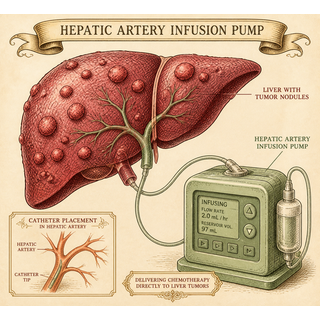
Hepatic artery infusion pump chemotherapy, or HAIP, is exactly what it sounds like: surgeons implant a pump that delivers chemotherapy into the hepatic artery, the blood vessel feeding much of the tumor supply in the liver. Normal liver tissue gets most of its blood from the portal vein, while liver tumors lean more heavily on the artery. Cancer biology, for once, leaves a forwarding address.
The drug in this strategy is often floxuridine, or FUDR. It has a strong “first-pass” effect in the liver, meaning much of it gets metabolized there before it can roam through the rest of the body causing chaos like an unsupervised intern.
The tradeoff: this is not a casual add-on. It requires surgery, pump management, imaging, careful dosing, and a center that knows what it is doing. Selection bias is practically standing in the corner wearing a name tag.
What This Study Found
Rousian and colleagues pooled individual patient data from four prospective phase II trials, totaling 142 patients with unresectable, liver-confined iCCA. Some had resectable regional lymph node disease, but distant metastases were excluded. These were not average all-comers from the oncology universe. They were a selected group with disease still mainly behaving like a liver problem.1
The tumors were not tiny wallflowers. Sixty-five percent of patients had multifocal disease, and 41% had tumors larger than 10 cm. After HAIP chemotherapy with FUDR, with or without systemic therapy, 53% of evaluable patients had a partial response on imaging, and the disease control rate was 96%.
Median overall survival was 26 months. The 3-year overall survival rate was 28%, and the 5-year rate was 15%. Thirteen patients, about 9%, eventually underwent resection, and 4 had a complete pathological response.
For unresectable iCCA, that is not a small signal. It is not a randomized proof stamp either. It is more like a carefully drawn map saying, “There may be a road here, but please bring a multidisciplinary team and maybe snacks.”
Why Epidemiologists Start Squinting
The most important phrase in this paper may be “benchmark results.” This pooled analysis does not prove HAIP beats modern systemic therapy in every eligible patient. It gives clinicians a stronger reference point for what outcomes can look like in expert centers among selected patients with liver-confined disease.
That matters because rare cancers are where evidence often arrives in small, slightly mismatched suitcases. One phase II trial here. A retrospective series there. A systematic review trying to make everyone sit at the same table.4 Pooling patient-level data helps, because it allows more consistent survival estimates and covariate analysis than simply stacking abstracts like medical Jenga.
One key finding: hepatic disease progression was strongly associated with worse survival. Translation: when the liver loses control of the situation, outcomes suffer. Not shocking, but clinically useful. It supports the logic of liver-directed therapy for patients whose main threat is still in the liver.
The Catch, Because There Is Always a Catch
HAIP is specialized. Complications can happen. Pumps need expertise. Patients must be chosen carefully. And this analysis comes from phase II trials, not a randomized phase III comparison against today’s chemo-immunotherapy standards.
Also, populations matter. A patient healthy enough to undergo pump placement at a high-volume center is not interchangeable with every person diagnosed with advanced iCCA. Confounding does not sleep. It just waits until you get excited.
Still, if future prospective studies confirm these results, HAIP could become a more defined option for a subgroup of patients with liver-confined iCCA: not a replacement for systemic therapy, but a regional strike added to the broader campaign.
For a cancer that often leaves clinicians choosing between imperfect tools, a pump that turns liver anatomy into a treatment advantage is worth paying attention to. Quietly. Carefully. With confidence intervals.
References
Disclaimer: The image accompanying this article is for illustrative purposes only and does not depict actual experimental results, data, or biological mechanisms.
-
Rousian M, Alessandris R, Schleimer L, et al. Hepatic artery infusion pump chemotherapy for unresectable intrahepatic cholangiocarcinoma: Pooled individual patient-level analysis of four clinical trials. Journal of Hepatology. 2026. DOI: 10.1016/j.jhep.2026.06.022 ↩
-
Oh DY, Ruth He A, Qin S, et al. Durvalumab plus gemcitabine and cisplatin in advanced biliary tract cancer. NEJM Evidence. 2022. DOI: 10.1056/EVIDoa2200015 ↩
-
Kelley RK, Ueno M, Yoo C, et al. Pembrolizumab in combination with gemcitabine and cisplatin compared with gemcitabine and cisplatin alone for patients with advanced biliary tract cancer: KEYNOTE-966. The Lancet. 2023. DOI: 10.1016/S0140-6736(23)00727-4 ↩
-
Holster JJ, El Hassnaoui M, Franssen S, et al. Hepatic arterial infusion pump chemotherapy for unresectable intrahepatic cholangiocarcinoma: A systematic review and meta-analysis. Annals of Surgical Oncology. 2022;29:5528-5538. DOI: 10.1245/s10434-022-11439-x ↩
-
Cercek A, Boerner T, Tan BR, et al. Assessment of hepatic arterial infusion of floxuridine in combination with systemic gemcitabine and oxaliplatin in patients with unresectable intrahepatic cholangiocarcinoma: A phase 2 clinical trial. JAMA Oncology. 2020;6(1):60-67. DOI: 10.1001/jamaoncol.2019.3718 ↩
-
Franssen S, et al. Hepatic arterial infusion pump chemotherapy in patients with unresectable intrahepatic cholangiocarcinoma. Journal of Clinical Oncology. 2025. DOI: 10.1200/JCO-25-00923 ↩