Some cancer papers feel like a side quest. This one feels more like the moment you realize the mini-boss was actually running the whole level. Researchers digging into ARID5B - a gene long tied to childhood B-cell acute lymphoblastic leukemia, or B-ALL risk - found that it is not just hanging around the genome looking decorative. It appears to help assemble a transcriptional repression complex that keeps certain B-cell programs on a short leash. And when a gene already linked to leukemia risk turns out to be managing the epigenetic bouncers at the door, people like me start reading the methods section with the same energy others reserve for playoff brackets.
ARID5B: famous by association, mysterious in person
ARID5B has been on the leukemia radar for years because genetic association studies repeatedly linked variants near it to a higher risk of childhood B-ALL. That part was solid. The annoying part - and biology is generous with annoying parts - was that nobody had a very crisp picture of what ARID5B was actually doing inside cells.
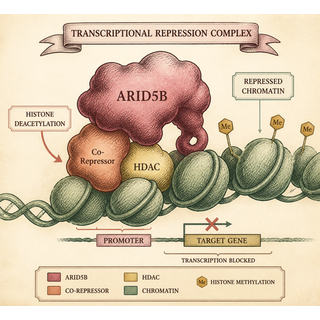
This new study tackled that problem head-on. Using proteomics, genomics, and transcriptomics, the authors mapped ARID5B’s molecular social circle and asked what happens when it shows up at specific spots in the genome. The answer: ARID5B partners with MIER1, C16ORF87, HDAC1, and HDAC2 to form a chromatin repressor complex that helps turn genes down.
That matters because gene regulation is not just about flipping things on. A huge chunk of healthy biology depends on knowing when to shut up.
The genome’s volume knob, with a leukemia twist
Let’s translate the jargon without sanding off the science. Your cells store DNA like a giant instruction manual, but they do not read every page at once. Proteins that regulate chromatin act more like stage managers than actors - deciding which genes get the spotlight and which ones stay backstage eating stale crackers.
In this study, ARID5B was found at active regulatory regions of the genome, including promoters and distal elements. That sounds odd for a repressor at first - why would a brake pedal sit near the gas? But gene control is like city traffic, not a light switch. Active regions still need supervision, otherwise B-cell programs can drift from “orderly immune development” into “absolutely not, call the hematologist.”
The key mechanistic finding is that ARID5B appears to recruit HDAC1 and HDAC2, two histone deacetylases. HDACs remove acetyl groups from histones, which generally makes chromatin less permissive for transcription. In plain English: ARID5B seems to help bring in the molecular crew that lowers the volume on selected genes.
Why should anyone outside a chromatin conference care?
Because B-ALL is the most common childhood cancer, and risk-linked inherited variants often sit in noncoding DNA, where they are much harder to interpret than a mutation that simply breaks a protein. Noncoding variants are the ultimate “something weird happened in the control room” problem.
This paper gives us a plausible biological story. If inherited variation around ARID5B changes how this repressor system works, that could alter the regulation of genes involved in B-cell proliferation and signaling. And those are exactly the sorts of pathways you would prefer not to freestyle during blood-cell development.
That does not mean the paper proves how every leukemia-risk variant works. Let’s not get drunk on mechanism after one paper. But it does move the field from “ARID5B is associated with risk” toward “here is the machinery ARID5B uses, and here is the kind of cellular program it controls.” That is a much better neighborhood to be in.
The part trial-minded people will appreciate
No, this is not a clinical trial. Nobody got randomized to Team HDAC or Team Leave The Chromatin Alone. But the translational implications are obvious enough to raise an eyebrow.
HDAC biology already matters in cancer, and HDAC inhibitors are not exactly new toys in oncology. What this study adds is context. It suggests that in B-cell biology, ARID5B may act as a targeting factor - bringing HDAC1/2 to specific genomic regions to repress B-cell-related genes. That is useful because broad HDAC inhibition can behave like trying to fix your apartment’s wiring by cutting electricity to the whole block. Sometimes effective, often messy.
If future studies show that leukemia-associated variants disrupt this ARID5B-centered repression system in a predictable way, that could help refine risk models or identify more specific therapeutic vulnerabilities. Huge “if,” of course. Translational oncology is a graveyard of promising arrows drawn too early from mechanistic data. Still, this is the kind of paper that gives later work somewhere concrete to stand.
What comes next?
Several obvious questions follow.
First, which noncoding risk variants actually alter ARID5B expression or function, and in what cell state? Second, do these mechanisms hold in primary patient samples, not just experimental systems? Third, can this repression network be linked to leukemia initiation, not merely normal B-cell regulation?
Those are not small questions. They are “fund me for five years and let me bother several bioinformaticians” questions. But they are now tractable in a way they were not before.
And that is why this paper is fun. Not “balloons and cake” fun - more “we finally found the hidden lever behind a locked door” fun. ARID5B has spent years being the suspiciously important character with no backstory. Now we have one: it helps assemble a chromatin repression complex that keeps B-cell programs under control. In leukemia biology, that is not a footnote. That is a map.
References
-
Kutschat AP, Frommelt F, Santini BL, Müller S, Batty P, Awasthi A, Karbon G, Superti-Furga G, Seruggia D. Leukemia risk factor ARID5B coordinates HDAC-mediated transcriptional repression. Nucleic Acids Res. 2025. doi: 10.1093/nar/gkag628. PubMed: 42328790
-
Inaba H, Greaves M, Mullighan CG. Acute lymphoblastic leukaemia. Lancet. 2023;401(10378):248-264. doi: 10.1016/S0140-6736(22)02391-3
-
Pui CH, Nichols KE, Yang JJ. Somatic and germline genomics in paediatric acute lymphoblastic leukaemia. Nat Rev Clin Oncol. 2019;16(4):227-240. doi: 10.1038/s41571-018-0136-6
-
Mullighan CG. The molecular genetic makeup of acute lymphoblastic leukemia. Hematology Am Soc Hematol Educ Program. 2023;2023(1):1-9. doi: 10.1182/hematology.2023000458
-
Dawson MA, Kouzarides T. Cancer epigenetics: from mechanism to therapy. Cell. 2012;150(1):12-27. doi: 10.1016/j.cell.2012.06.013
Disclaimer: The image accompanying this article is for illustrative purposes only and does not depict actual experimental results, data, or biological mechanisms.