That, basically, is the setup for a new cancer immunotherapy paper about a very sneaky problem: many of the best tumor targets are hidden inside cancer cells, where most antibody drugs cannot reach them. Antibodies are great at grabbing stuff hanging out on the cell surface. But intracellular proteins? Those are behind the velvet rope.
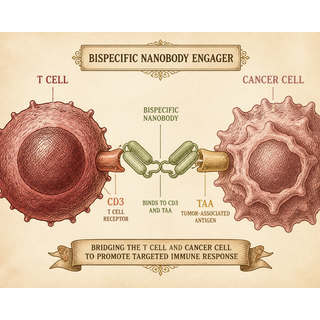
This new study takes a run at that problem with something small, weird, and pretty elegant: a TCR-mimic bispecific nanobody-based T cell engager - yes, the name sounds like it was assembled by committee during a caffeine emergency, but the idea is surprisingly clean. The researchers built a tiny two-part immune gadget that can bind CD3 on T cells with one end and a tumor peptide presented by HLA-A2 with the other, using the intracellular cancer antigen WT1 as the test case Ding et al., 2026.
The problem: cancer hides the good targets indoors
Most current T cell engagers work by physically dragging a T cell up to a cancer cell. One arm grabs the T cell, the other grabs the tumor. Congratulations, you've just forced an awkward but medically useful introduction.
The catch is that standard versions usually target surface proteins. That rules out a giant pool of cancer-related proteins that live inside the cell. And that is frustrating, because many famous cancer antigens - including WT1, a protein linked to several cancers - are intracellular.
Now, cells do leak hints about their inner life. They chop up proteins into peptides and display them on MHC class I molecules, like little molecular name tags. T cells naturally inspect these peptide-MHC displays with their T cell receptors, which is why this system matters so much in immunology and why it also sounds like a bureaucratic filing cabinet.
In other words, even if the target is inside the house, the cell may stick a tiny piece of it in the front window.
What this paper built
The authors designed a bispecific nanobody engager made from two VHH domains. VHHs are single-domain antibody fragments derived from camelid antibodies - one of many reminders that llamas and camels keep wandering into biomedical science and honestly have earned a little respect.
One VHH was designed to recognize CD3ε on T cells. The other was a TCR-mimic binder that recognizes a specific peptide-MHC complex: WT1 peptide presented by HLA-A2. Put together, the construct aims to bring T cells into contact with tumor cells displaying that WT1-derived peptide.
Why bother with nanobodies instead of more classic formats? Because traditional scFv-based bispecifics can be structurally finicky and prone to aggregation. Protein drugs that clump are a bit like trying to run a restaurant with spaghetti taped to your hands - technically possible, not ideal. Nanobody-style designs can be more stable, modular, and easier to engineer.
According to the abstract, this was a proof-of-concept platform study. The main point was not "we cured cancer, please alert the brass band," but "we can build a compact T cell engager that targets intracellular tumor antigens through peptide-MHC recognition."
Why that is a big deal
This matters because intracellular antigens hugely expand the target universe for cancer immunotherapy. If you can only hit what's on the cell surface, you're shopping from a limited menu. If you can hit peptide-MHC complexes that reflect what is happening inside tumor cells, the menu gets a lot more interesting.
That strategy has been gaining attention across the field. Reviews over the past few years have highlighted TCR-mimic antibodies and related binders as a promising way to access intracellular tumor biology through cell-surface peptide presentation (Hsiue et al., 2021; Marin-Acevedo et al., 2021). Work on bispecific T cell engagers and immune synapse engineering also supports the broader logic of redirecting T cells with compact, high-affinity molecules (Goebeler and Bargou, 2020).
WT1 itself is not a random pick. It has long been studied as a tumor-associated antigen in leukemias and solid tumors, making it an attractive immunotherapy target when presented in the right HLA context (Rauschenbach et al., 2023).
The catch, because biology always has one
There are limits here, and they matter.
First, this approach depends on HLA type - in this paper, HLA-A2. That means it is not automatically universal. Second, peptide-MHC targets can exist at very low density on tumor cells, which makes selective and potent targeting hard. Third, any therapy that powerfully activates T cells raises the usual concerns about off-tumor toxicity, cytokine release, and whether normal tissues might display similar peptides.
Also, tumors are not passive victims in this story. They can downregulate antigen presentation, alter MHC expression, and generally act like terrible houseguests who unplug the smoke alarm before setting the kitchen on fire.
So, no, this is not ready to be treated as a finished clinical solution. But as a platform idea, it is genuinely clever.
What this could mean in the real world
If this approach holds up and scales, it could help push immunotherapy into targets that were previously considered "undruggable" by antibodies. That opens possibilities for cancers where the most meaningful antigens are intracellular and where current surface-targeting approaches fall short.
Basically, instead of waiting for cancer to wear a nametag on the outside, researchers are teaching immune therapies to read the tiny receipts cells pin to the bulletin board. That's a much better surveillance system.
And there is something satisfying about the whole concept: using a small, stable, modular molecule to help T cells recognize what a tumor is trying to hide. Cancer loves loopholes. Immunotherapy keeps trying to hire better auditors.
References
-
Ding Z, Sun S, Yang X, et al. TCR-mimic bispecific nanobody-based T cell engager targeting intracellular tumor antigens for cancer immunotherapy. Signal Transduct Target Ther. 2026. doi: 10.1038/s41392-026-02745-x
-
Hsiue EH, Wright KM, Douglass J, et al. Targeting a neoantigen derived from a common TP53 mutation. Nat Cancer. 2021;2(7):745-757. doi: 10.1038/s43018-021-00180-0
-
Marin-Acevedo JA, Dholaria B, Soyano AE, et al. Next generation of immune checkpoint therapy in cancer: new developments and challenges. Front Immunol. 2021;12:661464. doi: 10.3389/fimmu.2021.661464
-
Goebeler ME, Bargou RC. T cell-engaging therapies - BiTEs and beyond. Nat Rev Clin Oncol. 2020;17(7):418-434. doi: 10.1038/s41571-020-0347-5
-
Rauschenbach L, Xie Y, Büttner R, et al. Wilms tumor 1 as an immunotherapeutic target in cancer. Cancers (Basel). 2023;15(12):3179. doi: 10.3390/cancers15123179
Disclaimer: The image accompanying this article is for illustrative purposes only and does not depict actual experimental results, data, or biological mechanisms.