Most of the time, your immune system works like a fussy neighborhood watch. It patrols, complains, overreacts to pollen, and generally keeps an eye on suspicious characters. But when that system gets dialed down - often on purpose, after an organ transplant or during treatment for autoimmune disease - some very odd and dangerous cancers can slip through the side door. One of them is immunosuppression-associated peripheral T-cell lymphoma, the star of a recent New England Journal of Medicine case report by Cliff and Kenealy.1
That is a mouthful, I know. Cancer biology has never met a short name it didn’t want to ignore.
A lymphoma with a very specific bad habit
Let’s unpack the phrase. Lymphoma means a cancer of lymphocytes, the white blood cells that help run immune defense. T cells are one major type of lymphocyte - basically the highly trained security staff of your immune system. Peripheral T-cell lymphoma, or PTCL, is a group of uncommon and often aggressive cancers that arise from mature T cells.23
Now add immunosuppression-associated, and the plot thickens. This means the lymphoma appears in the setting of weakened immune surveillance. That can happen after a solid organ transplant, for example, when doctors intentionally suppress immunity so the body does not reject the new organ. It can also happen with certain medications used for chronic inflammatory conditions.
That bargain can be lifesaving, but it comes with strings attached. If the immune system is the house dog, immunosuppression is a bit like telling it, “Good boy, now please stop barking at strangers for the next six months.” Useful for the mail carrier. Less ideal for burglars.
Why this case matters
The NEJM piece is a clinical image report, so it is short and focused rather than a long mechanistic study. But these case-based reports matter because they put a spotlight on cancers many people - including many physicians outside hematology - may rarely encounter.
Immunosuppression is more common than it used to be. Transplant medicine has improved. Autoimmune disease treatment has expanded. More people are living longer while taking drugs that dampen immune activity. That is good news overall, but it also means the rare complications deserve more attention, not less.4
And this particular complication is tricky. PTCL is already uncommon. In the setting of immunosuppression, it can be even harder to recognize because symptoms may blur into infection, medication side effects, or the many other health issues these patients already juggle.
In plain language: if someone’s body is already dealing with a lot, cancer can sneak in wearing a fake mustache.
The biological backstory, minus the nap-inducing jargon
Your immune system does two big jobs at once. First, it fights infections. Second, it helps destroy cells that look abnormal, including cells drifting toward cancer. This second role is called immune surveillance.5
When immunity is suppressed, that surveillance weakens. Some cancers become more likely, especially lymphomas. Many people have heard of post-transplant lymphoproliferative disorder, often tied to Epstein-Barr virus. But T-cell lymphomas can also emerge, and they are less common, less tidy, and often more aggressive.6
Researchers are still sorting out exactly how these lymphomas develop. It is probably not one simple cause. Chronic immune disruption, reduced tumor surveillance, viral triggers in some settings, and long-term changes in lymphocyte behavior may all contribute. Biology loves a tangled mess. It never says, “Let’s keep this easy for the students.”
Why doctors and patients care
The real-world stakes are pretty obvious once you say them out loud. A person may need immunosuppressive therapy to protect a transplanted kidney, liver, heart, or to control severe autoimmune disease. But the same treatment that keeps one disaster away may quietly raise the risk of another.
That creates a balancing act. Too little suppression, and the body may attack its own tissues or reject a transplanted organ. Too much, and infections and cancers gain room to maneuver. It is like trying to water a garden without feeding the weeds - simple in theory, maddening in practice.
For patients, this is why persistent swollen lymph nodes, unexplained fevers, weight loss, night sweats, or unusual skin findings should not be brushed off as “probably nothing,” especially in the context of long-term immunosuppression. Most of the time it will not be lymphoma. But this is not the place for heroic denial.
The bigger research picture
Recent reviews have emphasized that PTCL remains difficult to diagnose and treat, even outside the immunosuppression setting. It is biologically diverse, often resistant to standard therapy, and much less common than B-cell lymphomas, which means fewer large studies and fewer clean answers.237
Researchers are now digging into better classification, genomic features, and targeted approaches. There is also growing interest in how the tumor microenvironment - the cells and signals surrounding the lymphoma - helps these cancers survive.78 That matters because if you can understand the sketchy neighborhood around the cancer, you may find better ways to evict the tenant.
If findings from these newer studies hold up, the future could bring more tailored treatment and earlier recognition in high-risk patients. That would be a welcome change, because right now PTCL is not exactly the sort of cancer that wanders in politely and waits its turn.
The takeaway
This NEJM report is a reminder that the immune system does more than fight germs. It also keeps tabs on would-be cancers, and when that job is muted, rare lymphomas can appear. Immunosuppression-associated peripheral T-cell lymphoma sits at that uneasy crossroads between lifesaving treatment and serious downstream risk.
Medicine is full of tradeoffs. Sometimes the very thing that helps you is also the thing that makes doctors watch you a little more closely. Not because they are gloomy, but because biology is sneaky and has the bedside manner of a raccoon in a pantry.
References
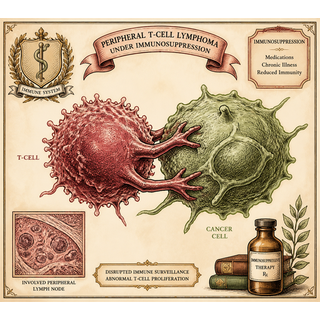
Disclaimer: The image accompanying this article is for illustrative purposes only and does not depict actual experimental results, data, or biological mechanisms.
-
Cliff ERS, Kenealy M. Immunosuppression-Associated Peripheral T-Cell Lymphoma. N Engl J Med. 2025;392:e31. doi:10.1056/NEJMicm2501877 ↩
-
Foss FM, Zinzani PL, Vose JM, Gascoyne RD, Rosen ST, Tobinai K. Peripheral T-cell lymphoma. Blood. 2024;143(13):1234-1249. doi:10.1182/blood.2023022332 ↩↩
-
Horwitz SM, Ansell SM, Ai WZ, et al. T-cell lymphomas: diagnosis, biology, and emerging therapies. Lancet. 2023;402(10404):123-138. doi:10.1016/S0140-6736(23)00877-1 ↩↩
-
Engels EA, Pfeiffer RM, Fraumeni JF Jr, et al. Spectrum of cancer risk among solid organ transplant recipients. JAMA. 2022;328(15):1484-1495. doi:10.1001/jama.2022.18044 ↩
-
“Immune system.” Wikipedia. Accessed June 25, 2026. https://en.wikipedia.org/wiki/Immune_system ↩
-
Dierickx D, Habermann TM. Post-transplantation lymphoproliferative disorders in adults. N Engl J Med. 2023;388(6):549-562. doi:10.1056/NEJMra2209308 ↩
-
Lunning MA, Vose JM. Management of peripheral T-cell lymphoma: new and emerging targets and therapies. Hematology Am Soc Hematol Educ Program. 2022;2022(1):620-628. doi:10.1182/hematology.2022000367 ↩↩
-
Iqbal J, Weisenburger DD, Greiner TC. Molecular and microenvironmental landscape of peripheral T-cell lymphoma. Nat Rev Clin Oncol. 2021;18(12):773-788. doi:10.1038/s41571-021-00532-0 ↩