At 3 AM in a lab in Munich, the most elegant prostate cancer idea on the whiteboard might look suspiciously like a sticker.
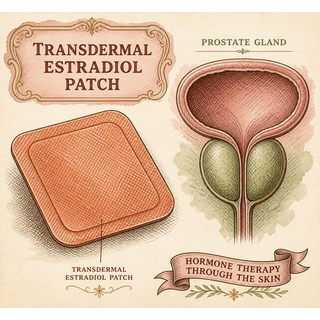
Not a laser. Not a molecule with a name long enough to require its own zip code. A patch. Specifically, a transdermal estradiol patch, the kind of delivery system that says, with admirable architectural restraint, "What if we entered through the side door?"
That side door matters because prostate cancer often runs on testosterone. For decades, one of the core strategies in locally advanced prostate cancer has been androgen deprivation therapy, or ADT: cut off the hormonal utilities and make the tumor building harder to operate. Standard ADT commonly uses LHRH agonists, which tell the brain-testis signaling axis to shut down testosterone production. It works, but the renovation is not subtle. It is less "thoughtful restoration" and more "turn off the water, electricity, and possibly the elevator."
The Problem With Demolishing the Whole Block
Testosterone is not the only tenant affected. When standard ADT suppresses testosterone, estradiol also drops, because men make much of their estradiol from testosterone. That loss can bring hot flashes, bone thinning, fatigue, metabolic changes, and other quality-of-life annoyances that are medically real and personally rude.
Enter transdermal estradiol, or tE2. Estradiol can suppress the pituitary signal that drives testosterone production, lowering testosterone into the desired range. But by delivering estradiol through the skin, researchers hope to avoid some older problems with oral estrogen, especially first-pass liver effects linked to clotting risk. Oral estrogen goes through the hepatic lobby and starts rearranging the furniture. A patch takes the service entrance.
Ian D. Davis' recent European Urology commentary responds to a major 2026 New England Journal of Medicine trial asking whether this old hormonal idea, redesigned as a patch, can stand beside standard ADT in locally advanced prostate cancer [1,2].
A Patch With a Building Permit
The NEJM study enrolled 1360 men at 75 centers in the United Kingdom. Participants had locally advanced, non-metastatic prostate cancer and were randomly assigned to either transdermal estradiol patches or LHRH agonists [2].
The main question was not "Is the patch cooler?" though frankly it has a certain minimalist confidence. The question was whether tE2 was noninferior for 3-year metastasis-free survival. In human terms: were men about as likely to remain alive without the cancer spreading?
The answer: yes. At 3 years, metastasis-free survival was 87.1% with tE2 and 85.9% with LHRH agonists. Five-year overall survival was also similar: 81.1% with tE2 and 79.2% with LHRH agonists [2].
That is the kind of result that makes oncologists sit forward in their chairs without spilling the conference coffee.
The Interior Design Trade-Offs
No therapy gets to be the penthouse for free. The side-effect floor plan changed.
Hot flashes were much less common with tE2: 44% versus 89% with LHRH agonists. More severe hot flashes, grade 2 or higher, were 8% with tE2 versus 37% with LHRH agonists [2]. For anyone who has watched ADT turn body temperature into an unreliable thermostat, that is not a small detail.
But gynecomastia, breast tissue enlargement or tenderness, moved in like an overconfident contractor. It occurred in 85% of men receiving tE2 versus 42% receiving LHRH agonists, with grade 2 or higher events in 37% versus 9% [2].
So the choice is not "side effects or no side effects." It is more like selecting between two flawed apartment layouts: one has faulty heating, the other has a surprise conservatory.
Why This Is More Than a Sticker Story
The broader PATCH and STAMPEDE programs have been testing whether transdermal estradiol can repurpose a familiar hormone into a practical prostate cancer treatment strategy. Earlier PATCH cardiovascular data found long-term cardiovascular outcomes with tE2 comparable to LHRH agonists, easing one of the biggest historical worries about estrogen therapy in prostate cancer [3]. A 2024 review of the repurposing program described how these trials adapted over time, which is science's version of renovating while the building is still occupied [4].
There is also a larger biological point here: estradiol in men is not decorative trim. Reviews of estrogen loss during ADT argue that estradiol helps maintain bone, metabolic, vascular, and brain health [5]. Remove it completely, and the body notices. Quietly at first. Then loudly, usually around 2 AM.
What Happens Next?
This does not mean every patient should swap injections for patches tomorrow. The trial focused on locally advanced, non-metastatic prostate cancer. Patch adherence, skin irritation, gynecomastia, long-term monitoring, cost, availability, and clinician familiarity all matter. Regulatory and guideline committees will also want to inspect the plumbing before anyone opens the building.
Still, the idea is elegant: instead of suppressing testosterone by draining the whole hormonal district, tE2 may preserve some estradiol signaling while still starving the tumor of androgen fuel. If reproduced, expanded, and made practical, this could give patients another ADT option that changes the daily experience of treatment.
Cancer therapy often sounds like urban warfare. Here, for once, the proposal feels closer to adaptive reuse: keep the structure standing, reroute the utilities, and make the neighborhood less hospitable to a badly behaved tumor.
References
-
Davis ID. Re: Transdermal Estradiol Patches in Locally Advanced Prostate Cancer. European Urology. 2026. doi: 10.1016/j.eururo.2026.05.019
-
Langley RE, Gilbert DC, Mangar S, et al. Transdermal Estradiol Patches in Locally Advanced Prostate Cancer. New England Journal of Medicine. 2026;394:1595-1607. doi: 10.1056/NEJMoa2511781
-
Langley RE, Gilbert DC, Duong T, et al. Transdermal oestradiol for androgen suppression in prostate cancer: long-term cardiovascular outcomes from the randomized PATCH trial programme. Lancet. 2021;397:581-591. doi: 10.1016/S0140-6736(21)00100-8. PMCID: PMC7614681
-
Gilbert DC, Nankivell M, Rush H, et al. A repurposing programme evaluating transdermal oestradiol patches for the treatment of prostate cancer within the PATCH and STAMPEDE trials. Clinical Oncology. 2024;36:e11-e19. doi: 10.1016/j.clon.2023.10.054. PMCID: PMC7617162
-
Coelingh Bennink HJT, Prowse A, Egberts JFM, Debruyne FMJ, Huhtaniemi IT, Tombal B. The Loss of Estradiol by Androgen Deprivation in Prostate Cancer Patients Shows the Importance of Estrogens in Males. Journal of the Endocrine Society. 2024;8:bvae107. doi: 10.1210/jendso/bvae107. PMCID: PMC11177789
Disclaimer: The image accompanying this article is for illustrative purposes only and does not depict actual experimental results, data, or biological mechanisms.