Somewhere in your colon, a messy little espionage drama may be unfolding: bacterial double agents slipping through the crowd, passing signals, changing the neighborhood, and leaving just enough evidence in stool to make scientists squint and say, "Well, that seems suspicious." A new meta-analysis in Cell Host & Microbe took that suspicion and fed it a truly rude amount of data - 6,779 samples from 27 studies - to ask a simple question with big consequences: does colorectal cancer leave a reliable microbiome fingerprint, or have we all been chasing microbial gossip?
And here is where it gets interesting: the answer looks a lot like yes.
A cancer signal hiding in plain poop
Colorectal cancer has been linked to gut microbiome changes for years, but the field has had a recurring problem: every study seemed to bring its own playlist, cookware, and family drama. Different sequencing methods, different populations, different sample sizes. Great for academic nuance, terrible for figuring out whether a finding is real enough to matter in the clinic.
So Pekel and colleagues did the statistical equivalent of cleaning out the entire garage. They re-computed and re-analyzed microbiome profiles across 27 studies, covering both shotgun metagenomics and amplicon sequencing, and built a unified picture of what shows up in colorectal cancer across datasets and age groups Pekel et al., 2026.
That matters because early-onset colorectal cancer is rising globally, and everyone wants to know whether it is biologically distinct. This paper found that the microbiome signatures in early-onset and late-onset colorectal cancer were nearly identical. In plain English: the bacteria associated with younger patients' cancers looked strikingly similar to those seen in older patients. The age split, at least here, did not produce some wildly different microbial universe.
That is useful. Also a little annoying, if you were hoping biology would hand us one neat, dramatic plot twist.
The usual suspects - and one especially notorious weirdo
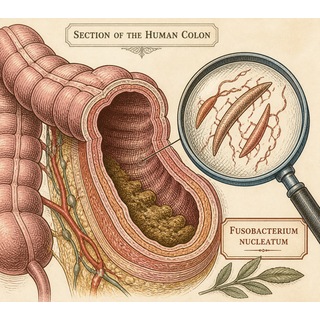
If you have spent any time around colorectal cancer microbiome papers, you have met Fusobacterium nucleatum, the bacterial celebrity who keeps showing up at the scene like a guy who definitely says, "I can explain." This study again found strong colorectal cancer-associated microbial signatures, including tumor-enriched organisms that also appeared in stool.
That overlap is the exciting part. If microbes enriched in tumors also leave a detectable signal in feces, that opens the door to noninvasive screening tools. Not "replace colonoscopy tomorrow" exciting - let's all breathe into a paper bag - but potentially "improve risk stratification and early detection" exciting.
The authors also looked more closely at Fusobacterium and found that virulence factor carriage varied across subspecies, with geographic patterns as well. In other words, not all Fusobacterium are playing the same game, and where they show up may depend partly on where people live. Microbiome research loves to punish anyone who asks for a simple answer.
Stage matters, because biology enjoys complications
Another smart wrinkle in the paper: tumor-associated microbes were clearly detectable in early-stage tumors, but their detection in stool rose somewhat in later-stage and distal tumors. The likely reason is dilution. If a microbe sits right at the tumor site, you may catch it there early, but seeing it in feces depends on how much of that signal survives the long, chaotic journey through the gut. Biology rarely misses a chance to make diagnostics harder than necessary.
Still, the consistency across tissue and stool is encouraging. It suggests these microbial signatures are not random bystanders. They may reflect real ecological shifts around tumors - or even contribute to them.
Fiber enters the chat
Now for the part where your salad gets a cameo.
The study found that the unified fecal colorectal cancer signature was inversely associated with dietary fiber intake and could be modified by dietary interventions. That does not mean fiber is a magical force field. It does mean the microbiome patterns linked to colorectal cancer appear connected, at least partly, to diet - and perhaps not in a fixed, inevitable way.
That is a big deal. A biomarker is useful. A modifiable biomarker is catnip.
And here is where it gets interesting: when a signal shifts with diet, researchers have to ask two questions at once. First, can we use it to detect cancer? Second, can we alter it to reduce risk, improve outcomes, or avoid false alarms? The statistics are doing two jobs now, which feels a bit greedy but productive.
Why this paper actually sticks
This study's real strength is not one flashy bacterium. It is scale and consistency. Meta-analyses can be a bit like organizing 27 group chats into one coherent conversation, which is usually a cry for help. But here, pooling across studies helped cut through the noise and identify signatures that generalized across age groups and sequencing approaches.
That gives the field firmer ground. Prior reviews have already suggested links between colorectal cancer and microbial dysbiosis, especially involving oral-associated bacteria, inflammatory pathways, and altered metabolism Janney et al., 2020; Wong and Yu, 2019. More recent work has also emphasized F. nucleatum as a possible driver of progression and immune modulation Zhang et al., 2024; Ou et al., 2023. This paper does not settle every causality debate, but it says, with a bigger sample and a straighter face, that the signal is not just statistical wallpaper.
The challenge now is turning signatures into tools that work in the real world: diverse populations, standardized assays, prospective validation, and performance good enough to matter. Sensitivity and specificity are not sexy dinner conversation, but they decide whether a biomarker becomes medicine or just a very impressive figure panel.
For now, the take-home is this: colorectal cancer seems to come with a surprisingly portable microbiome calling card, and that card looks similar whether the patient is younger or older. If future studies hold up, your gut microbes may become not just background noise, but informants.
Tiny, nosy, medically useful informants.
References
Pekel S, Karcher N, Essex M, et al. Meta-analysis reveals microbiome signatures for colorectal cancer that are universal across age groups and sequencing methods. Cell Host Microbe. 2026. DOI: 10.1016/j.chom.2026.05.030
Janney A, Powrie F, Mann EH. Host-microbiota maladaptation in colorectal cancer. Genome Medicine. 2020;12:53. DOI: 10.1186/s13073-020-00782-8 | PMCID: PMC7268961
Wong SH, Yu J. Gut microbiota in colorectal cancer: mechanisms of action and clinical applications. Nature Reviews Gastroenterology & Hepatology. 2019;16(11):690-704. DOI: 10.1038/s41575-019-0158-1
Zhang S, Yang Y, Weng W, et al. Fusobacterium nucleatum in colorectal cancer: from carcinogenesis to clinical application. Signal Transduction and Targeted Therapy. 2024;9:79. DOI: 10.1038/s41392-024-01775-3
Ou J, Carbonero F, Zoetendal EG, et al. The role of gut microbiota in colorectal cancer. Cancers (Basel). 2023;15(7):1887. DOI: 10.3390/cancers15071887 | PMCID: PMC10063262
Disclaimer: The image accompanying this article is for illustrative purposes only and does not depict actual experimental results, data, or biological mechanisms.