If chemotherapy were a food delivery app, a lot of it would still be leaving your order on the wrong porch. The dream is not just to kill cancer cells, but to hand the toxic package directly to them and not to the innocent neighbors. That is the pitch behind antibody-drug conjugates, or ADCs - basically guided missiles with better lab etiquette. A new paper on ovarian cancer asks whether a protein called CD98hc could serve as the address label for one of these drug-loaded antibodies, and for once, the sales pitch comes with some decent receipts.
A suspiciously useful target
Ovarian cancer is notorious for coming back after treatment, which is rude, exhausting, and clinically devastating. Researchers are constantly hunting for targets that sit on tumor cells more than normal cells, because those targets can help direct therapy where it is needed.
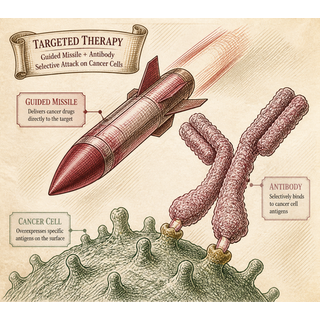
In this study, Montero and colleagues looked at CD98hc, a cell-surface protein involved in amino acid transport and signaling. In plain English, it helps cells import building materials and communicate growth-related messages. Cancer cells, being the needy overachievers they are, often crank up systems like this to support their bad life choices.
The team found that CD98hc levels were higher in ovarian tumor tissue than in normal ovary tissue. That alone does not make it a perfect target - lots of things look promising right up until reality hits them with a folding chair - but it is a solid start.
Then they checked whether an antibody against CD98hc could actually bind the protein on the cell surface and get pulled inside the cell into lysosomes. That matters because ADCs work best when the antibody docks, gets swallowed by the cancer cell, and then releases its toxic payload inside. Think less "throwing poison at the building" and more "Trojan horse with paperwork."
The payload matters more than the marketing
The researchers built several CD98hc-targeting ADCs using different payloads: DM1, MMAF, and DXd. Same delivery concept, different chemical warheads.
And here is where the story gets interesting. The anti-CD98hc-MMAF version came out looking strongest in ovarian cancer cell lines, with better cancer-killing activity than the other versions. That is a reminder that in ADC land, choosing the target is only half the game. The linker chemistry, the payload, the internalization behavior - all of that can turn a clever idea into either a therapy or a very expensive shrug.
The paper reports potent anti-tumor effects in preclinical ovarian cancer models, suggesting CD98hc might be a useful entry point for ADC treatment in this disease.
That does not mean we should start printing miracle headlines just yet. Mice are not tiny people in bad wigs, and cell lines have a long history of making researchers feel confident right before clinical trials teach humility. Still, the logic here is good: ovarian tumors appear to display the target, the antibody gets internalized, and at least one payload-antibody combo hits hard.
Why this is more than another shiny lab result
Ovarian cancer treatment has improved, but durable control remains difficult, especially after relapse. ADCs are attractive because they try to solve a very old oncology problem: how do you give a brutally effective drug without carpet-bombing the whole patient?
That question is not theoretical. ADCs have already changed treatment in several cancers, including breast and gynecologic malignancies. Mirvetuximab soravtansine, which targets folate receptor alpha in ovarian cancer, showed that a well-chosen surface target can become a real therapy, not just conference-slide wallpaper [1].
What makes CD98hc intriguing is that it taps into a different piece of tumor biology. Instead of targeting a marker famous mainly for being present, this approach goes after a protein linked to how cancer cells feed themselves and signal. That could matter if CD98hc expression proves common in ovarian tumors or relevant in cancers that resist other targeted options.
There is also a bigger idea hiding here: the next wave of ADCs may not come from finding completely new magic targets, but from matching the right target with the right payload and the right patient. Oncology, as usual, refuses to be simple.
The fine print nobody should skip
Before anyone starts acting like this paper personally cured ovarian cancer, a few caveats.
First, this is preclinical work. Useful, encouraging, necessary - but still preclinical. We do not yet know how much CD98hc is expressed across the messy diversity of real patient tumors, or whether normal tissues with CD98hc might create toxicity problems.
Second, ADCs can be deceptively complicated. A target can look tumor-specific enough until the drug starts hitting healthy cells that also express some of it. Even a good target can fail if the payload leaks, the linker misbehaves, or tumors adapt.
Third, ovarian cancer is not one uniform disease. It is more like several related disasters wearing the same name tag. Biomarker selection will matter.
Still, skepticism is not the same as dismissal. This study lays out a biologically plausible strategy and does the kind of mechanistic homework you want to see before anyone starts yelling "breakthrough" on social media with six rocket emojis.
The bigger takeaway
The fun part of modern cancer therapy is that it increasingly looks less like a sledgehammer and more like an attempted precision heist. This paper suggests CD98hc could be a new door into ovarian cancer cells, and that an MMAF-based ADC may be especially effective once inside.
If those findings hold up in broader models and eventually in human trials, the payoff could be real: another targeted option for a cancer that badly needs more of them.
And yes, that is still an "if." Oncology has a warehouse full of beautiful ifs. But this one is attached to a smart idea, a plausible mechanism, and data sturdy enough to deserve attention.
References
-
Moore KN, Oza AM, Colombo N, et al. Mirvetuximab soravtansine in FRalpha-positive, platinum-resistant ovarian cancer. N Engl J Med. 2023;389(23):2162-2174. doi:10.1056/NEJMoa2303280
-
Drago JZ, Modi S, Chandarlapaty S. Unlocking the potential of antibody-drug conjugates for cancer therapy. Nat Rev Clin Oncol. 2021;18(6):327-344. doi:10.1038/s41571-021-00470-8
-
Banerji U, Workman P. Critical parameters in the clinical success of antibody-drug conjugates. Lancet Oncol. 2023;24(1):e10-e22. doi:10.1016/S1470-2045(22)00665-6
-
Montero JC, Fraile Rivero V, Doyague MJ, Abad M, Pandiella A. Potent anti-tumor activity of CD98hc-targeted antibody-drug conjugates in ovarian cancer. Signal Transduct Target Ther. 2026. doi:10.1038/s41392-026-02747-9
Disclaimer: The image accompanying this article is for illustrative purposes only and does not depict actual experimental results, data, or biological mechanisms.